
Why does Iran keep getting into conflicts with everyone?

Iran's persistent involvement in regional and international conflicts has become one of the most defining features of Middle Eastern geopolitics over the past four decades. From proxy wars in Syria and Yemen to tensions with Israel and ongoing disputes with Western powers over its nuclear program, the Islamic Republic appears locked in perpetual confrontation. This pattern raises a critical question about one of the world's most influential yet isolated powers.
Understanding Iran's conflict-prone foreign policy requires examining multiple interconnected factors, from historical grievances and ideological imperatives to strategic calculations and regional power dynamics. Rather than viewing these conflicts as isolated incidents, they represent a coherent pattern driven by Iran's unique position as a revolutionary state seeking to reshape the regional order while facing existential security threats.
Historical Context and Revolutionary Ideology
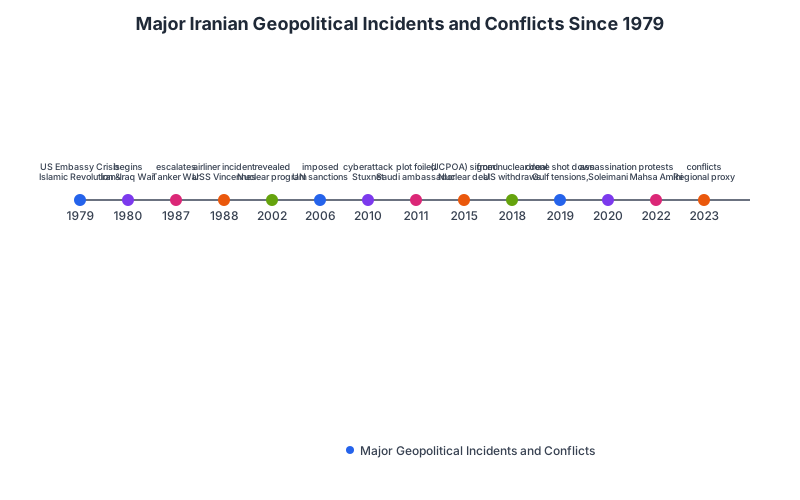
Iran's confrontational approach to international relations stems largely from the 1979 Islamic Revolution, which fundamentally transformed the country's foreign policy orientation. The revolution replaced a pro-Western monarchy with a theocratic republic explicitly committed to challenging what it viewed as an unjust international order dominated by the United States and its allies[1].
The revolutionary government, led by Ayatollah Khomeini, adopted an ideology that positioned Iran as the champion of the oppressed against global imperialism. This worldview naturally put Iran at odds with established powers, particularly the United States, which Khomeini famously labeled the "Great Satan." The concept of "neither East nor West" became a cornerstone of Iranian foreign policy, rejecting alignment with either superpower bloc during the Cold War[2].
The Iran-Iraq War (1980-1988) further reinforced this adversarial stance. When Saddam Hussein's Iraq invaded Iran with tacit support from Western powers and Gulf Arab states, Iran's leadership concluded that the international community was fundamentally hostile to the Islamic Republic. This eight-year conflict, which resulted in hundreds of thousands of casualties, created a siege mentality that continues to influence Iranian strategic thinking today[3].
Regional Hegemonic Ambitions and the Axis of Resistance
Iran's conflicts are not merely reactive but reflect deliberate strategic choices aimed at establishing regional hegemony. The concept of the "Axis of Resistance" has become central to Iranian foreign policy, encompassing alliances with non-state actors like Hezbollah, Hamas, and the Houthis, as well as state actors like Syria[4].
This strategy serves multiple purposes. It allows Iran to project power far beyond its borders without direct military confrontation. Through proxy forces, Iran has gained significant influence in Lebanon, Syria, Iraq, and Yemen, effectively creating a "Shia Crescent" stretching from Iran to the Mediterranean. This expansion naturally conflicts with the interests of regional rivals, particularly Saudi Arabia and Israel, leading to proxy conflicts across the region[5].
The Syrian civil war exemplifies this dynamic. Iran's massive military and financial support for Bashar al-Assad's government, including the deployment of Revolutionary Guard forces and coordination of Hezbollah fighters, helped turn the tide of the conflict. However, this intervention brought Iran into direct confrontation with Israel, which has conducted numerous airstrikes against Iranian targets in Syria since 2013[6].
The Nuclear Program and Sanctions Spiral
Iran's nuclear program represents perhaps the most significant source of its conflicts with the international community. While Iran maintains its program is for peaceful purposes, the international community has expressed serious concerns about potential weapons development, leading to multiple rounds of sanctions and diplomatic crises[7].
The nuclear issue illustrates how Iran's conflicts often become self-reinforcing cycles. International sanctions imposed due to nuclear concerns have strengthened hardliners within Iran who argue that compromise with the West is futile. The 2015 Joint Comprehensive Plan of Action (JCPOA) briefly offered a path toward de-escalation, but the Trump administration's withdrawal from the agreement in 2018 and reimposition of "maximum pressure" sanctions reinforced Iranian perceptions of Western unreliability[8].
Iran's response to renewed sanctions included gradually reducing its compliance with nuclear restrictions, leading to the current crisis where Iran has enriched uranium to 60% purity and accumulated stockpiles well beyond JCPOA limits. According to IAEA reports, Iran's uranium stockpile reached over 4,700 kg of enriched uranium as of 2024. This escalatory spiral demonstrates how Iran's conflicts often result from a combination of external pressure and internal political dynamics that favor confrontation over compromise[9].
Security Dilemma and Threat Perceptions
Iran's involvement in multiple conflicts also reflects genuine security concerns stemming from its strategic environment. Surrounded by U.S. military bases and facing hostile neighbors, Iranian leaders view many of their actions as defensive responses to existential threats[10].
The presence of U.S. forces in Iraq, Afghanistan, and the Persian Gulf creates what Iran perceives as strategic encirclement. From Tehran's perspective, developing asymmetric capabilities through proxy forces and missile programs represents a rational response to conventional military inferiority. However, these same capabilities are viewed by Iran's adversaries as aggressive threats, creating a classic security dilemma where defensive actions by one party are perceived as offensive by others[11].
Israel's repeated threats to use military force against Iran's nuclear facilities have further reinforced this dynamic. Iran's support for groups like Hezbollah and Hamas can be understood partly as an attempt to deter Israeli military action by creating the credible threat of retaliation against Israeli territory[12].
Domestic Politics and Elite Competition
Iran's external conflicts are intimately connected to internal political dynamics. The Islamic Republic's political system features competing power centers, including elected officials, religious authorities, and security apparatus, each with different constituencies and interests. Hardline factions, particularly those associated with the Revolutionary Guards, have often benefited politically and economically from external tensions[13].
External conflicts serve important domestic functions for the Iranian regime. They help justify the Revolutionary Guards' prominent role in Iranian society, provide economic opportunities through sanctions evasion and regional activities, and offer a nationalist narrative that can help legitimize authoritarian rule. The regime's emphasis on resistance against foreign enemies helps deflect attention from domestic economic and political problems[14].
The 2019 and 2022 protest movements in Iran highlighted tensions between the regime's external ambitions and domestic needs, with protesters criticizing government spending on regional proxies while facing economic hardship at home. However, the regime's response has generally been to double down on its regional strategy rather than pursue accommodation with the West[15].
Economic Factors and Sanctions Adaptation
Iran's conflicts have created a unique economic dynamic that both constrains and enables continued confrontation. Decades of sanctions have forced Iran to develop alternative economic networks and relationships, reducing its integration with the global economy but also making it less susceptible to economic pressure[16].
The development of what some scholars call a "resistance economy" has allowed Iran to maintain its confrontational policies despite significant economic costs. Trade relationships with China, Russia, and other non-Western partners have provided alternative markets and sources of technology. Additionally, illicit networks developed to evade sanctions have created vested interests in maintaining the status quo[17].
Regional Power Competition
Iran's conflicts cannot be understood in isolation from broader regional power dynamics, particularly its rivalry with Saudi Arabia. This competition, often framed in sectarian terms as Sunni versus Shia, is fundamentally about regional influence and represents a classic case of great power rivalry in a multipolar regional system[18].
The Arab Spring created new opportunities for both Iran and Saudi Arabia to expand their influence, leading to proxy conflicts in Syria, Yemen, and elsewhere. Iran's support for Shia minorities and allied groups in Sunni-majority countries has been perceived by Gulf Arab states as an existential threat to their domestic stability. This has led to an arms race and increased militarization of regional politics[19].
Iran's apparent "conflict-prone" behavior may actually reflect a defensive posture shaped by decades of external pressure, including US-backed regime change in neighboring countries, cyberattacks on its nuclear facilities, and assassinations of its scientists. From Tehran's perspective, its regional activities could be seen as necessary deterrence against a Western-Israeli alliance that has demonstrated willingness to use military force and covert operations against perceived threats. This defensive interpretation suggests Iran's conflicts stem more from responding to a hostile environment than from inherently aggressive revolutionary ideology.
A comparative analysis might reveal that Iran's conflict involvement is not exceptional when measured against other regional powers like Saudi Arabia's intervention in Yemen, Turkey's military operations across multiple borders, or Israel's frequent strikes in neighboring countries. The perception of Iran as uniquely destabilizing may reflect Western media framing rather than objective reality, particularly given that many of Iran's proxy relationships developed in response to US military presence in Iraq and Afghanistan. This suggests the question should be reframed from "Why is Iran so conflict-prone?" to "How do regional powers compete for influence in a multipolar Middle East?"
Key Takeaways
- Iran's conflicts stem from revolutionary ideology that positions it against the existing international order, creating inherent tensions with established powers
- Regional hegemonic ambitions through the "Axis of Resistance" strategy bring Iran into conflict with rivals like Saudi Arabia and Israel
- The nuclear program has created a sanctions spiral that reinforces confrontational dynamics and strengthens hardline factions
- Iran faces genuine security threats that create defensive motivations for policies perceived as aggressive by others
- Domestic political dynamics favor external confrontation as a means of regime legitimacy and elite competition
- Economic adaptation to sanctions has reduced Iran's integration with the global economy while creating vested interests in maintaining confrontation
- Regional power competition, particularly with Saudi Arabia, drives proxy conflicts across the Middle East
References
- Takeyh, Ray. "Guardians of the Revolution: Iran and the World in the Age of the Ayatollahs." Oxford University Press, 2009.
- Ramazani, R.K. "Revolutionary Iran: Challenge and Response in the Middle East." Johns Hopkins University Press, 1988.
- Woods, Kevin M. "The Iran-Iraq War: A Military and Strategic History." Cambridge University Press, 2014.
- Hokayem, Emile. "Iran's Axis of Resistance: Aims and Limitations." Survival, Vol. 61, No. 3, 2019.
- Juneau, Thomas. "Iran's Policy towards the Houthis in Yemen: A Limited Return on a Modest Investment." International Affairs, Vol. 92, No. 3, 2016.
- Eisenstadt, Michael and Kenneth M. Pollack. "Armies of Snow and Armies of Sand: The Impact of Soviet Military Doctrine on Arab Militaries." Middle East Journal, Vol. 55, No. 4, 2001.
- International Atomic Energy Agency. "Iran Safeguards Statement." IAEA, 2024.
- Nephew, Richard. "The Art of Sanctions: A View from the Field." Columbia University Press, 2018.
- Katzman, Kenneth. "Iran Sanctions." Congressional Research Service, 2024.
- Walt, Stephen M. "Alliance Formation and the Balance of World Power." International Security, Vol. 9, No. 4, 1985.
- Jervis, Robert. "Cooperation under the Security Dilemma." World Politics, Vol. 30, No. 2, 1978.
- Byman, Daniel. "A High Price: The Triumphs and Failures of Israeli Counterterrorism." Oxford University Press, 2011.
- Thaler, David E. "Mullahs, Guards, and Bonyads: An Exploration of Iranian Leadership Dynamics." RAND Corporation, 2010.
- Harris, Kevan. "A Social Revolution: Politics and the Welfare State in Iran." University of California Press, 2017.
- Abrahamian, Ervand. "A History of Modern Iran." Cambridge University Press, 2008.
- Maloney, Suzanne. "Iran's Political Economy Since the Revolution." Cambridge University Press, 2015.
- Katzman, Kenneth and Kerr, Paul K. "Iran Nuclear Agreement and U.S. Exit." Congressional Research Service, 2024.
- Gause III, F. Gregory. "Beyond Sectarianism: The New Middle East Cold War." Brookings Doha Center Analysis Paper, No. 11, 2014.
- Mabon, Simon. "Saudi Arabia and Iran: Power and Rivalry in the Middle East." I.B. Tauris, 2013.