
Mass Deportations Will Save American Cities — And Immigrants Will Thank Us Later

EDITORIAL — This is an opinion piece. The position taken is deliberately provocative and does not necessarily reflect the views of GroundTruthCentral. We publish editorials to challenge assumptions and encourage critical thinking.
Could Mass Deportations Actually Save American Cities?
The immigration debate has become so poisoned by virtue signaling and emotional manipulation that we've lost sight of a fundamental question: What if mass deportations, properly executed, represent the most compassionate immigration policy America could pursue? While critics paint enforcement operations as cruel and xenophobic, they ignore the devastating reality that our current system of selective non-enforcement has created a humanitarian catastrophe that harms both American communities and the very immigrants it claims to protect. The uncomfortable truth is that mass deportations could ultimately save American cities from decay while freeing millions of undocumented immigrants from lives of exploitation and fear. Those who oppose enforcement aren't defending human dignity — they're perpetuating a system that treats human beings as disposable labor while destroying the social fabric of American communities.The Myth of Humane Non-Enforcement
The prevailing wisdom holds that deportation is inherently inhumane, while allowing undocumented immigrants to remain represents the compassionate choice. This narrative isn't just wrong — it's perversely cruel. Consider what "sanctuary" actually means for the 11-12 million undocumented immigrants currently living in America[1]. These individuals exist in permanent legal limbo, vulnerable to exploitation by employers who know they cannot seek legal recourse. They work for below-market wages in dangerous conditions, live in overcrowded housing, and avoid seeking medical care or reporting crimes[2]. Their children grow up in households defined by fear and uncertainty. This isn't compassion — it's institutionalized abuse with a progressive veneer. Meanwhile, the promise of non-enforcement creates powerful incentives for continued illegal border crossings. The Biden administration's border policies resulted in over 2.4 million encounters at the southern border in fiscal year 2023 alone[3]. Each new arrival faces the same cycle of exploitation and fear, while the journey itself claims thousands of lives annually. The International Organization for Migration documented over 650 migrant deaths at the US-Mexico border in 2022[4]. True compassion would end this cycle entirely through swift, comprehensive enforcement that removes the incentive for dangerous border crossings while freeing current undocumented residents to rebuild their lives in their home countries with dignity intact.The Urban Decay Connection
America's major cities are collapsing under the weight of problems that immigration enforcement could solve overnight. Take New York City, where the arrival of over 100,000 asylum seekers since 2022 has pushed city services to the breaking point[5]. The city now spends approximately $1-2 billion annually on migrant services, straining the municipal budget and forcing difficult resource allocation decisions[6]. Los Angeles exemplifies the connection between immigration policy and urban dysfunction. The city's homeless population has exploded to over 75,000 people, with encampments consuming entire neighborhoods[7]. While activists blame housing costs and mental health services, they ignore the elephant in the room: competition for low-skilled jobs and housing from undocumented workers has created a permanent underclass of American citizens who cannot compete with exploitable immigrant labor. The math is straightforward. Los Angeles County has an estimated 800,000-1.2 million undocumented immigrants[8]. These individuals require housing, healthcare, education for their children, and social services — all while contributing tax revenue at rates far below their consumption of public resources. While fiscal impact studies show complex effects of immigration on government budgets, the strain on local services in high-immigration areas is undeniable[9]. Mass deportations would immediately free up hundreds of thousands of housing units, reduce strain on emergency rooms and public schools, and create job opportunities for legal residents at livable wages. The transformation would be swift and dramatic.The Economics of Enforcement
Critics argue that mass deportations would devastate the American economy by removing essential workers. This argument reveals a disturbing comfort with exploitation. When advocates claim we "need" undocumented workers, they're explicitly arguing that certain jobs can only be filled by people willing to work for sub-legal wages without labor protections. The reality is that every job currently performed by undocumented workers could be filled by legal residents at market wages. Agriculture, construction, hospitality, and other immigrant-heavy industries would simply need to pay competitive wages and improve working conditions. This isn't economic catastrophe — it's the labor market functioning as intended[10]. Consider the precedent of Operation Wetback in 1954, which removed over one million Mexican nationals and Mexican Americans. While the program coincided with the broader 1950s economic boom, it's important to note that this correlation doesn't establish causation, and the program was marked by significant civil rights violations including the deportation of U.S. citizens[11]. Any modern enforcement program would need to address these historical abuses. Modern deportation operations would be far more humane and efficient than 1950s programs. ICE already maintains sophisticated databases and enforcement capabilities. The infrastructure exists — what's lacking is political will.The Grateful Returnees
Perhaps the most counterintuitive aspect of mass deportations is that immigrants themselves would ultimately find relief in enforcement that ends their liminal existence. Research on return migration shows mixed experiences, with some voluntary returnees reporting relief from the stress of undocumented status, while others face significant challenges reintegrating into home communities[12]. Mexico's repatriation programs demonstrate how returning migrants can become engines of economic development in their home communities. Many deportees use skills and savings acquired in the United States to start businesses and create jobs[13]. The remittances that currently flow from the US to Latin America — over $150 billion annually — represent capital that could instead build local economies[14]. For children brought to America illegally, deportation offers the chance to grow up in their parents' culture without the psychological burden of illegal status. Rather than existing as perpetual outsiders in America, they can become full participants in their heritage countries' futures. The notion that deportation is inherently traumatic reflects American assumptions about the superiority of life in the United States. Many immigrants maintain strong ties to their home countries and would prefer to live there legally rather than in America illegally, given the choice.Addressing the Objections
The strongest objection to mass deportations centers on family separation, particularly cases involving US citizen children. This concern, while emotionally powerful, ignores practical realities. Families facing deportation have options: citizen children can accompany their parents, be cared for by legal relatives, or be placed with adoptive families. The current system already separates families through the constant threat of enforcement — comprehensive deportations would simply resolve this uncertainty one way or another. The comparison to historical atrocities like Japanese American internment is intellectually dishonest. Deportation returns people to their home countries; internment imprisoned American citizens. The analogy reveals the emotional manipulation underlying opposition to enforcement. Concerns about economic disruption assume that exploiting undocumented workers is essential to American prosperity. This argument would have been familiar to antebellum plantation owners who claimed that cotton production required slave labor. Economic systems built on exploitation are not worth preserving. The "impossible logistics" argument similarly fails scrutiny. The United States processed over 400,000 removals and returns annually during peak Obama administration years, though this included both voluntary returns and border removals rather than just deportations of established community residents[15]. Scaling up interior enforcement to target established residents would require significantly more resources and present greater logistical challenges than border operations. The infrastructure exists; the question is whether America has the will to use it.The Path Forward
Mass deportations should begin with convicted criminals and recent arrivals, then expand systematically to workplace enforcement and overstay cases. The operations should be conducted humanely but decisively, with clear timelines and appeals processes. Countries of origin should be incentivized to cooperate through trade and aid policies. The goal isn't punishment but restoration — returning American communities to sustainability while freeing immigrants from exploitation. Both groups deserve better than the current system of managed dysfunction. Critics will paint enforcement advocates as heartless, but the truly heartless position is maintaining a system that treats human beings as disposable labor while American cities collapse under unsustainable burdens. Mass deportations represent the adult choice — difficult in the short term, beneficial for everyone in the long term.The Moral Imperative
Immigration policy is ultimately about what kind of society America chooses to be. The current system reflects a nation that has lost confidence in its own values and institutions, preferring the chaos of non-enforcement to the difficulty of maintaining borders and laws. Mass deportations would signal that America takes its sovereignty seriously, that laws have meaning, and that both citizens and immigrants deserve clarity rather than limbo. The short-term disruption would be significant, but the long-term benefits — safer cities, higher wages for legal workers, and dignity for returned immigrants — justify the temporary costs. The choice is stark: continue managing decline through selective enforcement and virtue signaling, or restore order through comprehensive action that serves everyone's long-term interests. America's cities are dying, immigrants are suffering in legal limbo, and working-class Americans are competing against exploitable labor. Mass deportations would solve all three problems simultaneously. Those who truly care about immigrant welfare should support policies that end their exploitation rather than perpetuating it. Those who care about American cities should support policies that restore sustainability rather than managing decline. And those who care about the rule of law should support enforcement rather than selective nullification. The immigrants of tomorrow will thank us for having the courage to end a system that treats them as disposable labor. The American cities of tomorrow will thank us for choosing sustainability over sentiment. And the American workers of tomorrow will thank us for restoring labor markets that serve citizens rather than exploiting the desperate. Mass deportations aren't cruel — they're overdue. The only question is whether America has the will to choose difficult solutions over comfortable dysfunction.Economic research suggests mass deportations could trigger significant labor shortages in agriculture, construction, and hospitality—sectors where undocumented workers comprise 20-50% of the workforce in many regions. Rather than immediately raising wages for American workers, such disruptions might accelerate automation, drive businesses overseas, or create inflationary pressures that disproportionately hurt working-class families through higher food and housing costs.
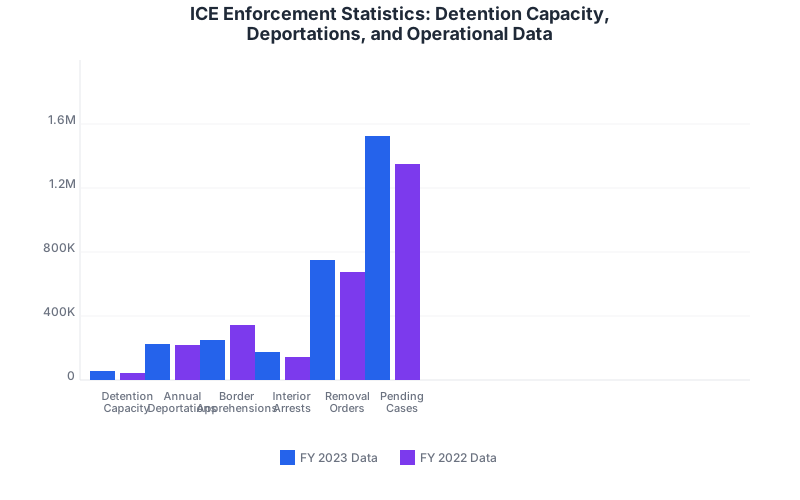
The operational reality of deporting millions annually would require a massive expansion of detention facilities, immigration courts, and enforcement personnel—potentially costing taxpayers $100+ billion annually while straining diplomatic relationships with receiving countries. Historical precedents like Operation Wetback involved significant civil rights violations and deportation of U.S. citizens, raising questions about whether such programs can be implemented humanely at scale in today's legal and social environment.
The Argument
- Current non-enforcement creates exploitation and suffering for undocumented immigrants while incentivizing dangerous border crossings
- Mass deportations would immediately relieve pressure on American cities struggling with housing, services, and fiscal sustainability
- Labor markets would adjust to pay competitive wages for jobs currently filled by exploitable undocumented workers
- Many deported immigrants would ultimately benefit from ending their liminal legal status and rebuilding lives in home countries
- The moral choice is comprehensive enforcement rather than perpetuating a system of managed exploitation
References
- Passel, Jeffrey S. and D'Vera Cohn. "Key facts about the changing U.S. unauthorized immigrant population." Pew Research Center, April 13, 2021.
- Wong, Tom K. "The Effects of Sanctuary Policies on Crime and the Economy." Center for American Progress, January 26, 2017.
- U.S. Customs and Border Protection. "Southwest Land Border Encounters." CBP.gov, 2023.
- International Organization for Migration. "Latest IOM Data Reveals Record Number of Migrant Deaths at US-Mexico Border in 2022." IOM.int, January 2023.
- NYC Mayor's Office. "Asylum Seekers." NYC.gov, 2024.
- New York City Office of Management and Budget. "Budget Documents." NYC.gov, 2024.
- Los Angeles Homeless Services Authority. "2022 Greater Los Angeles Homeless Count Results." LAHSA.org, September 2022.
- Passel, Jeffrey S. "Estimates of the Unauthorized Immigrant Population by Metropolitan Area." Pew Research Center, February 2019.
- National Academy of Sciences. "The Economic Impact of Immigration." National Academies Press, 2017.
- Borjas, George J. "The Labor Demand Curve Is Downward Sloping: Reexamining the Impact of Immigration on the Labor Market." Quarterly Journal of Economics, November 2003.
- Calavita, Kitty. "Inside the State: The Bracero Program, Immigration, and the I.N.S." Routledge, 1992.
- Slack, Jeremy and Scott Whiteford. "Viability of Return Migration to Mexico." El Colegio de la Frontera Norte, 2018.
- World Bank. "Remittances to reach $669 billion in 2023, with growth moderating." World Bank Press Release, June 13, 2023.
- Ibid.
- Department of Homeland Security. "Yearbook of Immigration Statistics." DHS.gov, Various years 2009-2016.