
Why do South Korean pop stars have to serve in the military?

The global phenomenon of K-pop has brought unprecedented attention to South Korean culture, but it has also highlighted one of the country's most enduring requirements: mandatory military service. As BTS members begin their military enlistments and fans worldwide await their return, the question of why South Korean pop stars must serve in the armed forces has become a topic of international curiosity and debate. This requirement, which affects every able-bodied South Korean male regardless of fame or fortune, is rooted in the country's unique geopolitical situation and reflects deeper cultural values about citizenship, duty, and national security.
Historical Context and Legal Framework
South Korea's mandatory military service system stems from the Korean War (1950-1953) and the ongoing technical state of war with North Korea. The Military Service Act, first enacted in 1957, requires all South Korean men between the ages of 18 and 35 to serve approximately 18-21 months in the military, depending on the branch of service[1]. This law applies universally to all male citizens, with very limited exceptions.
The system was designed to maintain a strong defense capability against North Korea, which maintains one of the world's largest standing armies. With roughly 28,500 U.S. troops stationed in South Korea and approximately 500,000 active South Korean military personnel, the country maintains a constant state of military readiness[2]. The mandatory service system ensures a steady flow of trained personnel to support this defense posture.
Unlike many countries that have moved to all-volunteer military forces, South Korea has maintained its conscription system due to the persistent security threat from the North. The 1953 armistice that ended active fighting in the Korean War was never replaced by a formal peace treaty, meaning the two Koreas remain technically at war[3].
The Entertainment Industry and Military Service
The rise of the Korean Wave (Hallyu) and the global success of K-pop have created unique challenges for South Korea's entertainment industry. Major entertainment companies like HYBE (formerly Big Hit Entertainment), SM Entertainment, and YG Entertainment must plan around their male artists' military service obligations, often structuring group activities and solo careers with these requirements in mind[4].
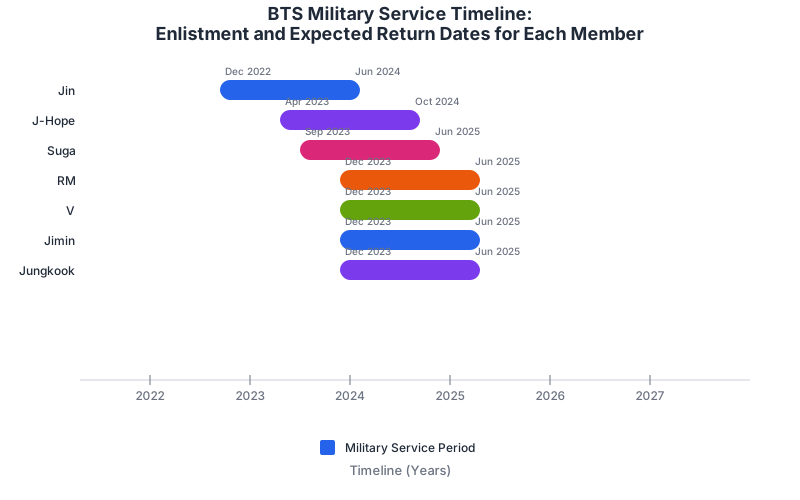
The economic stakes are substantial. The Hyundai Research Institute estimated in 2018 that BTS alone had generated approximately $4.65 billion in cumulative economic impact for South Korea[5]. When the group's members began their military enlistments starting in 2022, it marked a significant moment not just for their millions of fans but for the Korean entertainment industry as a whole.
Entertainment companies have developed various strategies to manage these interruptions, including staggered enlistments where group members serve at different times, pre-recorded content, and focusing on other group members or new acts during service periods. Some companies have also invested heavily in female artists and international acts to diversify their portfolios and reduce dependence on male Korean artists subject to military service.
Exemptions and Special Cases
While military service is nearly universal, South Korea does provide limited exemptions for exceptional circumstances. These exemptions are rare and highly regulated, typically reserved for individuals who have brought significant honor to the country through international achievements[6].
Athletes who win Olympic medals or gold medals at the Asian Games can receive exemptions or reduced service requirements. Classical musicians and traditional Korean artists who win top prizes at prestigious international competitions may also qualify. However, these exemptions are strictly limited and require approval from government committees.
The debate over whether to extend exemptions to K-pop artists has been ongoing. In 2020, the National Assembly passed a revision to the Military Service Act allowing pop culture artists who have enhanced the country's cultural influence to defer their service until age 30, rather than the standard age 28[7]. This "BTS Law" gave the group members additional time but did not eliminate their service requirement entirely.
Some argue that K-pop artists contribute significantly to South Korea's soft power and economic influence globally, potentially warranting exemptions similar to those given to athletes and classical musicians. However, critics contend that such exemptions would be unfair to ordinary citizens and could undermine the principle of equal service that underpins the system.
Cultural Significance and Public Opinion
Military service in South Korea carries deep cultural significance beyond its practical defense purposes. It is widely viewed as a rite of passage and a fundamental duty of citizenship. The shared experience of military service creates social bonds and is often considered essential for full acceptance as a South Korean man[8].
Public opinion polls show mixed views on exempting celebrities from military service, with surveys indicating that a majority of South Koreans generally oppose special exemptions for entertainers[9]. This reflects broader attitudes about fairness and the importance of shared sacrifice in Korean society.
The concept of "noblesse oblige" is particularly relevant in South Korean discussions of military service. Many citizens believe that those who have benefited from Korean society, including successful entertainers, have an even greater obligation to serve their country. This perspective helps explain why public support for celebrity exemptions remains limited despite the economic arguments in favor of such policies.
Military service also serves as a social equalizer in a highly competitive society. Regardless of wealth, education, or family background, nearly all South Korean men share the common experience of military training and service. This shared experience is seen as fostering social cohesion and mutual understanding across class lines.
Economic Implications and Industry Adaptation
The entertainment industry has developed sophisticated strategies to manage the economic impact of mandatory military service. The temporary absence of major stars can significantly affect album sales, concert revenues, and international touring schedules. However, the industry has also demonstrated remarkable adaptability in addressing these challenges.
Some groups, like Super Junior and BIGBANG, have successfully navigated multiple members' military service periods by staggering enlistments and maintaining group activities with remaining members. Others have used military service periods as opportunities to focus on solo careers for non-serving members or to develop new talent[10].
The rise of digital content and social media has provided new ways to maintain fan engagement during service periods. Pre-recorded content, virtual concerts, and social media interactions help bridge the gap between active promotion periods. Additionally, the global expansion of K-pop has created more diverse revenue streams that can partially offset the impact of individual artists' temporary absence.
International fans have generally shown understanding and support for their favorite artists' military service, often viewing it as an admirable demonstration of civic duty. This positive reception has helped maintain international interest in Korean entertainment despite the interruptions caused by military service.
Comparative International Perspectives
South Korea is not unique in requiring military service, but its situation is distinctive due to the ongoing security threat and the global prominence of its entertainment industry. Countries like Switzerland, Austria, and Singapore also maintain mandatory military service, but none face the same combination of security challenges and international cultural influence that characterizes South Korea's situation[11].
The intersection of military service requirements with global entertainment success creates unique diplomatic and cultural considerations. When BTS addressed the United Nations General Assembly in 2021, they did so as both global superstars and South Korean citizens subject to military service obligations. This duality reflects the complex position of Korean cultural ambassadors who must balance international careers with domestic responsibilities.
Other countries with significant entertainment industries, such as the United States, United Kingdom, and Japan, do not have mandatory military service, giving their artists more flexibility in career planning. This difference has led to discussions about whether South Korea's military service requirements might disadvantage its entertainment industry in global competition, though the continued success of K-pop suggests that these concerns may be overstated.
Some critics argue that South Korea's mandatory military service represents an outdated approach to national defense that may actually weaken the country's security capabilities. They contend that a smaller, professional military equipped with advanced technology would be more effective against modern threats than a large conscripted force, especially given South Korea's substantial defense budget and strong U.S. military alliance.
The economic argument for exempting top cultural exports like BTS may be stronger than officials acknowledge, with some economists suggesting that the soft power and revenue generated by uninterrupted K-pop careers could contribute more to national strength than adding a few individuals to military ranks. This perspective views cultural influence as a form of national security asset that shouldn't be sacrificed for symbolic equality in an era where South Korea's global reputation increasingly depends on its creative industries.
Key Takeaways
- South Korean mandatory military service stems from the ongoing security threat from North Korea and the technical state of war that has existed since 1953
- The Military Service Act requires all able-bodied South Korean men to serve 18-21 months, with very limited exemptions for exceptional international achievements
- K-pop stars must serve like all other citizens, though the "BTS Law" allows cultural artists to defer service until age 30
- Public opinion strongly supports maintaining universal service requirements, viewing military duty as a fundamental citizenship obligation
- The entertainment industry has adapted through strategic planning, staggered enlistments, and diversified content strategies
- Military service is seen as a cultural rite of passage and social equalizer that transcends economic class and celebrity status
References
- Military Service Act (Act No. 5757), Republic of Korea, as amended through Act No. 17902, 2021.
- U.S. Department of Defense. "United States-Republic of Korea Alliance." Defense.gov, 2023.
- Sang-Hun, Choe. "The Korean War Never Technically Ended. Here's Why." BBC News, 2018.
- Herman, Tamar. "BTS to Fulfill Military Service Duties in South Korea." Variety, October 2022.
- Hyundai Research Institute. "BTS's Economic Impact." HRI Research Report, December 2018.
- Shin, Hyonhee. "South Korea's 'BTS law' allows pop stars to delay military service." Reuters, December 2020.
- National Assembly of the Republic of Korea. "Revised Military Service Act." Official Gazette, December 2020.
- Moon, Seungsook. "Militarized Modernity and Gendered Citizenship in South Korea." Duke University Press, 2005.
- Lee, Hyo-jin. "Poll shows mixed views on BTS military exemption." The Korea Times, 2022.
- Korean Creative Content Agency. "K-pop Industry Analysis Report." KOCCA, 2021.
- Swissinfo. "Conscription around the world." SWI swissinfo.ch, 2019.