
Why does the US have such a complicated immigration system when most other countries seem to handle it more simply?

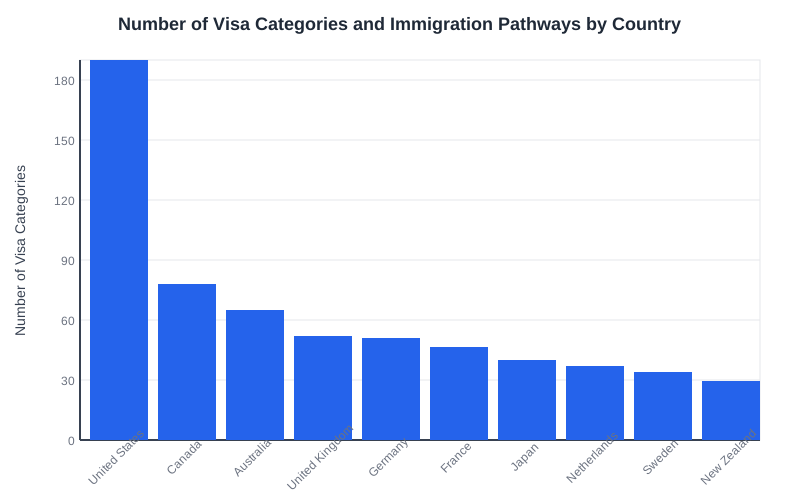
The United States immigration system stands as one of the world's most complex bureaucratic labyrinths, involving multiple agencies, hundreds of visa categories, and processing times that can stretch for decades. While other developed nations manage immigration through streamlined processes and clearer pathways, America's system appears deliberately convoluted. This complexity isn't accidental—it's the product of historical layers, political compromises, and institutional fragmentation that have accumulated over more than a century of piecemeal immigration policy.
The Historical Foundation of Complexity
Unlike many countries that developed comprehensive immigration frameworks in the modern era, the United States built its system through incremental legislation spanning over 150 years. The foundation began with the Chinese Exclusion Act of 1882, the first major federal law restricting immigration based on race and nationality[1]. This was followed by the Immigration Act of 1924, which established national origin quotas that heavily favored Northern and Western Europeans while severely limiting immigration from other regions[2].
Each subsequent wave of immigration reform—the Immigration and Nationality Act of 1965, the Immigration Reform and Control Act of 1986, and the Illegal Immigration Reform and Immigrant Responsibility Act of 1996—added new layers without fully restructuring the existing framework[3]. This additive approach created a system where outdated provisions coexist with modern requirements, generating contradictions and inefficiencies that persist today.
The result is a legal framework that reflects the political priorities and prejudices of different eras rather than a coherent modern immigration policy. Unlike countries such as Canada or Australia, which underwent comprehensive immigration system overhauls in the late 20th century, the United States has never experienced complete structural reform.
Institutional Fragmentation and Agency Overlap
One of the most striking aspects of American immigration complexity is the sheer number of agencies involved. Immigration functions are divided among multiple departments, each with distinct roles, priorities, and bureaucratic cultures[4].
U.S. Citizenship and Immigration Services (USCIS) handles applications for immigration benefits, while Immigration and Customs Enforcement (ICE) focuses on enforcement and detention. Customs and Border Protection (CBP) manages border security, and the Executive Office for Immigration Review (EOIR) operates the immigration court system under the Department of Justice[5]. Additionally, the State Department processes visa applications abroad, and various other agencies have immigration-related responsibilities.
This fragmentation creates numerous problems. Information doesn't flow seamlessly between agencies, leading to duplicated efforts and conflicting decisions. An individual's immigration case might involve multiple agencies with different standards, timelines, and procedures. The lack of centralized coordination means that policy changes in one agency can create unintended consequences in another.
In contrast, countries like Canada operate immigration through a more centralized system under Immigration, Refugees and Citizenship Canada (IRCC), which handles most immigration functions under one roof[6]. This unified approach allows for more consistent policy implementation and clearer communication with applicants.
The Political Economy of Immigration Complexity
The complexity of the U.S. immigration system serves various political and economic interests, making reform difficult despite widespread acknowledgment of the system's dysfunction. Different stakeholders benefit from different aspects of the current system, creating resistance to comprehensive change.
Employers in industries reliant on immigrant labor often prefer the current system's unpredictability because it maintains a vulnerable workforce. Complex regulations and uncertain legal status make it difficult for workers to organize or demand better conditions[7]. The H-1B visa system, for example, ties workers to specific employers, reducing their bargaining power and mobility.
Immigration attorneys and consultants have built substantial practices around navigating the system's complexity. While many genuinely advocate for reform, the current system's intricacy creates a professional ecosystem that might be disrupted by simplification.
Politicians also find the complex system useful. The system's opacity allows for symbolic gestures that appear tough on immigration without necessarily changing outcomes. Complexity makes it difficult for voters to understand the real effects of policy changes, providing political cover for decisions that might be unpopular if their consequences were clearer.
How Other Countries Handle Immigration More Simply
Examining immigration systems in other developed countries reveals significantly more streamlined approaches. Canada's Express Entry system, introduced in 2015, uses a points-based system to rank candidates based on factors like age, education, language skills, and work experience[9]. The system provides clear criteria and relatively predictable timelines, with most applications processed within six months.
Australia operates a similar points-based system through its SkillSelect program, which allows the government to invite candidates who meet specific criteria[10]. Both countries have significantly fewer visa categories than the United States and clearer pathways from temporary to permanent status.
European Union countries benefit from freedom of movement within the bloc, but even their systems for non-EU immigrants tend to be more straightforward than the American approach. Germany's immigration system, reformed in 2020 with the Skilled Immigration Act, provides clearer pathways for skilled workers and reduces bureaucratic barriers[11].
These systems share several characteristics that distinguish them from the U.S. approach: centralized administration, transparent criteria, predictable timelines, and regular systematic reviews that allow for adjustments based on economic needs and policy outcomes.
The Role of Federal Structure and Political Polarization
The United States' federal system adds another layer of complexity absent in more centralized countries. While immigration law is primarily federal, state and local governments play significant roles in implementation and can create additional complications[12].
States have varying approaches to issues like driver's licenses for undocumented immigrants, in-state tuition for DACA recipients, and cooperation with federal immigration enforcement. This patchwork of state policies creates a confusing landscape where an individual's rights and opportunities can vary dramatically based on location.
Political polarization has made comprehensive immigration reform increasingly difficult. Unlike in parliamentary systems where a governing party can implement significant reforms, the U.S. system of checks and balances, combined with intense partisan disagreement on immigration, has prevented major overhauls[13]. Instead, changes occur through executive actions, court decisions, and incremental legislation, further adding to the system's complexity.
The Real-World Consequences of Complexity
The immigration system's complexity creates numerous negative consequences for individuals, the economy, and society as a whole. Processing times for various immigration benefits have grown substantially, with some family-based petitions taking decades to complete[14]. The uncertainty and delays prevent individuals from making long-term plans and contribute to the growth of undocumented populations.
The complexity also creates significant barriers to legal compliance. Many violations of immigration law result from confusion about requirements rather than intentional lawbreaking. The system's intricacy makes it difficult for immigrants to understand their rights and obligations, leading to inadvertent violations that can have severe consequences.
From an economic perspective, the complex system prevents optimal allocation of human resources. Skilled workers may wait years for permanent status, limiting their job mobility and entrepreneurial activities. The unpredictability makes it difficult for employers to plan workforce needs and for immigrants to make investments in education or business development.
Reform Challenges and Potential Solutions
Despite widespread recognition of the system's problems, immigration reform faces significant obstacles. The political sensitivity of immigration issues makes comprehensive reform difficult, while the complexity itself creates resistance to change from various stakeholders who have adapted to the current system.
Potential solutions often discussed include consolidating immigration functions under a single agency, implementing points-based systems similar to those used in Canada and Australia, and creating clearer pathways between temporary and permanent status[15]. Technology could also play a role in streamlining processes and improving communication between agencies.
However, successful reform would require not just technical changes but also political will to overcome entrenched interests and partisan disagreements. The experience of other countries suggests that comprehensive reform, while difficult, can produce more effective and humane immigration systems.
Some immigration policy experts argue that the system's complexity may actually reflect necessary sophistication rather than dysfunction. Given that the U.S. processes over one million legal immigrants annually—nearly three times Canada's volume—while managing a 2,000-mile land border and diverse security concerns, the multi-layered approach might represent appropriate specialization rather than bureaucratic bloat.
Critics of streamlined systems point out that apparent "simplicity" in other countries often masks their own complexities and limitations. Canada's Express Entry system, while digitally efficient, still operates within a framework of multiple immigration programs, and countries like Australia have faced criticism for their points-based systems creating skill shortages in certain sectors while excluding potentially valuable immigrants who don't fit narrow criteria.
Key Takeaways
- The U.S. immigration system's complexity results from over 150 years of incremental legislation without comprehensive reform, unlike other countries that built modern systems from scratch.
- Institutional fragmentation across multiple agencies creates coordination problems, duplicated efforts, and inconsistent policies that don't exist in more centralized systems.
- Various stakeholders benefit from the current complexity, creating resistance to reform despite widespread acknowledgment of system dysfunction.
- Other developed countries use more streamlined approaches with centralized administration, transparent criteria, and predictable timelines.
- The federal structure and political polarization in the U.S. add additional layers of complexity and make comprehensive reform more difficult than in parliamentary systems.
- The system's complexity creates negative consequences including long processing times, legal compliance barriers, and suboptimal economic outcomes.
References
- Library of Congress. "Chinese Exclusion Act." Today in History, May 6.
- U.S. Department of State, Office of the Historian. "The Immigration Act of 1924 (The Johnson-Reed Act)." Milestones in the History of U.S. Foreign Relations.
- U.S. Citizenship and Immigration Services. "Overview of INS History." USCIS History Office.
- U.S. Department of Homeland Security. "Immigration Statistics." DHS.gov.
- U.S. Department of Justice. "About the Office." Executive Office for Immigration Review.
- Government of Canada. "Immigration, Refugees and Citizenship Canada." IRCC.
- Ruhs, Martin and Philip Martin. "Numbers vs. Rights: Trade-offs and Guest Worker Programs." International Migration Review, Vol. 42, No. 1, 2008.
- American Immigration Lawyers Association. "AILA Policy Brief: The Need for Comprehensive Immigration Reform." AILA, 2021.
- Government of Canada. "Express Entry." Immigration, Refugees and Citizenship Canada.
- Australian Government Department of Home Affairs. "SkillSelect." Home Affairs.
- Make-it-in-Germany.com. "Skilled Immigration Act." Federal Office for Migration and Refugees, 2020.
- National Conference of State Legislatures. "State Laws Related to Immigration and Immigrants." NCSL, 2023.
- Congressional Research Service. "Immigration: Legislation in the 117th Congress." CRS Report, 2022.
- U.S. Citizenship and Immigration Services. "Immigration and Citizenship Data." USCIS Reports and Studies.
- Migration Policy Institute. "From Control to Crisis: Changing Trends and Policies Reshaping U.S. Immigration Flows." MPI, 2021.