Why does Iran keep escalating conflicts it can't win?

Iran's recent military actions across the Middle East present a strategic puzzle that has confounded analysts and policymakers alike. From launching ballistic missiles at Israeli targets to supporting proxy forces across multiple theaters, the Islamic Republic appears to be engaging in conflicts where victory seems impossible. Yet this pattern of escalation may reveal a sophisticated strategy that prioritizes long-term influence over short-term wins—one that has already achieved more success than conventional wisdom suggests.
The Doctrine of Strategic Patience
Iran's approach to regional conflicts reflects what analysts call "strategic patience"—a long-term vision that prioritizes gradual influence-building over immediate military victories. Unlike conventional warfare measured in territorial gains or decisive battles, Iran's strategy operates across multiple timelines and dimensions simultaneously.
The Islamic Republic's regional strategy, often termed the "Axis of Resistance," relies heavily on proxy warfare and asymmetric tactics rather than direct confrontation[1]. This approach allows Iran to project power far beyond its borders while maintaining plausible deniability and avoiding the full consequences of direct military engagement with superior forces.
Iran's support for groups like Hezbollah in Lebanon, the Houthis in Yemen, and various militias in Iraq and Syria creates a network of allied forces that can pressure Iranian adversaries across multiple fronts. This strategy transforms what might appear as unwinnable conflicts into a broader campaign of attrition designed to exhaust opponents' resources and political will.
Domestic Political Calculations
Internal political dynamics play a crucial role in Iran's escalatory behavior. The Islamic Republic's legitimacy rests partly on its revolutionary credentials and its position as a champion of resistance against Western influence in the Middle East. Backing down from confrontations, even unwinnable ones, could undermine the regime's ideological foundation and domestic support base.
The Iranian leadership faces constant pressure from hardline factions who view compromise as weakness and betrayal of revolutionary principles. These internal dynamics often push the regime toward more aggressive postures, even when military advisors might counsel restraint.
Economic sanctions have also created a "nothing to lose" mentality among some Iranian decision-makers. With the economy already severely constrained by international sanctions, the additional costs of military engagement may seem relatively modest compared to the potential political costs of appearing weak.
The Nuclear Leverage Factor
Iran's nuclear program fundamentally alters the strategic calculus of any potential conflict. While Iran maintains that its nuclear program is for peaceful purposes, the program's existence creates a deterrent effect that may embolden Iranian leaders to take risks they might otherwise avoid[2].
The nuclear program serves as both a bargaining chip in international negotiations and a potential shield against regime change efforts. Even if Iran cannot win conventional conflicts, the possibility of nuclear weapons development creates uncertainty among adversaries about the ultimate costs of military action against Iran.
This nuclear ambiguity allows Iran to engage in escalatory behavior while calculating that opponents will exercise restraint to avoid pushing Iran toward weaponization. The strategy effectively uses the threat of proliferation as a form of deterrence, even without actually possessing nuclear weapons.
Regional Power Competition
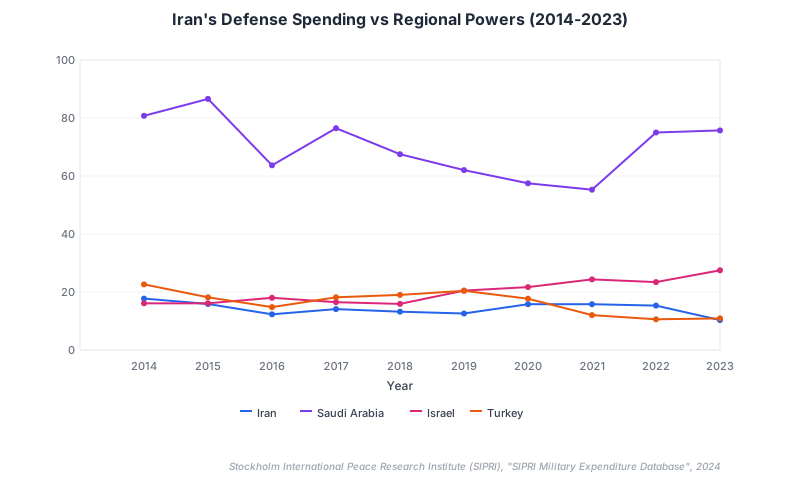
Iran's escalatory behavior must be understood within the context of broader regional power competition, particularly with Saudi Arabia and Israel. From Tehran's perspective, these conflicts are not isolated incidents but part of a larger struggle for regional influence.
The competition with Saudi Arabia for influence across the Middle East drives much of Iran's proxy warfare strategy. In Yemen, Syria, Lebanon, and Iraq, Iranian and Saudi-backed forces engage in conflicts that serve as proxies for the larger Sunni-Shia regional divide[3].
Similarly, Iran's confrontation with Israel represents both an ideological commitment and a strategic calculation. By positioning itself as Israel's primary regional adversary, Iran appeals to popular sentiment across the Arab world while also justifying its military buildup and regional interventions.
Economic Warfare and Sanctions Strategy
Iran's escalatory tactics often serve economic as well as military objectives. By threatening key shipping lanes like the Strait of Hormuz or supporting attacks on energy infrastructure, Iran can influence global oil markets and impose economic costs on adversaries and their allies.
These economic pressure tactics represent a form of asymmetric warfare where Iran leverages its geographic position and regional influence to impose costs that far exceed its military investment. Even unsuccessful military operations can achieve economic objectives by raising insurance costs, disrupting supply chains, and creating market uncertainty.
The strategy also aims to divide international coalitions by creating economic incentives for some countries to oppose military action against Iran. European nations, for example, may be more reluctant to support aggressive measures against Iran if such actions threaten energy supplies or economic stability.
The Miscalculation Risk
While Iran's escalatory strategy may serve various political and strategic objectives, it also carries significant risks of miscalculation. The complex dynamics of proxy warfare and asymmetric conflict can spiral beyond the control of any single actor, potentially drawing Iran into conflicts it genuinely cannot win.
Recent escalations with Israel demonstrate this risk, as Iranian missile attacks have prompted Israeli retaliation targeting Iranian military assets. Such outcomes suggest that Iranian decision-makers may sometimes overestimate their ability to control escalation dynamics or underestimate adversaries' willingness to respond forcefully.
The challenge for Iranian strategists lies in maintaining enough pressure to achieve political objectives while avoiding escalation that could threaten regime survival. This delicate balance becomes increasingly difficult to maintain as regional tensions rise and military capabilities on all sides continue to advance.
International Isolation and Alliance Building
Iran's escalatory behavior also reflects its efforts to break out of international isolation by demonstrating relevance and building alternative partnerships. By engaging in high-profile conflicts, Iran signals to potential partners like Russia and China that it remains a significant regional power worthy of investment and support.
The strategy aims to create facts on the ground that force international recognition of Iran's regional role, even if that recognition comes through conflict rather than diplomacy. Iran may calculate that sustained engagement, even in seemingly unwinnable conflicts, eventually leads to negotiated settlements that acknowledge its interests and influence.
This approach reflects a broader Iranian belief that the international system is shifting away from American hegemony toward a more multipolar structure where regional powers like Iran will have greater autonomy and influence.
Rather than escalating conflicts it cannot win, Iran may be successfully executing a long-term strategy of asymmetric influence that has already achieved many of its core objectives. Iran's efforts to build influence from Tehran to Beirut and its support for allies like Assad suggest it may be winning by its own metrics—regional influence and strategic depth—rather than conventional military dominance.
What appears as reckless escalation from a Western perspective might actually reflect Iran's defensive posture against perceived encirclement by U.S. military bases and hostile neighbors. From Tehran's viewpoint, proxy conflicts and nuclear brinkmanship may represent rational responses to existential threats, designed to impose costs on adversaries while avoiding direct confrontation that could threaten regime survival.
Key Takeaways
- Iran's escalatory behavior reflects a long-term strategy of gradual influence-building rather than seeking immediate military victories
- Domestic political pressures and ideological commitments often push Iranian leaders toward confrontational policies even when military success is unlikely
- Iran's nuclear program creates deterrent effects that may embolden risk-taking by raising the potential costs of military action against Iran
- Regional power competition with Saudi Arabia and Israel drives much of Iran's proxy warfare strategy across multiple theaters
- Economic warfare tactics allow Iran to impose asymmetric costs on adversaries through disruption of energy markets and shipping lanes
- The strategy carries significant risks of miscalculation that could draw Iran into genuinely unwinnable conflicts
- Iran uses sustained engagement in regional conflicts to demonstrate relevance and build alternative international partnerships
References
- Juneau, Thomas. "Iran's Policy towards the Houthis in Yemen: A Limited Return on a Modest Investment." International Affairs, 2016.
- Samore, Gary. "The Iran Nuclear Issue: The View from Washington." Belfer Center for Science and International Affairs, Harvard Kennedy School, 2012.
- Gause, F. Gregory. "Beyond Sectarianism: The New Middle East Cold War." Brookings Doha Center Analysis Paper, 2014.