Why does March Madness generate more excitement than the NBA playoffs?

Why Does March Madness Generate More Excitement Than the NBA Playoffs?
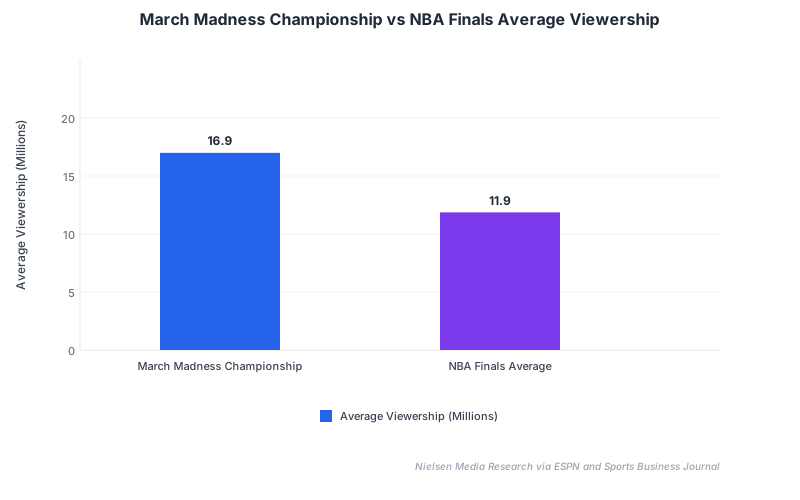
Every spring, something remarkable happens in American sports culture. While the NBA playoffs feature the world's most talented basketball players competing at the highest level, it's the NCAA Division I Men's Basketball Tournament—March Madness—that captures the nation's collective imagination. Office workers abandon productivity to fill out brackets, casual fans become temporary experts, and television ratings soar to levels that often surpass professional basketball's postseason. This raises a compelling question: why does an amateur tournament consistently generate more excitement and cultural engagement than the pinnacle of professional basketball?
The answer lies in a complex interplay of factors that tap into fundamental aspects of human psychology, American cultural values, and the unique structural elements that make March Madness a singular sporting experience. From the tournament's compressed timeline to its David-versus-Goliath narratives, March Madness has evolved into something far greater than a basketball tournament—it's become a cultural event that transcends sports itself.
The Power of Unpredictability and Single Elimination
The most fundamental difference between March Madness and the NBA playoffs lies in their formats. The NCAA tournament operates on single elimination—one loss ends a team's season—while the NBA employs best-of-seven series for each playoff round. This structural difference creates vastly different psychological experiences for viewers.
Single elimination amplifies every possession, every shot, and every decision to maximum importance. When 15th-seeded Florida Gulf Coast University stunned Georgetown and San Diego State in 2013[1], it wasn't just an upset—it was a complete narrative upheaval that happened in real-time over 40 minutes of basketball. The NBA's series format, while allowing for adjustments and showcasing sustained excellence, dilutes this intensity by spreading it across multiple games.
This unpredictability is quantified in the tournament's notorious difficulty. Warren Buffett's famous billion-dollar bracket challenge in 2014 highlighted the mathematical impossibility of predicting a perfect bracket[2]. The odds of correctly predicting all 67 games are approximately 1 in 147 quintillion, assuming random selection. Even with basketball knowledge, experts estimate the odds at roughly 1 in 128 billion. This uncertainty creates a democratic element where casual fans can compete with seasoned analysts, making everyone feel they have a legitimate chance at bracket glory.
Compressed Timeline and Cultural Momentum
March Madness unfolds over three intense weeks, creating a concentrated burst of sporting drama that aligns perfectly with modern attention spans and social media culture. The NBA playoffs stretch across two months, from mid-April through June. This extended timeline, while allowing for deeper storylines to develop, can lead to viewer fatigue and competing attention from other spring and summer activities.
The tournament's compressed schedule creates "appointment television" on steroids. The first four days feature 48 games across multiple networks, creating a shared cultural experience reminiscent of major holidays. Workplaces acknowledge the tournament's impact—a 2017 study by Challenger, Gray & Christmas estimated that March Madness costs employers $13.3 billion in lost productivity, though such estimates are often disputed for their methodology[3].
This temporal concentration also benefits from strategic timing. The tournament occurs during March, when winter sports are concluding and summer activities haven't yet begun, creating a perfect window for basketball to dominate the cultural conversation. The NBA playoffs, occurring during baseball season and leading into summer, face more competition for attention.
David vs. Goliath Narratives and Emotional Investment
March Madness thrives on underdog stories that tap into deep-seated American cultural values about merit, opportunity, and the possibility of achieving greatness regardless of circumstances. The tournament's structure, with its 68-team field and seeding system, creates built-in narrative frameworks that viewers instinctively understand and emotionally invest in.
The most compelling examples occur when double-digit seeds defeat higher-seeded opponents. When 16th-seeded University of Maryland, Baltimore County defeated top-seeded Virginia in 2018—the first time a 16-seed had beaten a 1-seed in the men's tournament—it represented the ultimate validation of the tournament's promise that anything can happen[4]. These moments resonate because they reflect broader American ideals about opportunity and meritocracy.
The NBA, featuring only the best teams from the regular season, lacks this underdog dynamic. While lower seeds occasionally upset higher seeds, the talent gap is generally smaller, and the series format reduces the likelihood of true upsets. The professional league's emphasis on star power and market size often means that smaller-market teams struggle to generate national interest, even when they perform well.
Amateur Status and Authenticity Perception
The evolving compensation landscape of college players creates a complex perception of authenticity that many fans still find more compelling than professional sports. While recent Name, Image, and Likeness (NIL) regulations have fundamentally changed college athletics by allowing players to profit from endorsements, the perception of college athletes as students first persists among many fans. This creates a narrative of young athletes balancing academics with athletics, playing for school pride and future opportunities.
This perception of relative authenticity resonates with fans who may feel disconnected from professional athletes earning millions of dollars. When Kemba Walker led the University of Connecticut to the 2011 championship, his emotional celebrations and obvious joy created a connection with viewers that felt genuine and unfiltered[5]. The youth of college players also adds to their relatability—these are students close in age to many viewers' children or recent memories of their own college experiences.
The NBA, while featuring incredible athletic performances, sometimes struggles with perceptions of players being disconnected from average fans due to their wealth and celebrity status. Professional players may appear more calculating in their decisions, whether regarding team changes, contract negotiations, or public statements, which can create emotional distance from fans.
Bracket Culture and Social Participation
The bracket phenomenon has transformed March Madness from a passive viewing experience into an active, social competition that extends far beyond basketball fans. Various sources estimate that tens of millions of Americans participate in bracket competitions annually, creating a shared cultural experience that bridges demographic and geographic divides[6]. This participation element is unique in American sports—no other tournament or playoff system generates comparable mass participation.
Bracket pools create micro-communities within offices, families, and friend groups, where basketball knowledge becomes secondary to luck, intuition, and sometimes completely random selection. This democratization of expertise allows non-fans to engage meaningfully with the tournament, expanding its cultural reach far beyond traditional basketball audiences. The social aspect of comparing brackets, celebrating correct predictions, and commiserating over "bracket busters" creates ongoing engagement throughout the tournament.
The NBA playoffs lack this participatory element. While fantasy basketball exists, it doesn't create the same widespread, accessible competition that brackets provide. The series format also makes prediction more complex and less suitable for simple, winner-take-all forecasting that makes bracket pools so appealing.
Media Presentation and Storytelling
Media coverage of March Madness differs significantly from NBA playoff coverage in ways that enhance viewer engagement. The tournament's format allows broadcasters to focus on compelling storylines, historical context, and emotional narratives rather than technical analysis of player performance over multiple games. The "One Shining Moment" video montage that concludes each tournament has become a cultural touchstone, capturing the emotional essence of the event in a way that resonates with viewers long after the games end.
Television networks have adapted their coverage to maximize the tournament's dramatic potential. The use of multiple simultaneous games, constant updates on other contests, and the famous "whip-around" coverage during the first weekend creates a sense of controlled chaos that mirrors the tournament's unpredictable nature. "Selection Sunday," revealing the tournament field and seedings, has become an event unto itself, generating discussion and analysis that extends the tournament's cultural footprint.
NBA playoff coverage, while more sophisticated in its analysis, often focuses on technical aspects of the game, player statistics, and strategic adjustments that may not resonate with casual fans. The longer series format requires different storytelling approaches that may not capture the immediate emotional impact that makes March Madness so compelling.
Regional and Alumni Connections
College basketball benefits from built-in fan bases that extend far beyond geographic proximity to teams. Alumni connections create lifelong emotional investments in schools that transcend wins and losses. A Duke University graduate will maintain interest in the Blue Devils' tournament performance decades after graduation, creating a stable fan base that professional teams must work to cultivate and maintain.
The tournament also taps into regional pride in ways that professional sports cannot replicate. When a school like Gonzaga University, representing a relatively small city in Washington state, makes deep tournament runs, it becomes a source of regional identity and pride that extends throughout the Pacific Northwest. These connections are particularly strong in areas without major professional sports teams, where college athletics serve as the primary source of high-level sporting identity.
The NBA, despite efforts to build local connections, faces challenges with player movement, franchise relocations, and the reality that professional athletes are employees rather than representatives of local institutions. While cities develop strong connections to their NBA teams, these relationships can be disrupted by business decisions in ways that college loyalties typically cannot.
The "excitement" gap between March Madness and NBA playoffs might actually reflect marketing timing rather than inherent entertainment value. March Madness benefits from occurring during a sports dead zone with minimal competition, while NBA playoffs compete against baseball season and approach summer distractions—suggesting that scheduling advantages, not tournament format, drive the engagement differences.
For serious basketball fans, the NBA playoffs may generate deeper, more sustained excitement through superior athletic performance and strategic complexity that casual observers miss. The seven-game format allows for dramatic momentum shifts, coaching adjustments, and player development arcs that create richer narratives than single-elimination randomness—excitement that doesn't translate to social media buzz but represents genuine sporting drama.
Key Takeaways
- Single-elimination format creates higher stakes and unpredictability compared to NBA's best-of-seven series
- Compressed three-week timeline generates concentrated cultural momentum and shared viewing experiences
- Underdog narratives and David vs. Goliath storylines tap into fundamental American cultural values
- Amateur status creates perception of authenticity and emotional connection with young players
- Bracket culture democratizes participation, allowing non-fans to engage meaningfully with the tournament
- Alumni and regional connections provide built-in, lifelong fan bases that professional teams must work to cultivate
- Media presentation emphasizes emotional storytelling over technical analysis, broadening appeal beyond basketball enthusiasts
References
- Associated Press. "Florida Gulf Coast Upsets Georgetown 78-68 in NCAA Tournament." ESPN, March 22, 2013.
- Berkshire Hathaway Inc. "Warren Buffett's Billion Dollar Basketball Bracket Challenge." Quicken Loans Press Release, January 21, 2014.
- Challenger, Gray & Christmas. "March Madness Could Cost Employers $13.3 Billion in Lost Productivity." Business Wire, March 15, 2017.
- Thamel, Pete. "U.M.B.C. Becomes First 16 Seed to Beat a 1 Seed, Stunning Virginia." The New York Times, March 16, 2018.
- Wojnarowski, Adrian. "Kemba Walker's magical March leads UConn to title." Yahoo Sports, April 4, 2011.
- American Gaming Association. "March Madness 2019: Americans to Wager $8.5 Billion on NCAA Tournament." Press Release, March 18, 2019.