Why is it taking so long to get back to the Moon when we did it 50 years ago?

More than half a century has passed since Neil Armstrong first set foot on the lunar surface, yet humanity's return to the Moon continues to face delays, cost overruns, and technical challenges. The question haunts space enthusiasts and taxpayers alike: if we could reach the Moon with 1960s technology, why can't we do it faster today? The answer reveals fundamental changes in technology, politics, economics, and institutional knowledge that make today's lunar missions both more ambitious and more complicated than the Apollo era.
The Apollo Legacy: A Different Era, Different Priorities
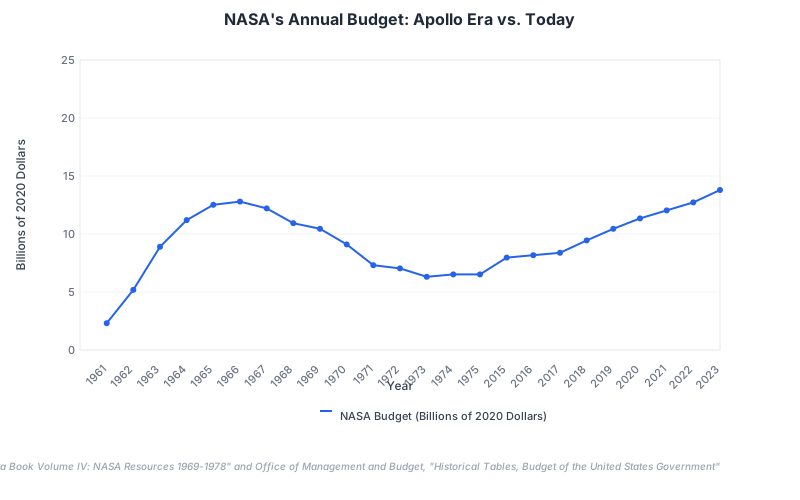
The Apollo program succeeded under extraordinary circumstances that no longer exist. During the height of the Cold War, the United States committed unprecedented resources to beating the Soviet Union to the Moon[1]. At its peak in 1966, NASA consumed 4.5% of the federal budget—approximately $170 billion in today's dollars over the program's lifetime[2]. This massive investment supported over 400,000 workers across government agencies, contractors, and universities.
The Apollo program also operated under fundamentally different risk tolerance. The urgency of the space race meant accepting higher risks to human life and mission success. Three astronauts died in the Apollo 1 fire, and numerous close calls occurred throughout the program[3]. Today's safety standards, while morally superior, require extensive testing and redundancy that extends development timelines significantly.
Perhaps most importantly, Apollo had a singular, clearly defined goal with bipartisan political support and sustained funding. The program maintained momentum across three presidential administrations—something modern space programs struggle to achieve.
The Knowledge Gap: Lost Institutional Memory
One of the most significant challenges facing current lunar missions is the loss of institutional knowledge from the Apollo era. The last Saturn V rocket launched in 1973, and the final Apollo astronaut to walk on the Moon, Eugene Cernan, died in 2017[4]. The engineers, technicians, and managers who made Apollo possible have largely retired or passed away, taking decades of hard-won experience with them.
This knowledge gap extends beyond personnel to manufacturing capabilities. The industrial base that produced Apollo-era hardware has been dismantled or repurposed. The tooling, supply chains, and specialized facilities that built the Saturn V no longer exist. While documentation remains, the tacit knowledge—the informal understanding of how things actually work—has largely disappeared.
NASA has acknowledged this challenge, with former Administrator Mike Griffin noting that recreating Apollo capabilities would require reverse engineering their own historical achievements[5]. This reality helps explain why developing new lunar capabilities often seems to start from scratch rather than building directly on Apollo's foundation.
Modern Complexity: Higher Standards and Greater Ambitions
Today's lunar missions operate under dramatically different requirements than Apollo. While Apollo aimed simply to land on the Moon and return safely, Artemis seeks to establish sustainable lunar presence. This includes building a lunar Gateway space station, developing reusable landing systems, and creating infrastructure for long-term exploration[6].
Modern safety and reliability standards also far exceed those of the 1960s. Current spacecraft must demonstrate much higher levels of crew safety, environmental protection, and mission success probability. The Space Launch System (SLS), NASA's new heavy-lift rocket, incorporates lessons learned from decades of spaceflight, including the Space Shuttle disasters that killed 14 astronauts[7].
Additionally, today's missions must comply with extensive environmental regulations, workplace safety requirements, and oversight procedures that didn't exist during Apollo. While these protections are valuable, they add layers of complexity and time to development processes.
Political and Economic Realities
The political landscape for space exploration has changed dramatically since the 1960s. Unlike Apollo's sustained support, modern lunar programs face regular budget fluctuations and shifting priorities with each new administration. The Constellation program, initiated under President Bush, was cancelled by President Obama, who then started the Artemis precursor program that was later rebranded and redirected by President Trump[8].
This political instability creates a stop-and-start dynamic that wastes resources and momentum. Contractors and NASA centers must constantly adapt to changing requirements, leading to design modifications, schedule delays, and cost increases. The Government Accountability Office has repeatedly criticized NASA programs for poor cost and schedule performance, often citing changing requirements as a primary factor[9].
Economic factors also differ significantly from the Apollo era. The aerospace industry has consolidated substantially, reducing competition and increasing costs. Where Apollo benefited from intense competition between multiple contractors, today's space industry often relies on sole-source contracts with limited alternatives.
Technological Evolution: A Double-Edged Sword
Paradoxically, advances in technology have both helped and hindered lunar mission development. Modern computers, materials, and manufacturing techniques offer capabilities that Apollo-era engineers could only dream of. However, this technological sophistication comes with increased complexity and longer development cycles.
Apollo-era systems were relatively simple by today's standards. The Apollo Guidance Computer had less processing power than a modern calculator, but it was reliable and purpose-built[10]. Modern spacecraft incorporate vastly more complex systems with millions of lines of code, advanced sensors, and intricate subsystems that require extensive testing and validation.
The shift toward reusable systems also adds complexity. While Apollo used expendable hardware designed for single missions, Artemis emphasizes reusability to reduce long-term costs. Developing reusable systems requires additional engineering for refurbishment, maintenance, and multiple-use certification.
International Cooperation and Commercial Partnerships
Unlike Apollo's primarily American effort, Artemis involves extensive international cooperation and commercial partnerships. While this approach spreads costs and leverages global expertise, it also introduces coordination challenges and dependencies on multiple organizations with different priorities and schedules.
The Artemis Accords have attracted partnerships with 29 nations as of late 2023, each contributing different capabilities and requirements[11]. Commercial partners like SpaceX, Blue Origin, and others bring innovation and competition but also introduce new interfaces and integration challenges that didn't exist during Apollo.
These partnerships offer significant benefits, including cost-sharing, technological diversity, and political sustainability. However, they also require extensive coordination, standardization efforts, and diplomatic considerations that can slow development and increase complexity.
The Path Forward: Building for the Future
Despite these challenges, significant progress has been made. The successful Artemis I mission in 2022 demonstrated that NASA can still accomplish complex lunar missions, even if the timeline differs from original projections[12]. The mission tested the Orion spacecraft and SLS rocket in lunar orbit, providing crucial data for future crewed missions.
The delays and difficulties in returning to the Moon reflect not failure, but the reality of attempting something far more ambitious than Apollo under completely different circumstances. While Apollo aimed for a brief demonstration of capability, Artemis seeks to establish permanent human presence beyond Earth orbit—a far more complex undertaking that could transform humanity's relationship with space.
Understanding these challenges helps set realistic expectations for future lunar exploration. The path back to the Moon may be longer and more complex than originally envisioned, but it's building toward something more sustainable and ambitious than what came before.
Some aerospace experts argue that delays in returning to the Moon may actually reflect more responsible engineering practices rather than institutional failure. Unlike Apollo's "damn the torpedoes" approach driven by Cold War urgency, modern programs prioritize sustainable, reusable systems that could support long-term lunar presence—a fundamentally different and arguably more valuable goal than brief flag-planting missions.
The premise that we "should" be able to return to the Moon faster today may itself be flawed, given that we're not simply recreating Apollo but building an entirely new infrastructure for permanent lunar operations. Private companies like SpaceX have demonstrated that when freed from NASA's bureaucratic constraints and political interference, complex space systems can indeed be developed rapidly—suggesting the delays may stem from institutional rather than technical challenges.
Key Takeaways
- Apollo succeeded under unique Cold War circumstances with massive funding (4.5% of federal budget) and high risk tolerance that no longer exist
- Critical institutional knowledge and manufacturing capabilities from the Apollo era have been lost over five decades
- Modern lunar missions face higher safety standards, greater complexity, and more ambitious goals than Apollo's brief landing missions
- Political instability and changing priorities across administrations have repeatedly disrupted long-term space programs
- While technological advances offer new capabilities, they also introduce complexity that extends development timelines
- International cooperation and commercial partnerships provide benefits but add coordination challenges absent from Apollo
- Current efforts aim for sustainable lunar presence rather than Apollo's demonstration missions, requiring fundamentally different approaches
References
- Launius, Roger D. Apollo's Legacy: Perspectives on the Moon Landings. Smithsonian Institution Press, 2019.
- NASA Office of Inspector General. "NASA's Management of the Artemis Missions." Report No. IG-21-004, November 2020.
- Murray, Charles and Catherine Bly Cox. Apollo: The Race to the Moon. Simon & Schuster, 1989.
- "Eugene Cernan, Last Astronaut on the Moon, Dies at 82." The New York Times, January 16, 2017.
- Griffin, Michael D. Testimony before House Committee on Science and Technology, September 2008.
- NASA. "Artemis Plan: NASA's Lunar Exploration Program Overview." NASA Headquarters, September 2020.
- Columbia Accident Investigation Board. "Report Volume 1." NASA, August 2003.
- Foust, Jeff. "The Political History of NASA's Moon Programs." SpaceNews, July 20, 2019.
- Government Accountability Office. "NASA: Assessments of Selected Large-Scale Projects." GAO-21-306SP, May 2021.
- Mindell, David A. Digital Apollo: Human and Machine in Spaceflight. MIT Press, 2008.
- NASA. "The Artemis Accords: Principles for Cooperation in the Civil Exploration and Use of the Moon, Mars, and Other Celestial Bodies." October 2020.
- NASA. "Artemis I Mission Overview and Results." NASA Press Release 22-120, December 2022.