
AI Alert! Emergency Career Intervention for Software Engineers
How Should Software Engineers Navigate the AI Revolution Before It's Too Late?
Career Stage Analysis: From Students to Senior Leaders
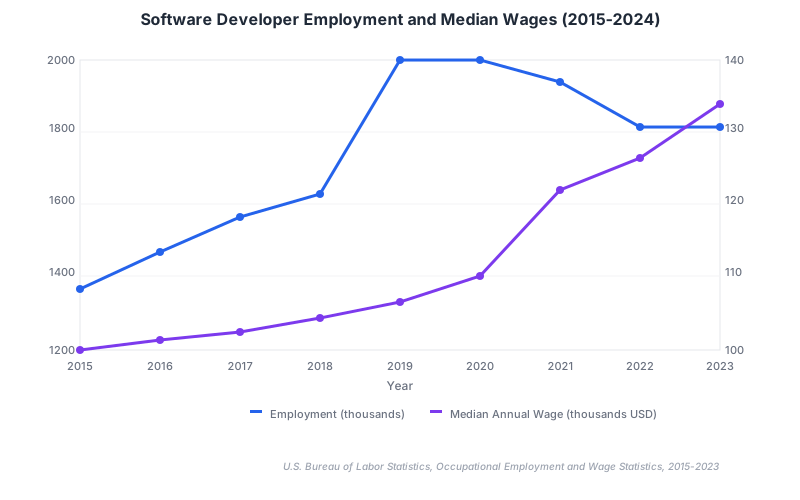
College Students and New Graduates Contrary to alarmist predictions, computer science remains a viable and valuable field of study. However, the curriculum focus must shift dramatically. Students should prioritize AI-adjacent skills while maintaining strong fundamentals in algorithms, data structures, and system design. The key differentiator will be understanding how to effectively collaborate with AI tools rather than competing against them. Students should focus on specialized domains where human judgment remains critical: security engineering, distributed systems architecture, and AI safety research. The Bureau of Labor Statistics projects 22% growth in software development jobs from 2022 to 2032—much faster than the average for all occupations[3]. However, these roles will increasingly require AI literacy as a baseline competency. Practical recommendations include contributing to open-source AI projects, learning prompt engineering techniques, and developing expertise in AI model deployment and monitoring. Universities offering specialized tracks in machine learning operations (MLOps), AI ethics, or human-computer interaction provide competitive advantages in the current market. Mid-Career Professionals (3-8 Years Experience) Mid-career engineers face the highest risk and opportunity simultaneously. This cohort possesses enough experience to understand complex systems but may lack the adaptability of newer graduates or the strategic influence of senior professionals. The imperative is immediate skill diversification and specialization deepening. Engineers at this level should identify their "AI complement" rather than their "AI replacement." For instance, a backend engineer should become expert in AI model serving architectures, API design for AI systems, and performance optimization for inference workloads. The goal is positioning oneself as indispensable for AI-powered applications rather than competing with AI for traditional development tasks. Strategic moves include transitioning into roles with higher human interaction components: technical product management, developer advocacy, or customer-facing engineering roles. These positions leverage technical expertise while requiring uniquely human skills like empathy, negotiation, and strategic thinking. Senior Engineers and Technical Leaders (8+ Years) Senior professionals must evolve into AI strategy architects. Their deep technical knowledge becomes most valuable when applied to organizational AI adoption, technical due diligence for AI vendors, and designing human-AI collaboration workflows. The focus should shift from individual contributor excellence to enabling team-wide AI productivity multiplication. Leadership roles in AI transformation—Chief AI Officer, Head of AI Engineering, Director of AI Strategy—represent significant career advancement opportunities. However, these roles require understanding both technical implementation and business impact of AI systems.Specialization-Specific Strategic Guidance
Frontend Development Frontend engineers face particular disruption from AI-powered design tools and code generation. Tools like GitHub Copilot, Tabnine, and emerging visual-to-code AI systems can generate significant portions of UI code. However, this creates opportunities for frontend engineers to focus on higher-level concerns: user experience optimization, accessibility compliance, and performance engineering. The strategic pivot involves becoming expert in AI-powered development workflows while specializing in areas requiring human creativity and judgment. This includes complex state management, advanced animation systems, and cross-platform compatibility optimization. Frontend engineers should also explore emerging areas like AI-powered user interface adaptation and personalization systems. Critical skills include mastering modern frameworks (React, Vue, Angular) with AI coding assistants, understanding WebAssembly for AI model deployment in browsers, and developing expertise in progressive web applications that can leverage on-device AI capabilities. Backend Development Backend engineers have perhaps the strongest position in the AI transformation, as AI systems require sophisticated infrastructure, data pipelines, and API architectures. The demand for engineers who can design scalable AI model serving systems, implement efficient data processing pipelines, and optimize inference performance has increased dramatically. Specialization opportunities include becoming expert in AI infrastructure: model serving platforms (TensorFlow Serving, TorchServe), vector databases (Pinecone, Weaviate), and real-time inference systems. Understanding the unique requirements of AI workloads—GPU utilization, memory optimization, batch processing—creates significant competitive advantages. Backend engineers should also explore opportunities in AI safety and security, including model monitoring, adversarial attack prevention, and bias detection systems. These areas require deep technical expertise combined with understanding of AI-specific vulnerabilities. Infrastructure and DevOps Infrastructure professionals are experiencing increased demand as AI systems require specialized deployment and monitoring capabilities. The complexity of AI model deployment, versioning, and monitoring creates new categories of infrastructure challenges that traditional DevOps practices don't adequately address. MLOps (Machine Learning Operations) represents a natural evolution for infrastructure engineers. This includes expertise in model deployment pipelines, A/B testing for AI systems, and monitoring model performance degradation over time. Understanding containerization technologies (Docker, Kubernetes) specifically for AI workloads provides significant career advantages. Cloud platform specialization becomes increasingly valuable, particularly in AI-specific services: Amazon SageMaker, Google Cloud AI Platform, and Azure Machine Learning. Infrastructure engineers should also develop expertise in cost optimization for AI workloads, which often involve expensive GPU resources and large-scale data processing. Quality Assurance and Testing Traditional manual testing roles face the highest displacement risk from AI automation. However, this creates opportunities for QA professionals to evolve into AI testing specialists. AI systems require fundamentally different testing approaches: bias testing, adversarial testing, and performance testing under varying data distributions. The transition involves learning AI-specific testing methodologies and tools. This includes understanding how to test machine learning models, validate AI system outputs, and ensure AI system reliability under edge cases. QA professionals should develop expertise in automated testing frameworks specifically designed for AI systems. Emerging opportunities include AI safety testing, where professionals validate that AI systems behave safely and ethically across diverse scenarios. This requires understanding both technical testing methodologies and ethical frameworks for AI development. Product Management Product managers working with AI systems require deep technical understanding combined with strategic business acumen. The complexity of AI product development—from data requirements to model performance metrics—demands product managers who can bridge technical and business concerns effectively. Key skills include understanding AI capabilities and limitations, designing effective human-AI interaction patterns, and measuring AI product success through appropriate metrics. Product managers should develop expertise in AI product strategy, including competitive analysis of AI capabilities and go-to-market strategies for AI-powered products. The role increasingly involves managing cross-functional teams including data scientists, ML engineers, and AI researchers. Understanding these disciplines' workflows, constraints, and success metrics becomes essential for effective product management in AI-driven organizations.Essential Tools and Technologies for AI-Era Software Engineering
AI-Powered Development Tools Every software engineer must develop proficiency with AI coding assistants. GitHub Copilot, currently the market leader, integrates directly into popular IDEs and can generate code, suggest completions, and even write entire functions based on natural language descriptions. However, effective use requires understanding how to write clear, specific prompts and how to evaluate and modify AI-generated code. Alternative tools include Tabnine, which offers more customizable AI models, and Amazon CodeWhisperer, which integrates particularly well with AWS services. Engineers should experiment with multiple tools to understand their strengths and limitations across different programming languages and use cases. Beyond code generation, AI-powered debugging and testing tools are emerging. Tools like DeepCode (now part of Snyk) use AI to identify potential bugs and security vulnerabilities. Understanding how to integrate these tools into development workflows provides significant productivity advantages. AI Infrastructure and Deployment Tools For engineers working on AI systems, familiarity with specialized infrastructure tools becomes essential. This includes model serving frameworks like TensorFlow Serving, TorchServe, and MLflow for model management and versioning. Container orchestration for AI workloads requires understanding of specialized configurations for GPU utilization, memory management, and scaling policies. Kubernetes operators specifically designed for AI workloads, such as Kubeflow, provide standardized approaches to AI system deployment. Vector databases represent a new category of infrastructure specifically designed for AI applications. Tools like Pinecone, Weaviate, and Chroma enable efficient storage and retrieval of high-dimensional vectors used in AI applications. Understanding when and how to use these systems becomes increasingly important for backend and infrastructure engineers. Monitoring and Observability for AI Systems Traditional application monitoring tools are insufficient for AI systems, which require specialized monitoring for model performance, data drift, and bias detection. Tools like Weights & Biases, Neptune, and MLflow provide AI-specific monitoring capabilities. Understanding how to implement effective monitoring for AI systems requires knowledge of metrics specific to machine learning: model accuracy over time, feature drift detection, and inference latency optimization. Engineers should develop expertise in designing monitoring systems that can detect when AI models require retraining or adjustment.Critical Metrics and Leading Indicators to Monitor
Industry Employment Metrics The Bureau of Labor Statistics' Occupational Employment and Wage Statistics provides quarterly data on software development employment trends. However, more timely indicators come from technology-specific job boards and salary surveys. Stack Overflow's annual Developer Survey provides comprehensive data on technology adoption, salary trends, and job satisfaction across different specializations. The survey's AI and machine learning sections offer particular insight into emerging skill demands and compensation trends. Dice's Tech Job Report and Robert Half's Salary Guide for Technology Professionals provide quarterly updates on demand for specific technical skills. These reports increasingly include AI-related roles and skill premiums, offering insight into market direction. Technology Adoption Indicators GitHub's State of the Octoverse report provides annual analysis of programming language trends, framework adoption, and developer behavior patterns. The report's sections on AI tool usage and code generation provide insight into how AI is transforming development practices. Stack Overflow Trends offers real-time data on technology question volume, indicating developer interest and adoption of new tools and frameworks. Monitoring trends for AI-related technologies (machine learning frameworks, AI development tools) provides early indicators of market direction. Google Trends data for technical terms and tools can provide leading indicators of technology adoption. Searches for specific AI frameworks, tools, and methodologies often precede broader market adoption by 6-12 months. Compensation and Market Dynamics Levels.fyi provides real-time compensation data for technology roles, with increasing granularity around AI-specific positions. Current market data suggests AI-specialized roles often command salary premiums, though specific premiums vary significantly by location, company size, and exact specialization[4]. The AI Index Report, published annually by Stanford's Human-Centered AI Institute, provides comprehensive analysis of AI industry trends, including employment, investment, and research publication metrics. This report offers the most authoritative view of AI industry growth and its impact on employment. Industry layoff tracking platforms provide insight into which companies and roles are most affected by industry contractions. Analysis suggests varying impacts across different technical specializations, though comprehensive comparative analysis remains limited[5]. Skills Demand Tracking LinkedIn's Emerging Jobs Report identifies the fastest-growing job categories and required skills. The report consistently shows AI-related roles among the highest growth categories, with specific insight into which skills are most in demand. Indeed's Job Trends data provides real-time analysis of job posting volume for specific skills and roles. Monitoring trends for AI-related keywords (machine learning, deep learning, neural networks) provides insight into market demand evolution. Coursera's Global Skills Report analyzes online learning trends, providing insight into which technical skills professionals are developing. The report's technology sections offer early indicators of skill demand before these requirements appear in job postings.Strategic Career Positioning for Long-Term Success
Building AI-Complementary Expertise The most successful software engineers will position themselves as AI force multipliers rather than AI competitors. This requires developing expertise in areas where human judgment, creativity, and strategic thinking remain essential while leveraging AI tools for productivity enhancement. Domain expertise becomes increasingly valuable when combined with technical skills. Engineers with deep understanding of specific industries—healthcare, finance, manufacturing—can bridge the gap between AI capabilities and real-world applications. This combination of technical and domain knowledge creates defensible career positions. Communication and collaboration skills become differentiating factors as AI handles more routine technical tasks. Engineers who can effectively translate between technical and business stakeholders, mentor junior team members, and lead cross-functional projects will find increased demand for their services. Continuous Learning and Adaptation Strategies The pace of AI advancement requires continuous learning approaches rather than traditional skill development cycles. Engineers should establish systematic processes for staying current with AI developments, including regular review of research publications, experimentation with new tools, and participation in AI-focused communities. Practical learning strategies include maintaining personal AI experimentation projects, contributing to open-source AI tools, and attending AI-focused conferences and workshops. The goal is developing intuitive understanding of AI capabilities and limitations through hands-on experience. Professional development should focus on building T-shaped expertise: deep specialization in one area combined with broad understanding of AI applications across multiple domains. This approach provides both immediate value and long-term career flexibility.While current AI coding assistants show impressive productivity gains, we may be witnessing a classic technology hype cycle where early enthusiasm outpaces practical limitations. The 55% productivity boost cited in studies may reflect cherry-picked scenarios rather than real-world enterprise development, where code quality, maintainability, and integration complexity often matter more than raw coding speed.
The assumption that AI will inevitably transform all software engineering roles equally overlooks significant regulatory and industry constraints that could slow adoption for years. In sectors like healthcare, aerospace, and financial services, where code errors can have life-threatening or financially catastrophic consequences, human oversight and liability concerns may preserve traditional engineering roles much longer than Silicon Valley timelines suggest.
Key Takeaways
- Computer science education remains valuable, but curricula must emphasize AI collaboration and specialized domains requiring human judgment
- Mid-career engineers face the highest risk but also significant opportunities through strategic skill diversification and AI-complementary specialization
- Frontend engineers should focus on UX optimization and AI-powered personalization; backend engineers have strong positioning in AI infrastructure
- Infrastructure and DevOps professionals should transition into MLOps specialization; QA professionals should evolve into AI testing specialists
- Essential tools include AI coding assistants (GitHub Copilot, Tabnine), AI infrastructure platforms (MLflow, Kubeflow), and specialized monitoring systems
- Critical metrics to monitor include BLS employment statistics, Stack Overflow surveys, Levels.fyi compensation data, and the Stanford AI Index Report
- Long-term success requires positioning as an AI force multiplier, developing domain expertise, and maintaining continuous learning practices
- The most defensible career positions combine deep technical expertise with uniquely human skills like strategic thinking, communication, and cross-functional leadership
References
- Ziegler, Albert, et al. "Productivity assessment of neural code completion." GitHub Research, 2022. Available at: https://github.blog/2022-09-07-research-quantifying-github-copilots-impact-on-developer-productivity-and-happiness/
- Various industry sources. "Tech Industry Layoffs 2022-2023." Multiple tracking platforms and news sources, 2023.
- U.S. Bureau of Labor Statistics. "Software Developers, Quality Assurance Analysts, and Testers." Occupational Outlook Handbook, 2023. Available at: https://www.bls.gov/ooh/computer-and-information-technology/software-developers.htm
- Levels.fyi. "Software Engineer Compensation Data." Levels.fyi, 2023. Available at: https://www.levels.fyi/
- Various industry tracking platforms. "Technology Sector Employment Analysis." Multiple sources, 2023.