
Why are today's athletes so much better than athletes from 100 years ago?

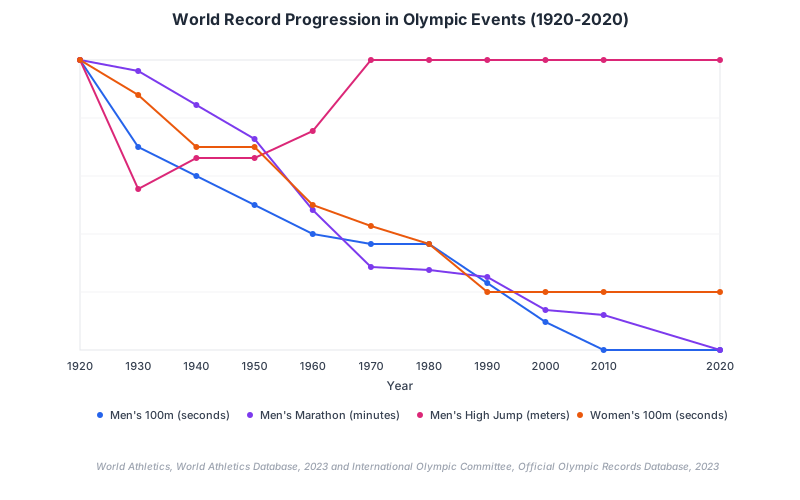
When Jesse Owens blazed to a world record 10.3 seconds in the 100-meter dash in 1936, he was hailed as the fastest man alive. Today, that time wouldn't qualify for most elite high school championships. Usain Bolt's current world record of 9.58 seconds—a staggering 0.72 seconds faster—represents the dramatic evolution of human athletic achievement over just eight decades.
The answer lies not in human evolution—our species hasn't changed significantly in 100 years—but in a perfect storm of scientific advancement, technological innovation, and systematic optimization that has revolutionized how we develop athletic talent. This transformation reveals not just the story of sports, but the broader narrative of human potential in the modern era.
The Foundation: Scientific Understanding of Human Performance
The most significant driver of athletic improvement has been the application of rigorous scientific principles to sports training. A century ago, athletes trained largely on intuition and tradition. Today's athletes benefit from decades of research in exercise physiology, biomechanics, and sports psychology.
Exercise physiology emerged in earnest during the mid-20th century, revealing crucial insights into how the human body responds to training. Researchers discovered the principles of progressive overload, periodization, and specificity that form the backbone of modern training programs[1]. Understanding energy systems—how the body produces and utilizes fuel during different types of exercise—allowed coaches to design programs that precisely target each sport's physiological demands.
Biomechanical analysis has been equally transformative. High-speed cameras and motion capture technology now allow microscopic analysis of movement patterns impossible to detect with the naked eye. In swimming, underwater cameras revealed the critical importance of streamlined body position and optimal stroke mechanics, contributing to dramatic improvements in world records.
Sports psychology, virtually non-existent a century ago, now plays a crucial role in athletic development. Mental training techniques, visualization, and performance psychology help athletes maximize their physical capabilities while managing competitive pressure.
The Technology Revolution
Technology has transformed every aspect of athletic performance, from equipment design to training methods and recovery protocols. The materials revolution alone has contributed significantly to improved performance across numerous sports.
In track and field, synthetic tracks introduced in the 1960s provided more consistent and responsive surfaces than the cinder tracks of earlier eras. Modern running spikes are lighter, more aerodynamic, and provide superior traction. The development of the Fosbury Flop high jump technique was only possible with softer landing mats that made the head-first approach safe.
Swimming has seen perhaps the most dramatic technological improvements. Lane ropes reduce turbulence, starting blocks optimize launch angles, and pool designs minimize wave reflection—all contributing to faster times. The controversial full-body polyurethane suits of the late 2000s were so effective they were banned for providing unfair advantage.
Equipment advances extend across all sports. Pole vaulters use lightweight fiberglass poles instead of heavy wooden ones, enabling significantly higher vaults. Tennis rackets evolved from heavy wooden frames to lightweight composites allowing more powerful, precise shots. Virtually every piece of sporting equipment has undergone similar transformation.
Nutrition and Recovery Science
Sports nutrition has evolved dramatically from the limited dietary knowledge available a century ago, when athletes often followed questionable practices based on folklore rather than science.
Modern sports nutrition relies on rigorous research into macronutrient timing, hydration strategies, and supplementation. Athletes now understand carbohydrate loading before endurance events, protein timing for muscle recovery, and precise hydration protocols to maintain performance. Sports drinks, energy gels, and targeted supplements provide tools to optimize fueling strategies.
Recovery science has become equally sophisticated. While athletes a century ago simply rested between sessions, today's competitors employ ice baths, compression therapy, massage, sleep optimization, and other evidence-based recovery modalities to enhance adaptation and reduce injury risk. The recognition of sleep's crucial role has led to entire programs dedicated to optimizing rest and recovery.
Training Methodology Evolution
Training methods have undergone complete transformation based on scientific understanding of adaptation principles. Early 20th-century training was characterized by high-volume, low-intensity work with little systematic progression.
Modern periodization models provide systematic approaches to organizing training loads across different time periods, ensuring athletes peak at optimal times while minimizing overtraining risk. The concept of specificity—training that closely mimics competitive demands—has replaced generic fitness approaches.
Strength and conditioning evolved from basic calisthenics to sophisticated programs incorporating Olympic lifting, plyometrics, and sport-specific movement patterns. The understanding that strength training enhances performance in virtually all sports, rather than making athletes "muscle-bound" as once believed, has been revolutionary.
Data-driven training has become increasingly prevalent. Heart rate monitors, GPS tracking, force plates, and other technologies provide objective feedback for precise training load management. Athletes and coaches can now quantify training stress and adaptation in previously impossible ways.
Talent Identification and Development Systems
The systematic identification and development of athletic talent has become far more sophisticated and widespread. A century ago, most athletes discovered their talents by chance and received minimal formal coaching. Today, organized youth programs, talent identification systems, and structured development pathways help identify and nurture potential from early ages.
Countries like Australia and the United Kingdom have implemented national talent identification programs using scientific testing to identify young athletes with sport-specific potential. These programs provide systematic development pathways that optimize crucial developmental years.
The professionalization of coaching has been equally important. Modern coaches typically hold advanced degrees in exercise science and undergo continuous education. Coaching certification programs and knowledge sharing through conferences have raised coaching standards worldwide.
Medical and Health Advances
Advances in sports medicine enable athletes to train harder, recover faster, and compete longer than their predecessors. Many injuries that would have ended careers a century ago are now routinely treated.
Arthroscopic surgery, developed in the 1960s and continuously refined, allows minimally invasive treatment of joint injuries. Tommy John surgery, first performed in 1974, has enabled countless baseball pitchers to return from elbow injuries that would have previously ended careers.
Injury prevention has become increasingly sophisticated, with movement screening, biomechanical analysis, and corrective exercise programs helping athletes avoid injuries before they occur. Physical therapy and rehabilitation protocols based on scientific understanding of tissue healing have dramatically improved recovery outcomes.
Global Competition and Professionalization
The expansion of global competition has intensified the drive for athletic excellence. Modern Olympic Games, professional leagues, and international competitions create unprecedented competitive pressure driving continuous improvement. Athletes now regularly compete against the world's best rather than primarily local or regional competitors.
Professionalization allows athletes to dedicate themselves full-time to training and competition. A century ago, most athletes were amateurs balancing training with full-time jobs. Today's professionals focus entirely on optimizing performance, supported by teams of coaches, trainers, nutritionists, and specialists.
Increased prize money and sponsorship opportunities create powerful financial incentives for achievement, attracting more people to pursue athletic careers and funding the support systems necessary for optimal performance.
Population Growth and Participation
Simple mathematics plays a role in improved performance. Global population has more than quadrupled since 1920, creating a much larger pool of potential athletes. Additionally, increased participation in organized sports, particularly among women and in developing countries, has dramatically expanded the talent pool.
Women's inclusion in Olympic competition has been gradual but transformative. Women's marathon wasn't added until 1984, and many events have been added recently. This expansion has revealed tremendous previously untapped athletic potential.
Global sports expansion has brought athletes from previously underrepresented countries and regions. Success from Africa in distance running, the Caribbean in sprinting, and other regional specializations has raised overall competitive standards.
However, this narrative of inevitable progress may obscure a more troubling reality: we might simply be getting better at identifying and exploiting genetic outliers rather than genuinely improving human athletic potential. The dramatic improvements could reflect larger population pools, better scouting systems, and economic incentives that draw talent from previously untapped demographics—essentially mining human genetic diversity more efficiently rather than transcending biological limits.
Moreover, our obsession with measurable metrics like speed and strength may blind us to what we've lost in the pursuit of athletic excellence. Historical athletes like Jim Thorpe excelled across multiple sports with a well-rounded athleticism that today's hyper-specialized competitors often lack, raising questions about whether we're producing better athletes or simply more efficient athletic machines optimized for narrow performance parameters.
Key Takeaways
- Scientific understanding of exercise physiology, biomechanics, and sports psychology has revolutionized training methods and performance optimization
- Technological advances in equipment, surfaces, and training tools have provided athletes with significant performance advantages
- Modern sports nutrition and recovery science enable athletes to train harder and adapt more effectively than previous generations
- Systematic talent identification and professional coaching development have optimized the nurturing of athletic potential
- Medical advances in injury prevention and treatment allow athletes to maintain peak performance longer and recover from setbacks more effectively
- Global competition and professionalization have intensified the drive for excellence while providing resources for optimal development
- Population growth and expanded participation have dramatically increased the pool of potential elite athletes
References
- Bompa, Tudor and G. Gregory Haff. Periodization: Theory and Methodology of Training. Human Kinetics, 2009.