
Sony's PS5 Price Hike Is Actually Protecting Gamers From a Much Worse Fate

EDITORIAL — This is an opinion piece. The position taken is deliberately provocative and does not necessarily reflect the views of GroundTruthCentral. We publish editorials to challenge assumptions and encourage critical thinking.
The Manufacturing Reality Nobody Wants to Acknowledge
Let's start with an uncomfortable truth: the PlayStation 5 was already being sold at a substantial loss when it launched at $499 in 2020[1]. This isn't unusual—console manufacturers have traditionally operated on a "razor and blades" model, selling hardware at a loss to build an installed base, then recouping profits through game sales and licensing fees. But the PS5's situation was more extreme than most previous generations. The console's advanced AMD Zen 2 CPU, custom RDNA 2 GPU, and high-speed SSD represented cutting-edge technology that was expensive to manufacture even under normal circumstances. When global supply chain disruptions hit in 2021 and 2022, followed by persistent inflation affecting semiconductor manufacturing costs, Sony found itself hemorrhaging money on every unit sold. Sony's own financial disclosures indicated losses of approximately $20-40 per PS5 console at launch[3]. These losses were expected to decrease over time as manufacturing scaled up and component costs declined. However, ongoing supply chain pressures have likely prevented the typical cost reductions that console manufacturers rely on. For a company that has shipped over 25 million PS5 consoles, even modest per-unit losses represent substantial financial exposure.The Alternative Timeline: What Happens Without Price Corrections
Critics of Sony's price increase seem to believe companies can simply absorb infinite losses indefinitely. This betrays a fundamental misunderstanding of how businesses operate in competitive markets. When a company faces unsustainable losses on a core product, it has three options: raise prices, reduce production, or exit the market entirely. Consider what would happen if Sony had chosen option two—drastically cutting PS5 production to minimize losses. We've already seen glimpses of this scenario during the console's launch period, when severe shortages created a thriving resale market where PS5s regularly sold for $800-1000 on secondary markets[4]. If Sony had maintained artificially low prices while cutting production to sustainable levels, we'd likely see PS5s trading at $700-800 as the normal market price, with most units going to scalpers rather than actual gamers. The third option—Sony exiting the console market entirely—would be catastrophic for the gaming ecosystem. Microsoft has shown little interest in competing aggressively on hardware pricing, with Xbox Series X units also being sold at a loss[5]. Without Sony's competition, Microsoft would face little pressure to keep prices reasonable or continue investing heavily in exclusive content. The result would likely be higher prices, less innovation, and fewer compelling games.Historical Precedent: When Nintendo Chose Survival Over Sentiment
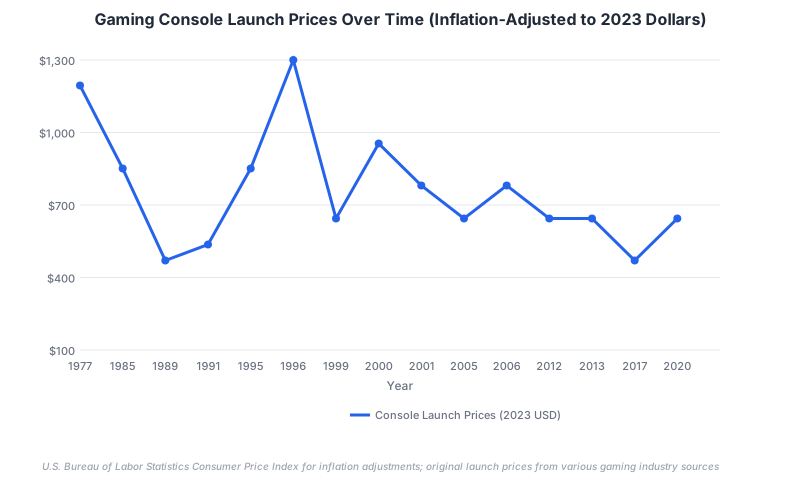
The gaming industry has faced similar crossroads before. In the mid-1990s, Nintendo found itself in an analogous position with the Nintendo 64. Cartridge costs were spiraling due to manufacturing complexities, and Nintendo faced intense pressure to either switch to cheaper CD-ROM technology or absorb massive per-unit losses[6]. Nintendo chose a third path: they maintained cartridge technology but passed increased costs directly to consumers. N64 games launched at $60-70, representing an increase from SNES games which typically retailed for $50-60. Gamers complained about the price increases, but Nintendo's decision ensured the platform remained profitable enough to support continued first-party development. The alternative timeline—where Nintendo absorbed cartridge costs to keep game prices artificially low—would likely have resulted in far fewer high-quality exclusive titles and potentially Nintendo's exit from the console market entirely. Instead, the higher prices enabled Nintendo to invest in revolutionary games like Super Mario 64, The Legend of Zelda: Ocarina of Time, and GoldenEye 007 that defined gaming for a generation.The Economics of Platform Competition
Sony's price increase also serves a crucial function in maintaining healthy competition in the console market. By establishing sustainable pricing, Sony ensures it can continue investing in the exclusive content and technological innovation that drives platform differentiation. Without this investment, the PlayStation platform would gradually become less competitive, ultimately reducing consumer choice. Microsoft's response to Sony's price increase has been notably different—the company has maintained its existing Xbox Series X and S pricing in markets where Sony implemented increases. This divergent strategy suggests different approaches to managing cost pressures, with Microsoft potentially absorbing higher per-unit losses to maintain market position. Some critics argue this represents an opportunity for Microsoft to gain market share through competitive pricing, but the reality is that both companies face similar cost pressures. The question becomes whether maintaining unsustainable pricing ultimately serves consumers better than establishing economically viable price points that enable continued platform investment.The Long-Term Investment Perspective
Perhaps most importantly, Sony's price increase should be understood as an investment in the platform's long-term viability. The additional revenue generated by higher hardware prices directly funds the exclusive game development, technological research, and platform improvements that make PlayStation competitive. Consider Sony's recent investments in first-party studios like Insomniac Games, Housemarque, and Bluepoint Games[8]. These acquisitions, which cost hundreds of millions of dollars, are only possible because Sony maintains sufficient profitability to fund long-term strategic initiatives. If hardware losses became too severe, these investments would be among the first casualties, leading to a less compelling platform with fewer exclusive games. The regional price increases, spread across the typical 6-7 year console lifecycle, represent a modest additional cost for most gamers. In exchange, that additional cost helps ensure continued investment in the exclusive titles, system updates, and technological innovations that justify the platform's existence.Addressing the Accessibility Argument
The strongest objection to Sony's price increase centers on accessibility—the concern that higher prices will exclude lower-income gamers from the PlayStation ecosystem. This is a legitimate worry that deserves serious consideration, but it's worth examining whether the alternatives would actually serve these consumers better. If Sony had chosen to maintain unsustainable pricing, the most likely outcome would be chronic shortages that push real market prices well above MSRP. During the PS5's launch period, limited supply meant that consoles were effectively rationed to consumers willing and able to pay premium prices to scalpers. Maintaining artificially low official prices while constraining supply would recreate this dynamic permanently. Moreover, Sony has introduced several programs specifically designed to maintain accessibility, including expanded trade-in programs, financing options, and the PlayStation 5 Digital Edition at a lower price point. These initiatives suggest that the company recognizes the importance of maintaining broad market access while establishing sustainable pricing for its premium hardware.The Inflation Reality Check
Finally, it's worth contextualizing Sony's price increase within broader economic trends. Since the PS5's 2020 launch, inflation has significantly impacted manufacturing costs across multiple sectors. According to official data from major gaming markets, consumer price inflation has been substantial during this period, with the U.S. experiencing approximately 13% cumulative inflation from 2020 to 2022, while European markets saw similar or higher rates[10]. Sony's regional price adjustments represent an attempt to partially account for these broader economic pressures while maintaining market accessibility. From this perspective, Sony has shown considerable restraint in pricing, absorbing the majority of cost increases rather than passing them fully to consumers. The gaming community's outrage over price adjustments that don't even fully account for inflation suggests a disconnect from economic reality. Other entertainment categories—from movie tickets to streaming subscriptions—have seen far more aggressive price increases over the same period, often without delivering meaningfully improved value propositions. Sony's PlayStation 5 price increases represent a necessary correction to unsustainable economics, not corporate greed. By establishing pricing that allows for continued platform investment, Sony is protecting the long-term health of the PlayStation ecosystem. The alternative—maintaining artificially low prices that force chronic shortages, reduced investment, or platform abandonment—would ultimately cost gamers far more than modest regional price adjustments. The gaming community's reflexive opposition to these price adjustments reflects short-term thinking that ignores the complex economics of console manufacturing and platform competition. Rather than vilifying Sony for acknowledging economic reality, gamers should recognize these price increases as a necessary step toward ensuring the PlayStation platform remains viable, competitive, and innovative for years to come.However, Sony's price increase could represent a strategic pivot toward premium positioning rather than cost necessity. With PlayStation Network generating billions in high-margin revenue and the PS5 maintaining strong demand despite shortages, Sony may be testing how much consumers will pay for what they're positioning as a luxury gaming experience—a move that benefits shareholders more than protecting gamers from any particular "fate."
The timing of this price hike raises questions about whether Sony is capitalizing on limited competition rather than responding to manufacturing pressures. Unlike previous console generations where price cuts were standard as production scaled up, Sony's increase during a supply-constrained period suggests the company may be prioritizing profit margins over market penetration—a strategy that could ultimately limit the gaming ecosystem's growth potential.
Key Takeaways
- Sony was already losing $20-40 per PS5 unit at launch, with ongoing cost pressures preventing typical manufacturing savings
- The alternatives—production cuts or market exit—would result in much higher effective prices through scarcity
- Historical precedent shows that sustainable pricing enables continued platform investment and innovation
- Regional price increases partially account for inflation while maintaining relative affordability compared to other entertainment sectors
- Microsoft's decision to maintain pricing creates competitive differentiation rather than industry-wide increases
- Additional revenue funds exclusive game development and platform improvements that justify the ecosystem
References
- Takahashi, Dean. "Sony sold 4.5 million PS5 consoles and expects to lose money on each one." VentureBeat, February 2021.
- Sony Interactive Entertainment. "Quarterly Financial Results." Sony Corporation, 2021-2022.
- Spangler, Todd. "PS5 Resale Prices Hit $1,000 as Sony Console Shortage Continues." Variety, December 2020.
- Warren, Tom. "Microsoft is taking a big loss on Xbox Series X and S sales." The Verge, May 2021.
- Kent, Steven L. The Ultimate History of Video Games. Three Rivers Press, 2001.
- Phillips, Tom. "Sony's PlayStation Studios acquisitions strategy explained." Eurogamer, July 2021.
- Bureau of Labor Statistics. "Consumer Price Index Summary." U.S. Department of Labor, 2022; Eurostat. "Euro area annual inflation." European Central Bank, 2022.