Marine Biology's 'Breakthroughs' Are Actually Setting Back Ocean Conservation by Decades

EDITORIAL — This is an opinion piece. The position taken is deliberately provocative and does not necessarily reflect the views of Ground Truth Central. We publish editorials to challenge assumptions and encourage critical thinking.
The Seductive Trap of Discovery
The past decade's marine biology breakthroughs read like science fiction made real. Researchers have discovered entire ecosystems thriving around underwater volcanoes, documented coral reefs that resist bleaching, and identified deep-sea creatures that challenge our understanding of life itself[1]. Each discovery generates headlines, secures funding, and reinforces the narrative that science is steadily solving the ocean crisis. But this narrative is fundamentally flawed. Discovery and conservation operate on completely different timescales and require entirely different approaches. While scientists spend years studying the mating habits of a newly discovered deep-sea anglerfish, commercial fishing fleets strip-mine the seafloor above it. While researchers debate the evolutionary implications of coral genetic diversity, rising ocean temperatures kill entire reef systems faster than we can catalog them[2]. The marine biology establishment has confused knowledge accumulation with conservation action. They've created a sophisticated intellectual framework for understanding oceanic decline while the actual oceans die around them. It's like conducting detailed autopsies while the patient bleeds out on the operating table.The False Promise of Technological Solutions
Marine biology's technological achievements are particularly seductive because they feel so advanced, so promising. Autonomous underwater vehicles map previously unexplored trenches. Environmental DNA sampling reveals hidden biodiversity. Satellite tracking follows individual marine animals across entire ocean basins[3]. These tools generate data at scales previous generations of marine biologists could only dream of. But more data doesn't equal better conservation outcomes—in fact, it often achieves the opposite. The explosion of marine research has created what we might call "analysis paralysis" on a global scale. Policymakers delay action while waiting for more complete datasets. Conservation groups spend years debating the precise boundaries of marine protected areas based on species distribution models. Meanwhile, the window for meaningful intervention continues to shrink. Consider coral reef conservation. Researchers have made remarkable breakthroughs in understanding coral genetics, identifying "super corals" that resist bleaching, and developing techniques for coral restoration[4]. These discoveries generate enormous optimism and funding. But coral reefs are still disappearing at unprecedented rates because the fundamental drivers—ocean acidification, warming, and pollution—remain unaddressed. The breakthroughs provide hope that delays the difficult political and economic changes necessary to actually save reefs.The Opportunity Cost of Misdirected Brilliance
The most damaging aspect of marine biology's current trajectory isn't what it accomplishes, but what it prevents. The marine biology community attracts some of the world's most talented scientists, people capable of solving complex problems and communicating urgent realities to the public. But the current academic incentive structure rewards discovery over application, novelty over conservation impact. Researchers who discover new species advance faster than those who successfully advocate for fishing restrictions. This misallocation of talent has real consequences. The thousands of papers published annually about ocean ecosystems represent a massive intellectual investment, while illegal fishing operations extract billions of dollars worth of marine life with minimal interference[5]. While researchers study the complex social behaviors of dolphins, industrial shipping routes fragment marine habitats on a massive scale. The sophistication of our understanding grows while the systems we study collapse.The Conservation Theater Problem
Perhaps most insidiously, marine biology breakthroughs have become a form of conservation theater—dramatic performances that create the appearance of environmental action without delivering meaningful results. When governments and corporations want to appear environmentally responsible, they fund marine research. When environmental groups need to demonstrate progress, they cite scientific discoveries. When the public feels guilty about ocean destruction, they find comfort in stories about scientific breakthroughs. This dynamic creates a perverse feedback loop. The more dire the ocean situation becomes, the more funding flows to research that documents the decline rather than stops it. We've created an entire industry around studying environmental catastrophe rather than preventing it. The recent excitement around discovering microplastics in the deepest ocean trenches exemplifies this problem[6]. Researchers celebrated the technical achievement of detecting plastic pollution in previously inaccessible environments. Media coverage focused on the scientific methodology and the surprising extent of plastic penetration into marine ecosystems. But the discovery changed nothing about plastic production, waste management, or corporate responsibility. It simply added another data point to our comprehensive documentation of ongoing destruction.The Distraction of Wonder
Marine biology's greatest breakthroughs often generate a sense of wonder that, paradoxically, reduces urgency about conservation. When scientists discover bioluminescent creatures in ocean depths or document the complex communication systems of whales, public attention focuses on the marvels of marine life rather than its destruction. The natural world becomes a source of fascination rather than a system requiring immediate protection. This "wonder trap" is particularly problematic because it shifts the emotional framing of ocean issues. Instead of feeling outraged about habitat destruction, people feel amazed by scientific discoveries. Instead of demanding immediate action, they feel satisfied that smart people are working on the problem. The breakthroughs become a substitute for the difficult work of actual conservation. The discovery of new deep-sea ecosystems illustrates this dynamic perfectly. Each new hydrothermal vent community or abyssal plain ecosystem generates excitement about the diversity of life in extreme environments. But these discoveries also reveal how little we know about what we're destroying through deep-sea mining, bottom trawling, and climate change. Rather than inspiring immediate protective action, the discoveries often lead to calls for more research, more exploration, more understanding—while the destruction continues unabated.What Real Ocean Conservation Looks Like
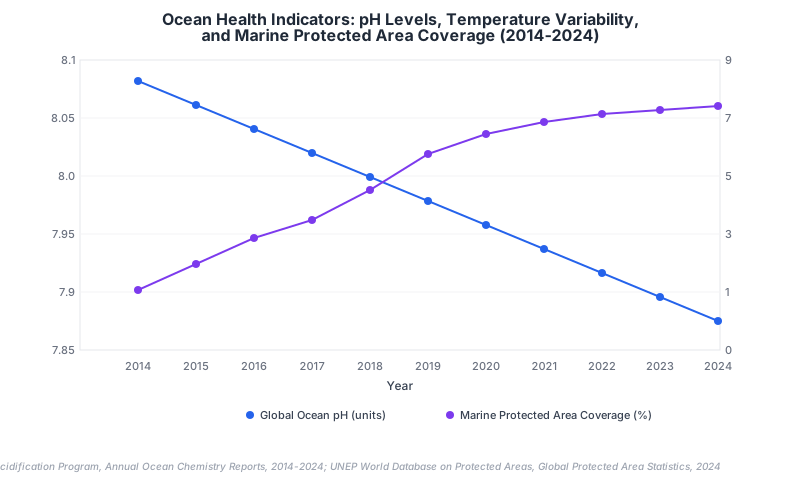
Effective ocean conservation doesn't require breakthrough discoveries or cutting-edge technology. It requires political will, economic restructuring, and enforcement of existing knowledge. We already know that overfishing depletes marine ecosystems. We already know that plastic pollution harms marine life. We already know that carbon emissions acidify oceans and raise temperatures. The science on these fundamental issues has been settled for decades. What we need isn't more sophisticated understanding of marine ecosystems—it's the courage to act on what we already know. This means restricting fishing quotas even when it hurts fishing communities economically. It means banning single-use plastics even when it inconveniences consumers. It means transitioning away from fossil fuels even when it threatens existing industries. The most successful ocean conservation efforts of recent decades haven't depended on scientific breakthroughs. The recovery of humpback whale populations resulted from hunting bans, not genetic research[7]. The restoration of some fish stocks has come from fishing restrictions, not species discovery. The protection of marine habitats has required political action, not technological innovation.The Path Forward
This isn't an argument against all marine research—it's an argument for radically reorienting research priorities toward conservation outcomes. Instead of celebrating the discovery of new species, we should celebrate the protection of existing ones. Instead of funding expeditions to document previously unknown ecosystems, we should fund efforts to preserve the ecosystems we already know are threatened. Marine biology needs to become explicitly activist. Researchers should spend as much time in legislative hearings as in laboratories. Grant funding should prioritize conservation impact over publication potential. Academic careers should advance based on environmental outcomes, not just scientific discoveries. The ocean crisis demands urgency, not wonder. It requires action, not analysis. The marine biology community's continued focus on breakthrough discoveries isn't just ineffective—it's actively harmful, creating dangerous illusions of progress while the systems they study disappear forever.However, some conservation biologists argue that the research-versus-action framing creates a false dichotomy that ignores successful collaborations between academia and conservation. Coral restoration programs in Florida and the Great Barrier Reef, for instance, depend entirely on genetic research to identify heat-resistant coral varieties, while whale tracking studies have directly informed shipping lane modifications that reduce vessel strikes.
The funding competition argument may also be overstated, as research grants and conservation enforcement typically draw from entirely different budget sources—academic institutions versus regulatory agencies. Critics of the "analysis paralysis" narrative point out that without baseline biodiversity studies and population monitoring, conservation efforts often fail due to insufficient understanding of ecosystem dynamics and species requirements.
The Argument
- Marine biology's focus on discovery creates an illusion of conservation progress while oceans continue degrading
- Technological breakthroughs generate "analysis paralysis" that delays necessary political and economic action
- Academic incentives reward novelty over conservation impact, misallocating brilliant minds and resources
- Scientific discoveries become "conservation theater" that substitutes wonder for urgency
- Effective ocean conservation requires acting on existing knowledge, not discovering new facts
- Marine biology must reorient toward explicitly activist, outcome-focused research priorities
References
- Ramirez-Llodra, Eva et al. "Deep, diverse and definitely different: unique attributes of the world's largest ecosystem." Biogeosciences, 2010.
- Hughes, Terry P. et al. "Global warming transforms coral reef assemblages." Nature, 2018.
- Hussey, Nigel E. et al. "Aquatic animal telemetry: A panoramic window into the underwater world." Science, 2015.
- van Oppen, Madeleine J.H. et al. "Building coral reef resilience through assisted evolution." Proceedings of the National Academy of Sciences, 2015.
- Agnew, David J. et al. "Estimating the worldwide extent of illegal fishing." PLOS ONE, 2009.
- Jamieson, Alan J. et al. "Microplastics and synthetic particles ingested by deep-sea amphipods in six of the deepest marine ecosystems on Earth." Royal Society Open Science, 2019.
- Zerbini, Alexandre N. et al. "Assessing the recovery of an Antarctic predator from historical exploitation." Royal Society Open Science, 2019.