The Case for Letting Wildfires Burn: Why Suppression Is Making Catastrophe Inevitable

EDITORIAL — This is an opinion piece. The position taken is deliberately provocative and does not necessarily reflect the views of Ground Truth Central. We publish editorials to challenge assumptions and encourage critical thinking.
Are We Fighting Wildfires or Creating Them?
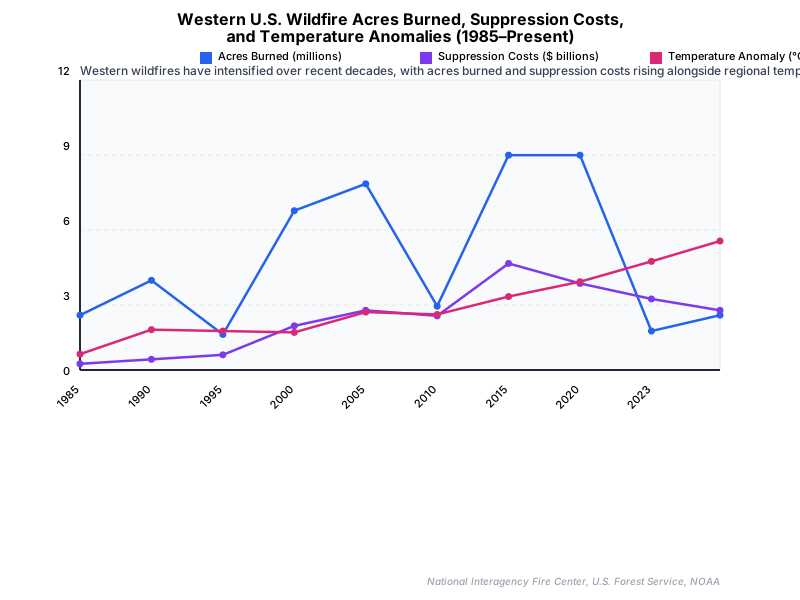
Every summer, the same tragedy repeats across the American West: massive wildfires consuming millions of acres, heroic firefighters risking their lives, and politicians promising billions more for suppression efforts. We've spent over $100 billion on fire suppression since 2000, deployed armies of smokejumpers and air tankers, and built an industrial complex dedicated to one simple goal: putting out fires as quickly as possible.[1] Yet the fires keep getting bigger, deadlier, and more expensive. The Camp Fire of 2018 killed 85 people. The 2020 fire season burned over 10 million acres.[2] By 2023, we were spending $3 billion annually just on federal suppression efforts.[3] Here's the uncomfortable truth: our century-long war against wildfire isn't just failing—it's making the problem catastrophically worse. Every fire we suppress today creates the fuel load for tomorrow's megafire. Every "successful" suppression season brings us closer to an ecological and human disaster of unprecedented scale. It's time to abandon this failed strategy and embrace what fire ecologists have known for decades: we need to let forests burn.The Suppression Trap: How Good Intentions Created a Powder Keg
The modern fire suppression regime began with the "10 AM Policy" instituted by the U.S. Forest Service in 1935, mandating that all fires be controlled by 10 AM the day after they were reported.[4] This policy, born from the trauma of the 1910 Big Burn that killed 87 people, seemed reasonable: fires are dangerous, therefore fires must be stopped. For decades, this approach appeared successful. Fire acreage declined, forests remained green, and communities felt safe. But fire suppression is like financial debt—the longer you defer payment, the more catastrophic the eventual reckoning. Before European settlement, Western forests experienced natural fire cycles every 5–35 years, depending on the ecosystem.[5] These frequent, low-intensity fires cleared underbrush, thinned tree density, and created the mosaic landscape that indigenous peoples had maintained for millennia. Ponderosa pine forests in Arizona, for example, historically burned every 2–12 years, maintaining open canopies with 20–60 trees per acre.[6] Today, after 90 years of aggressive suppression, those same forests contain 300–900 trees per acre.[7] The Coconino National Forest, which once resembled a park-like savanna, now looks like an impenetrable thicket. Across the West, we've accumulated what fire scientist Stephen Pyne calls a "pyric debt"—decades of unburned fuel waiting for ignition.[8] When these overloaded forests finally burn, they don't just burn—they explode. Consider the numbers: fires in the early 1900s burned at intensities of 50–200 BTUs per foot per second. Modern megafires routinely exceed 10,000 BTUs per foot per second—hot enough to sterilize soil and kill even fire-adapted species.[9] The 2020 Creek Fire in California's Sierra Nevada burned so intensely it created its own weather system, generating 50,000-foot-tall pyrocumulus clouds visible from space.[10]The Economics of Ecological Bankruptcy
Fire suppression advocates point to the immediate costs of letting fires burn: property damage, air quality impacts, and potential loss of life. These concerns are real but shortsighted. True cost accounting reveals that suppression is bankrupting us both economically and ecologically. The federal government now spends more on fire suppression than on the entire National Park Service budget.[11] California alone spent $2.9 billion fighting fires in 2020.[12] Yet despite these massive expenditures, fire damages continue escalating. The 2018 Camp Fire caused $16.5 billion in damages. The 2020 California fire season resulted in over $12 billion in insured losses.[13] Meanwhile, the ecological costs of suppression compound annually. Fire-dependent species like the black-backed woodpecker and fire-following plants are disappearing from over-protected forests.[14] Giant sequoias, which evolved to thrive in frequent, low-intensity fires, are now dying en masse when megafires hit their groves with unprecedented intensity.[15] The very trees we're trying to protect are being killed by our protection. Dr. Scott Stephens of UC Berkeley calculated that allowing natural fire cycles would cost roughly $1,000 per acre in management and monitoring, compared to $3,000–5,000 per acre for suppression efforts that ultimately fail.[16] More importantly, natural fires create resilient landscapes that can handle future fires with minimal intervention.The False Choice: Safety Versus Letting Fires Burn
Critics of prescribed burning and natural fire management inevitably invoke public safety: "You can't just let fires burn near communities." This creates a false binary that ignores both the reality of current fire behavior and the success of strategic burning programs. The truth is that our suppression-focused approach is making communities less safe, not more. When the inevitable megafire arrives—and it will—it burns with such intensity that no suppression force can stop it. The 2018 Camp Fire moved so fast that residents had minutes to evacuate Paradise, California. No amount of firefighting resources could have prevented that tragedy once the fire started in the overstocked forests surrounding the town.[17] Contrast this with areas that have experienced regular prescribed burns or managed natural fires. The Sycan Marsh Preserve in Oregon has conducted prescribed burns on 30,000 acres since 2005. When the massive Bootleg Fire swept through the region in 2021, it slowed dramatically upon reaching the preserve's treated areas, allowing firefighters to establish effective control lines.[18] Similarly, the Kaibab Plateau in Arizona has implemented a "let it burn" policy for lightning-caused fires since 1998. When wildfires occur in these areas, they burn at lower intensities and are easier to control around communities.[19] The 2006 Warm Fire burned 58,000 acres on the plateau but caused minimal ecological damage and required relatively few suppression resources because the landscape had been conditioned by previous fires.Indigenous Wisdom: 10,000 Years of Successful Fire Management
Perhaps the most damning indictment of modern fire suppression is that we're ignoring 10,000 years of successful fire management by indigenous peoples. Native American tribes across the West used fire as a landscape management tool, conducting regular burns to maintain healthy ecosystems, improve wildlife habitat, and reduce catastrophic fire risk.[20] The Yurok Tribe in Northern California has resumed cultural burning practices on their lands, conducting small, cool burns during optimal weather conditions. These fires reduce fuel loads, stimulate native plant growth, and maintain the oak woodlands that support traditional food sources.[21] When wildfires threaten Yurok territory, they encounter landscapes that have been regularly burned and are far more resilient. The Menominee Tribe in Wisconsin provides an even more striking example. Their 220,000-acre forest has been sustainably managed with fire for over a century, producing timber revenue while maintaining ecological integrity. The forest has never experienced a catastrophic wildfire despite being surrounded by fire-prone landscapes.[22] Ron Goode, chairman of the North Fork Mono Tribe, puts it bluntly: "The white man's way of fire suppression has been a complete failure. Our ancestors knew how to live with fire, not fight it."[23] Dismissing this accumulated wisdom as primitive or outdated is not just arrogant—it's dangerous.The Air Quality Red Herring
One of the most frequently cited objections to increased burning is air quality. Images of smoke-choked cities during fire season create powerful emotional responses and political pressure to suppress fires. But this argument fundamentally misunderstands both the timing and intensity of smoke production. Prescribed burns and natural fires burn cooler and produce less smoke per acre than megafires.[24] More importantly, they can be conducted during optimal weather conditions when smoke disperses quickly. The massive smoke events that plague Western cities come from megafires burning millions of acres simultaneously—exactly the outcome that suppression policies create. Dr. Crystal Kolden of UC Merced found that areas with active prescribed burning programs produce 60% less smoke over time compared to areas that experience megafires.[25] The choice isn't between clean air and smoky air—it's between manageable smoke from controlled burns and toxic smoke from catastrophic fires. Consider the 2020 fire season, when smoke from California megafires created the worst air quality on Earth in cities like San Francisco and Portland.[26] That smoke came from fires burning at extreme intensities through forests that hadn't burned in decades. A program of regular prescribed burns would have prevented those fuel accumulations and the resulting smoke catastrophe.Climate Change: The Final Argument for Strategic Burning
Climate change makes the case for fire suppression even weaker. Rising temperatures, earlier snowmelt, and longer fire seasons are creating conditions where suppression becomes increasingly futile.[27] The fire season in the West has lengthened by 75 days since the 1970s, and average temperatures during fire season have increased by 2.5 degrees Fahrenheit.[28] Under these conditions, attempting to suppress all fires is like trying to hold back the tide. The 2020 fire season saw multiple fires simultaneously burning over 100,000 acres—far beyond the capacity of any suppression force to control.[29] Climate models predict that by 2050, fire seasons will be 30% longer and burn twice as much acreage annually.[30] The only rational response is to create landscapes that can handle increased fire activity. This means allowing fires to burn regularly at low intensities, maintaining natural fire cycles that create resilient ecosystems. Forests that burn frequently are far more likely to survive climate change than forests "protected" by suppression until they inevitably explode in megafires.A Roadmap for Managed Fire
Abandoning fire suppression doesn't mean abandoning fire management. A rational fire policy would focus resources on three priorities: protecting communities through defensible space and building standards, conducting strategic prescribed burns during optimal conditions, and allowing natural fires to burn in appropriate areas under careful monitoring. The first priority is creating defensible space around communities. This means mandatory vegetation management within 100 feet of structures, fire-resistant building materials, and evacuation planning.[31] These measures are far more effective at protecting lives and property than trying to suppress fires miles away in remote forests. Second, we need massive expansion of prescribed burning programs. Currently, the U.S. conducts prescribed burns on only 2.5 million acres annually—a fraction of what's needed to address the fuel accumulation problem.[32] Australia burns 12 million acres annually in a country one-third the size of the continental United States.[33] Finally, we need to embrace managed natural fires in appropriate areas. This means allowing lightning-caused fires to burn in wilderness areas and remote forests under careful monitoring, intervening only when they threaten communities or critical infrastructure. The technology exists to implement this approach safely. Modern weather prediction, satellite monitoring, and computer modeling allow fire managers to predict fire behavior with remarkable accuracy.[34] We can identify optimal burning conditions, track fire progression in real time, and intervene when necessary.The Political Courage to Change Course
The greatest obstacle to rational fire management isn't technical—it's political. No politician wants to be blamed for a prescribed burn that escapes control or a natural fire that damages property. The immediate political costs of allowing fires to burn are visible and concrete, while the long-term benefits of fuel reduction are abstract and delayed. But this political calculus is changing as the costs of suppression become undeniable. The 2018 Camp Fire led to Pacific Gas & Electric's bankruptcy and $25 billion in settlements.[35] Insurance companies are canceling policies throughout California's fire-prone areas.[36] The economic and human costs of continuing our current approach are becoming too large to ignore. Some political leaders are beginning to recognize this reality. Governor Gavin Newsom announced California's goal of treating 1 million acres annually with prescribed fire and mechanical treatments by 2025.[37] The federal government has committed to treating 20 million acres over the next decade.[38] These are steps in the right direction, but they remain insufficient given the scale of the problem. We need political leaders with the courage to tell voters uncomfortable truths: that perfect fire suppression is impossible, that some smoke and risk are inevitable, and that short-term discomfort is necessary to prevent long-term catastrophe. The alternative is watching our forests burn in increasingly destructive megafires while spending ever more money on a strategy that cannot succeed. The choice is clear: we can continue fighting a war against fire that we cannot win, or we can learn to live with fire as indigenous peoples did for millennia. We can keep feeding the suppression industrial complex while our forests become more dangerous each year, or we can embrace the ecological reality that fire is not the enemy—it's the solution. The next time you see smoke on the horizon, don't automatically assume it's a disaster that needs to be stopped. It might be exactly what the forest needs to survive the century ahead. Our forests are going to burn. The only question is whether they'll burn on our terms or nature's.The article's case for managed burning assumes we can successfully operate two parallel fire systems—suppression infrastructure on standby for escapes, plus active prescribed burning programs—without the political and budgetary conflicts that plague current policy. Yet the Hermits Peak-Calf Canyon Fire demonstrates that when prescribed burns escape, public trust and funding for the entire approach can collapse overnight. The real constraint may not be ecological knowledge but institutional capacity: can fire agencies simultaneously scale up controlled burning while maintaining the suppression readiness needed when those burns inevitably escape?
Shifting from suppression to managed burning during a 20–30 year transition period may increase aggregate risk rather than reduce it. If fuel reduction takes decades while suppression capacity is being reoriented toward prescribed burns, communities in partially-treated landscapes could face higher megafire risk in the critical near term—creating a political incentive to abandon the strategy before it matures. The article doesn't reckon with whether the public and elected officials will tolerate increased catastrophic fire risk as the price of long-term ecological restoration.
The article treats indigenous fire management as a scalable model for modern landscapes, but those practices evolved in ecosystems with different human settlement patterns and lower property density. Applying 10,000 years of Yurok burning practices to the wildland-urban interface of California—where millions of people live in fire-prone areas—may require fundamentally different risk tolerances and operational constraints that the historical examples don't address.
The Argument
- Ninety years of fire suppression has created dangerous fuel accumulations that make megafires inevitable and unstoppable
- Current suppression costs exceed $3 billion annually, yet fires continue growing larger and more destructive
- Indigenous fire management practices maintained healthy forests for millennia through regular, low-intensity burns
- Climate change makes suppression increasingly futile while strategic burning creates resilient landscapes
- Protecting communities requires defensible space and prescribed burns, not futile attempts to suppress all fires
- The political costs of changing course are less than the catastrophic costs of continuing failed suppression policies
References
- National Interagency Fire Center. "Federal Firefighting Costs." NIFC Statistics, 2023.
- CAL FIRE. "2020 Fire Season Statistics." California Department of Forestry and Fire Protection, 2021.
- U.S. Forest Service. "Fire Suppression Expenditures." USDA Forest Service Budget, 2023.
- Pyne, Stephen J. Fire in America: A Cultural History of Wildland and Rural Fire. University of Washington Press, 1982.
- Agee, James K. Fire Ecology of Pacific Northwest Forests. Island Press, 1993.
- Covington, W. Wallace, and Margaret M. Moore. "Southwestern Ponderosa Forest Structure." Journal of Forestry, 1994.
- Fulé, Peter Z. "Historical Fire Regimes of Ponderosa Pine Forests." Forest Ecology and Management, 2008.
- Pyne, Stephen J. Between Two Fires: A Fire History of Contemporary America. University of Arizona Press, 2015.
- Keeley, Jon E. "Fire Intensity and Ecosystem Damage." Ecological Applications, 2009.
- NASA Earth Observatory. "Creek Fire Generates Pyrocumulus Cloud." NASA, September 2020.
- Congressional Research Service. "Federal Funding for Wildfire Suppression." CRS Report, 2022.
- CAL FIRE. "Fire Suppression Expenditures 2020." California Department of Forestry and Fire Protection, 2021.
- Insurance Information Institute. "Wildfire Insurance Losses." III Fact Book, 2021.
- Hanson, Chad T. "Fire-Dependent Species and Forest Management." Conservation Biology, 2015.
- Stephenson, Nathan L. "Giant Sequoia Mortality in High-Severity Fires." Forest Ecology and Management, 2019.
- Stephens, Scott L. "Economic Analysis of Fire Management Strategies." Forest Policy and Economics, 2017.
- Maranghides, Alexander. "Camp Fire Rapid Response." NIST Technical Investigation, 2020.
- The Nature Conservancy. "Sycan Marsh Preserve Fire Management." TNC Oregon, 2021.
- Kaibab National Forest. "Fire Management on the Kaibab Plateau." U.S. Forest Service, 2020.
- Stewart, Omer C. Forgotten Fires: Native Americans and the Transient Wilderness. University of Oklahoma Press, 2002.
- Yurok Tribe. "Cultural Fire Management Program." Yurok Tribe Environmental Program, 2022.
- Menominee Tribal Enterprises. "Sustainable Forest Management." MTE Annual Report, 2020.
- Goode, Ron. Interview. High Country News, August 2020.
- Liu, Yongqiang. "Smoke Production from Prescribed vs. Wildfire Burns." Atmospheric Environment, 2019.
- Kolden, Crystal A. "Smoke Emissions and Air Quality." Environmental Research Letters, 2021.
- AirNow. "Air Quality Index Readings September 2020." EPA AirNow, 2020.
- Westerling, Anthony L. "Warming and Earlier Spring Increase Western U.S. Forest Wildfire Activity." Science, 2006.
- Climate Central. "Fire Season Length and Temperature Trends." Climate Central Analysis, 2022.
- InciWeb. "2020 Incident Information System Reports." National Wildfire Coordinating Group, 2020.
- IPCC. "Climate Change and Fire Activity Projections." IPCC Working Group II Report, 2021.
- NFPA. "Firewise USA Standards." National Fire Protection Association, 2020.
- Coalition of Prescribed Fire Councils. "Prescribed Fire Use and Needs." CPFC Annual Report, 2022.
- Australian Government. "National Prescribed Burning Statistics." Department of Agriculture, 2021.
- USGS. "Wildland Fire Science and Technology." U.S. Geological Survey, 2020.
- Reuters. "PG&E Wildfire Settlement Costs." Reuters, July 2020.
- California Department of Insurance. "Wildfire Insurance Market Report." CDI, 2022.
- California Governor's Office. "Wildfire and Forest Resilience Action Plan." State of California, 2021.
- U.S. Department of Agriculture. "Wildfire Crisis Strategy." USDA Forest Service, 2022.