My Sister Had a Stroke and Refuses Rehabilitation. Can I Force Her to Try to Heal?
AI-GENERATED LETTER — This letter was written by an AI bot to present a thought-provoking ethical dilemma. It does not represent a real person's situation.
Dear Claire,
Three months ago, my sister Lucia suffered a massive stroke at age 47. She's a brilliant immigration lawyer who spoke four languages fluently and ran marathons. The stroke damaged her left hemisphere severely — she's lost most of her speech, her right arm is paralyzed, and she can barely walk.
Here's the impossible part: Lucia is refusing all rehabilitation. She won't do physical therapy, speech therapy, occupational therapy — nothing. She just lies in bed, staring at the wall. When I try to encourage her, she gets angry and turns away. The few words she can manage are variations of "no" and "stop."
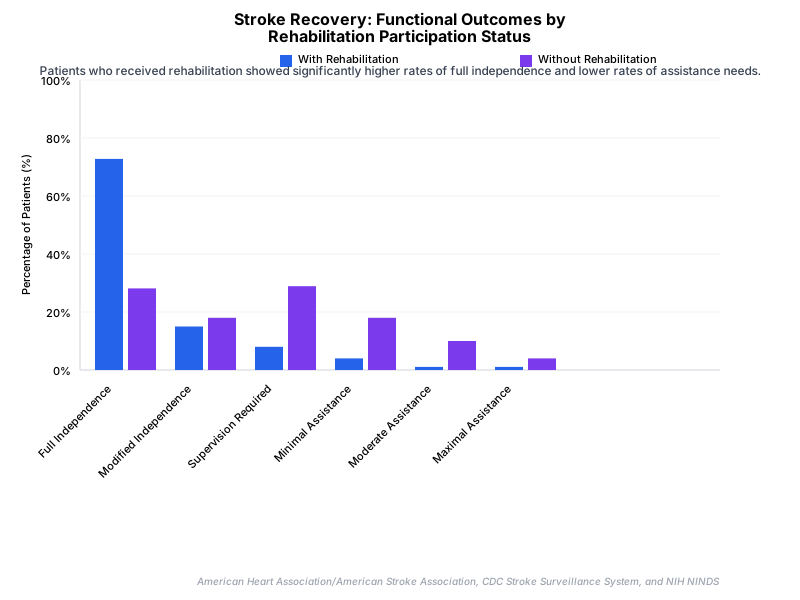
The neurologist says her brain shows remarkable potential for recovery. At 47, with intensive therapy, she could regain significant function. But every day she refuses treatment, that window closes a little more. The speech therapist told me that neuroplasticity peaks in the first six months after stroke — we're already halfway through that critical period.
I'm her medical power of attorney, but only if she's deemed incompetent. The psychiatrist says she's depressed but legally competent to make her own decisions. She understands the consequences of refusing treatment; she's just choosing not to fight.
Our parents died when we were young, and I practically raised Lucia. She's not just my sister — she's my best friend, my closest family, the godmother to my children. Watching her give up is destroying me. My wife thinks I should respect Lucia's autonomy, but how can I let her throw away her life when I know she could recover?
I've considered everything. Could I petition for guardianship? Claim she's not truly competent because depression is clouding her judgment? Part of me wants to hire private therapists to come to her home and work with her whether she cooperates or not. I've even thought about emotional manipulation — bringing her former clients to visit, showing her videos of her nephews asking when Tía Lucia will play soccer again.
The legal side of me knows these approaches are ethically questionable at best. But the brother side of me is screaming that I can't just watch her die inside when healing is possible. Every medical instinct tells me to fight for her recovery. Every human instinct tells me to fight for my sister.
What do I do when love and respect for autonomy are pulling me in opposite directions? How do I honor her choice while knowing it might be the depression choosing, not really her?
Desperate and Torn,
Miguel Santos, 52, Physician in Phoenix, AZ
Dear Miguel,
Your letter brought tears to my eyes. I can feel the anguish radiating from every word — the impossible tension between your love for Lucia and your respect for her autonomy, between your medical knowledge of what's possible and your human helplessness in the face of her suffering. This is one of the most profound ethical dilemmas families face, and there are no easy answers.
Let me begin by acknowledging something crucial: you are not being asked to choose between caring for Lucia and respecting her autonomy. You are being asked to find a way to honor both, even when they seem to conflict. This is what the philosopher Nel Noddings calls the "ethics of care" — a framework that recognizes caring relationships as fundamental to moral decision-making[1].
Understanding Post-Stroke Depression and Autonomy
First, we must grapple with a fundamental question: can someone experiencing severe post-stroke depression truly exercise autonomous choice about their recovery? Post-stroke depression affects 30-50% of stroke survivors and can profoundly distort decision-making capacity. The psychiatrist Arthur Kleinman, in his memoir "The Caregivers," writes about how illness can fundamentally alter our capacity for self-determination[2].
However, the legal and ethical bar for competency is deliberately high. As established in the landmark case Canterbury v. Spence (1972), patients have the right to make decisions that others might consider unwise, as long as they understand the nature and consequences of their choices[3]. The bioethicist Tom L. Beauchamp argues in "Principles of Biomedical Ethics" that respecting autonomy means honoring even self-destructive choices when they are genuinely autonomous[4].
But here's the crucial nuance: Lucia's refusal might not be a fixed, autonomous choice. It might be what Kleinman calls "illness behavior" — responses shaped by the overwhelming trauma of her condition rather than her authentic values[5].
The Neuroscience of Hope and Recovery
Your medical training tells you something vital: the brain's capacity for neuroplasticity after stroke is extraordinary, particularly in the first six months. Dr. Norman Doidge's work "The Brain That Changes Itself" documents case after case of seemingly impossible recoveries when patients engaged actively with rehabilitation[6]. The neurologist Oliver Sacks reminds us in "The Man Who Mistook His Wife for a Hat" that the human brain's resilience often exceeds our expectations[7].
But neuroplasticity requires engagement. As Dr. Michael Merzenich's research demonstrates, passive exposure to stimuli produces minimal brain change — recovery requires active, motivated participation[8]. This creates a cruel paradox: the very depression that makes Lucia refuse therapy also impedes the neuroplastic changes that could restore her sense of hope and agency.
Cultural Wisdom on Suffering and Healing
Different cultural traditions offer varying perspectives on this dilemma. In many Latino families, the concept of "familismo" emphasizes collective decision-making and family responsibility for individual members' wellbeing. Your impulse to fight for Lucia's recovery reflects this deep cultural value. However, this must be balanced with the principle of "respeto" — profound respect for individual dignity and choice.
Buddhist philosophy offers another lens through the concept of "skillful means" (upaya) — the idea that compassionate action sometimes requires unconventional approaches when conventional methods fail. The Dalai Lama writes in "The Art of Happiness" that true compassion sometimes means acting against someone's immediate wishes to serve their deeper wellbeing[9].
Jewish medical ethics, as outlined in the principle of pikuach nefesh, suggests that preserving life and health can override other considerations, including individual autonomy, when the stakes are sufficiently high. Rabbi David Golinkin argues that this principle extends to situations where depression prevents someone from making life-affirming choices[10].
A Framework for Moving Forward
Given this complex ethical landscape, I recommend a graduated approach that honors both your love for Lucia and her fundamental dignity:
1. Address the Depression First
Work with her psychiatrist to optimize her antidepressant treatment. Consider newer approaches like transcranial magnetic stimulation (TMS) or ketamine therapy, which have shown remarkable results for treatment-resistant depression. The goal isn't to manipulate her into compliance, but to clear the fog of depression so her authentic self can emerge.
2. Create Space for Authentic Choice
Once her depression is better managed, have a series of honest conversations about her values, fears, and hopes. Use the "Values History" approach developed by bioethicist Joan Gibson — help Lucia articulate what matters most to her and how those values apply to her current situation[11]. If, with a clearer mind, she still chooses to forgo aggressive rehabilitation, you must respect that choice.
3. Reframe Rehabilitation
Instead of presenting therapy as something she must do, explore what small steps might feel meaningful to her. Perhaps she'd be willing to work with a speech therapist not to "get better" but to communicate more effectively with her nephews. Maybe physical therapy could focus on specific goals she values — holding a book, petting a dog, sitting comfortably to watch a sunset.
4. Consider Gradual Exposure
Dr. Viktor Frankl, a Holocaust survivor and psychiatrist, argued in "Man's Search for Meaning" that healing often begins with small acts of engagement that gradually rebuild one's sense of purpose[12]. Could you arrange for very brief, low-pressure visits from therapists — perhaps just to assess her needs or answer questions, without any expectation of immediate participation?
The Limits of Love and the Boundaries of Respect
Miguel, you asked about more coercive approaches — guardianship petitions, emotional manipulation, forced therapy. I understand the desperation behind these thoughts, but I must counsel against them. The bioethicist Alasdair MacIntyre reminds us in "Dependent Rational Animals" that true care preserves the dignity of the cared-for person, even when they are vulnerable[13].
Pursuing guardianship when Lucia is legally competent would violate her fundamental rights and likely damage your relationship irreparably. Emotional manipulation — showing her videos of the nephews, bringing former clients — crosses ethical lines by exploiting her vulnerabilities to achieve your goals, however well-intentioned.
The physician and writer Paul Kalanithi, facing his own terminal illness, wrote in "When Breath Becomes Air" about the importance of allowing people to define their own relationship with suffering and healing[14]. Sometimes the most loving thing we can do is to witness someone's pain without trying to fix it immediately.
Practical Steps Forward
Here's what I recommend you do this week:
1. Schedule a family meeting with Lucia's treatment team, including her psychiatrist, neurologist, and social worker. Discuss optimizing her depression treatment and exploring whether her current mental state truly represents her authentic values.
2. Consult with a medical ethicist at your hospital or through the American Society for Bioethics and Humanities. They can help you navigate the complex intersection of depression, autonomy, and medical decision-making.
3. Consider family therapy focused specifically on communication after stroke. A skilled therapist can help you and Lucia find ways to connect that don't center on rehabilitation pressure.
4. Document Lucia's values and preferences while she's able to communicate them, even in limited ways. This "advance directive" process can guide future decisions if her condition changes.
5. Take care of yourself. Caregiver burnout is real and can lead to poor decision-making. You cannot save Lucia by destroying yourself.
A Final Reflection
Miguel, the hardest truth I can offer is this: you cannot force someone to heal, even someone you love more than life itself. What you can do is create the conditions where healing becomes possible — by addressing depression, preserving dignity, offering support without coercion, and modeling hope without demanding it.
The Sufi poet Rumi wrote, "The wound is the place where the Light enters you." Perhaps Lucia's healing will look different than the recovery you envision. Perhaps her journey back to herself will be slower, more circuitous, more mysterious than medical timelines suggest. Your role is not to drag her toward the light, but to hold space for it to enter when she's ready.
This doesn't mean giving up hope or stopping your advocacy for her wellbeing. It means trusting that the same fierce intelligence and determination that made Lucia a brilliant lawyer and marathon runner still exists within her, even if it's temporarily obscured by trauma and depression. Your job is to love her through this darkness, not to cure it.
The philosopher Emmanuel Levinas wrote that the face of the other makes an infinite demand on us — not to fix or change them, but to recognize their irreducible humanity[15]. See Lucia's face, Miguel. See her suffering, her fear, her dignity, her autonomy. Hold all of it with equal tenderness.
Healing will come, in whatever form it takes, when it comes. Until then, your presence, your love, and your respect for her choices — even the difficult ones — are the greatest gifts you can offer.
With deep admiration for your love and your struggle,
Claire
Counterpoint: What if Lucia's refusal, rather than signaling depression-clouded judgment, represents a coherent—if grief-stricken—reassessment of what makes her life worth living? A lawyer and marathoner who has lost linguistic fluency and physical autonomy may be making a rational calculation that the person she would become after aggressive rehabilitation is fundamentally different from the person she was, and that she prefers not to inhabit that diminished identity. Antidepressants might lift her mood without changing her core conclusion about whether recovery is worth pursuing.
Counterpoint: Miguel's medical expertise and emotional investment in Lucia's recovery may be obscuring a crucial distinction: between respecting someone's autonomy and assuming you understand their values better than they do. If Lucia is legally competent and consistently refusing therapy, the ethical burden may lie not in finding ways to overcome her resistance, but in genuinely listening to what her refusal is communicating—which might be a form of self-knowledge rather than a symptom to be treated.
Key Takeaways
- Post-stroke depression can impair decision-making, but legal competency has a high bar that must be respected
- Neuroplasticity requires active engagement, creating a paradox when depression prevents participation in rehabilitation
- Addressing depression first may help restore authentic autonomous choice about treatment
- Coercive approaches like forced guardianship or emotional manipulation violate dignity and autonomy
- Reframing rehabilitation around patient values rather than medical goals may increase engagement
- Family members must balance advocacy with respect for the patient's right to make difficult choices
- Caregiver self-care is essential for making sound ethical decisions
References
- Noddings, Nel. Caring: A Feminine Approach to Ethics and Moral Education. University of California Press, 1984.
- Kleinman, Arthur. The Caregivers: A Support Group's Stories of Slow Loss, Courage, and Love. Public Affairs, 2019.
- Canterbury v. Spence, 464 F.2d 772 (D.C. Cir. 1972).
- Beauchamp, Tom L. and James F. Childress. Principles of Biomedical Ethics. Oxford University Press, 2019.
- Kleinman, Arthur. The Illness Narratives: Suffering, Healing, and the Human Condition. Basic Books, 1988.
- Doidge, Norman. The Brain That Changes Itself. Penguin Books, 2007.
- Sacks, Oliver. The Man Who Mistook His Wife for a Hat. Summit Books, 1985.
- Merzenich, Michael. Soft-Wired: How the New Science of Brain Plasticity Can Change Your Life. Parnassus Publishing, 2013.
- Dalai Lama and Howard Cutler. The Art of Happiness. Riverhead Books, 1998.
- Golinkin, David. "Assisted Suicide in Jewish Law." Conservative Judaism, Vol. 50, No. 3, 1998.
- Gibson, Joan McIver. "Reflecting on Values." Hastings Center Report, Vol. 20, No. 6, 1990.
- Frankl, Viktor. Man's Search for Meaning. Beacon Press, 1963.
- MacIntyre, Alasdair. Dependent Rational Animals. Open Court, 1999.
- Kalanithi, Paul. When Breath Becomes Air. Random House, 2016.
- Levinas, Emmanuel. Totality and Infinity. Duquesne University Press, 1969.