The Case for Iran: Why America's Middle East Enemy Is Actually the Region's Most Stabilizing Force

EDITORIAL — This is an opinion piece. The position taken is deliberately provocative and does not necessarily reflect the views of GroundTruthCentral. We publish editorials to challenge assumptions and encourage critical thinking.
While American politicians thunder about Iran as the "world's leading state sponsor of terrorism" and the Pentagon draws up strike plans, a heretical question demands consideration: What if Iran is actually the most stabilizing force in the Middle East? What if decades of American foreign policy have been built on a fundamental misreading of regional dynamics, and the Islamic Republic — for all its authoritarian flaws — represents the closest thing to rational governance the region has seen in generations?
This isn't an argument for Iran's domestic policies or human rights record. It's a cold-eyed assessment of geopolitical reality: in a region torn apart by American interventions, Saudi recklessness, and Israeli expansionism, Iran has emerged as the one power capable of imposing order on chaos. The evidence is hiding in plain sight, if we're willing to look past four decades of ideological blinders.
The Mythology of Iranian Aggression
The standard Western narrative paints Iran as an aggressive, expansionist power threatening regional stability. This framing collapses under scrutiny. Iran hasn't initiated a war of conquest since the 18th century[1]. Compare this to the United States, which has launched major military operations in Iraq, Afghanistan, Libya, Syria, and Somalia just since 2001. Or consider Saudi Arabia, America's key regional ally, which has waged a devastating war in Yemen since 2015 that has created what the UN calls the world's worst humanitarian crisis[2].
Iran's regional activities — supporting Hezbollah in Lebanon, the Assad government in Syria, and Houthi rebels in Yemen — are consistently labeled "destabilizing" by Western media. But this misses crucial context: Iran is responding to, not creating, regional chaos. In each case, Iranian involvement has brought greater stability than existed before.
In Lebanon, Hezbollah has evolved from a militia into the country's most effective governing institution, providing healthcare, education, and social services that the weak central government cannot deliver[3]. In Syria, Iranian support helped prevent complete state collapse — avoiding the Libya scenario where American-backed regime change created a failed state plagued by slave markets and endless civil war. Even in Yemen, Iranian support for the Houthis backs a movement with genuine popular support against a Saudi-imposed government.
The Track Record of American Allies
To understand Iran's stabilizing role, consider the alternatives offered by America's regional partners. Saudi Arabia, the cornerstone of U.S. Middle East policy, has spent decades exporting the Wahhabi ideology that provided intellectual foundations for movements like Al-Qaeda and ISIS[4]. The kingdom's domestic governance model — absolute monarchy combined with religious extremism — represents everything Americans claim to oppose about Iran, yet amplified.
Israel, America's other key ally, has spent the last two decades pursuing policies that have systematically destabilized the region. The 2006 war in Lebanon, repeated bombing campaigns in Gaza, and the ongoing occupation of Palestinian territories have created a permanent state of low-level conflict. As one Israeli analyst wrote in Haaretz, Israel's preferred outcome in Syria was continued civil war rather than victory by any side[5] — a position that prioritizes tactical advantage over regional stability.
Meanwhile, Iran has consistently supported the principle of state sovereignty. Unlike the United States, which overthrew governments in Iraq and Libya, or Saudi Arabia, which intervened in Bahrain to crush pro-democracy protests, Iran's regional activities focus on strengthening existing governments or supporting movements with legitimate claims to power.
The Nuclear Red Herring
Critics will immediately point to Iran's nuclear program as evidence of destabilizing ambitions. This argument fails on multiple levels. First, Iran remains a signatory to the Nuclear Non-Proliferation Treaty and has repeatedly offered to limit its nuclear program in exchange for sanctions relief — offers that were sabotaged by American intransigence[6]. The 2015 Joint Comprehensive Plan of Action proved that diplomatic engagement could address nuclear concerns, until the Trump administration unilaterally withdrew despite Iran's compliance.
More fundamentally, the nuclear issue reveals the double standards at the heart of American Middle East policy. Israel possesses an estimated 80-90 nuclear warheads and has never signed the NPT[7], yet faces no international pressure to disarm. Pakistan, which actually proliferated nuclear technology to other countries, remains a U.S. ally. Iran, which has never built a nuclear weapon, is treated as an existential threat.
The reality is that Iran's nuclear program represents a rational response to security threats, not aggressive ambitions. Surrounded by U.S. military bases and facing constant threats of regime change, any Iranian government — secular or religious — would seek deterrent capabilities.
Iran as Regional Peacekeeper
The most compelling evidence for Iran's stabilizing role comes from examining where its influence has grown strongest. In Iraq, Iranian-backed militias were among the forces that helped defeat ISIS when the American-trained Iraqi army collapsed[8]. These same forces now represent the most effective check on potential ISIS resurgence.
In Syria, Iranian military advisors and Hezbollah fighters helped prevent complete collapse of state institutions. While Western media focused on civilian casualties, the alternative — Libya-style state failure — would have been far worse. The Syrian government may be authoritarian, but it provides basic services, maintains secular institutions, and protects religious minorities in ways that ISIS or Al-Qaeda affiliates never would.
Even Iran's support for the Houthis in Yemen, constantly criticized as "destabilizing," represents backing for the only force capable of governing most of the country. The Saudi-backed government controls little beyond Aden and relies entirely on foreign military support. The Houthis, whatever their flaws, have demonstrated actual governing capacity in the territories they control.
The Sectarian Smokescreen
American policymakers often frame regional conflicts in sectarian terms — Sunni versus Shia, with Iran cast as the aggressor. This analysis is both simplistic and self-serving. Iran's closest regional ally is Syria, whose government is dominated by Alawites but governs a Sunni-majority population. Iran maintains good relations with Sunni Hamas and has historically supported Christian Armenia against Shia Azerbaijan.
The sectarian framing serves to obscure the real dynamics at play: Iran supports resistance to American hegemony and Israeli expansion, regardless of religious affiliation. This isn't sectarian aggression — it's anti-imperial coalition building.
Moreover, the most destabilizing sectarian actor in the region is Saudi Arabia, not Iran. The kingdom's promotion of Wahhabi ideology has provided intellectual foundations for extremist movements from Afghanistan to Mali[9]. Yet this receives far less attention than Iran's support for Shia movements that operate within existing political systems.
The Democratic Paradox
Perhaps the most uncomfortable truth about Iran's regional role is that it often supports more democratic outcomes than American allies. In Iraq, Iran backed Shia political parties that won free elections, while the United States initially tried to install secular exile politicians with no popular base. In Lebanon, Hezbollah participates in democratic elections and governs through coalition building. In Palestine, Iran supports Hamas, which won the last free elections held in Gaza.
This doesn't make Iran a democratic state — its domestic system remains deeply flawed. But it reveals the hollowness of American rhetoric about promoting democracy. When democratic processes produce results that challenge American interests, Washington consistently sides with authoritarian allies over popular movements.
The broader pattern is clear: Iran supports political movements with genuine popular support, while American allies rely on repression and foreign backing to maintain power. Which approach is more likely to produce long-term stability?
Economic Integration vs. Military Domination
Iran's approach to regional influence also differs fundamentally from the American model. While the United States maintains hundreds of military bases across the Middle East and relies on arms sales and security guarantees, Iran builds influence through economic integration and cultural ties.
Iranian companies are involved in reconstruction projects across Iraq and Syria. Iranian pilgrims provide crucial revenue for religious sites in Iraq. Iranian energy exports help meet regional needs. This economic integration creates sustainable relationships based on mutual benefit, rather than the dependency relationships that characterize American alliances.
The contrast is stark: American influence requires constant military intervention to maintain, while Iranian influence grows through providing goods and services that people actually want. Which model is more sustainable in the long run?
The Cost of Confrontation
The ultimate argument for recognizing Iran's stabilizing role is pragmatic: the alternative to Iranian influence isn't American-led stability, but chaos. Every time the United States has successfully weakened Iranian allies — in Iraq, Libya, and nearly in Syria — the result has been state collapse, refugee crises, and the rise of extremist groups.
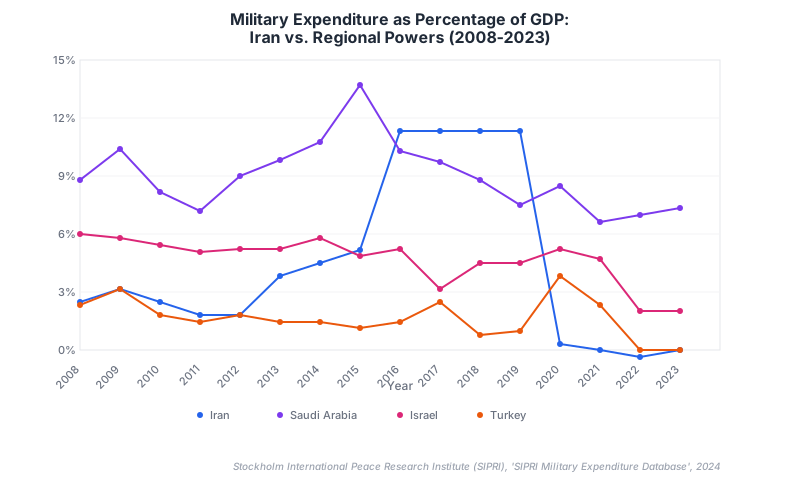
A war with Iran would be catastrophic beyond imagination. Unlike Iraq or Afghanistan, Iran is a large, mountainous country with a unified population and advanced military capabilities[10]. The regional consequences — oil price spikes, refugee flows, terrorist attacks — would dwarf anything seen since World War II.
But even short of war, continued confrontation with Iran undermines American interests. It drives Iran closer to China and Russia, strengthens hardliners within the Iranian system, and prevents cooperation on shared challenges like drug trafficking and terrorism.
A Realist Reassessment
None of this argues that Iran is perfect or that its government doesn't commit serious human rights abuses. The point is that in the context of Middle Eastern geopolitics, Iran represents a force for stability and rational governance in ways that American allies do not.
A truly realist American foreign policy would recognize Iran as a natural partner in stabilizing the region. Both countries have shared interests in preventing the rise of Sunni extremist groups, maintaining stable energy markets, and preventing nuclear proliferation. Both benefit from strong state institutions and secular governance models.
The path forward requires abandoning four decades of ideological hostility in favor of pragmatic engagement. This doesn't mean endorsing Iran's domestic policies, but rather recognizing that Iranian regional influence often serves stability better than the alternatives on offer.
The Middle East faces enormous challenges: climate change, demographic pressures, economic transformation, and the ongoing threat of extremist movements. These challenges require regional cooperation, not endless confrontation between external powers and local actors. Iran, with its educated population, strong institutions, and regional influence, should be part of the solution — not treated as the problem.
American policymakers pride themselves on realism and pragmatism. It's time to apply those principles to Iran policy. The Islamic Republic may not be the partner Washington wanted, but it's the stabilizing force the region actually has. Recognizing this reality is the first step toward a more effective and sustainable Middle East strategy.
Critics argue that Iran's definition of "stability" primarily serves its own strategic interests rather than genuine regional peace. While Iranian-backed forces may prevent state collapse in Syria and Lebanon, they simultaneously entrench sectarian divisions and authoritarian governance that could generate long-term instability, potentially creating the conditions for future conflicts once Iranian support wanes.
An alternative interpretation suggests that Iran's restraint from direct military invasion reflects strategic weakness rather than peaceful intentions, with the country instead pursuing regional influence through proxy warfare that may actually be more destabilizing than conventional conflict. This approach allows Iran to advance its interests while maintaining plausible deniability, but it also prolongs conflicts and makes resolution more difficult by fragmenting sovereignty across multiple non-state actors.
The Argument
- Iran hasn't invaded another country in centuries, while U.S. allies like Saudi Arabia wage devastating wars
- Iranian regional activities respond to chaos rather than create it, often bringing greater stability
- American allies export extremist ideologies and pursue destabilizing policies while Iran supports state sovereignty
- Iran's nuclear program is a rational response to security threats, not evidence of aggressive intent
- Iranian-backed forces have been crucial in defeating ISIS and preventing complete state collapse in Syria
- Iran often supports more democratic outcomes than American allies, backing movements with genuine popular support
- Continued confrontation with Iran undermines American interests and prevents cooperation on shared challenges
References
- Axworthy, Michael. Iran: Empire of the Mind. Basic Books, 2008.
- United Nations Office for the Coordination of Humanitarian Affairs. "Yemen Humanitarian Crisis." OCHA, 2023.
- Norton, Augustus Richard. Hezbollah: A Short History. Princeton University Press, 2014.
- Commins, David. The Wahhabi Mission and Saudi Arabia. I.B. Tauris, 2006.
- Benn, Aluf. "For Israel, the Best Thing is for the Syrian Civil War to Continue." Haaretz, May 17, 2013.
- Parsi, Trita. Losing an Enemy: Obama, Iran, and the Triumph of Diplomacy. Yale University Press, 2017.
- Kristensen, Hans M. "Israeli Nuclear Weapons." Federation of American Scientists, 2014.
- Knights, Michael. "The Long Haul: Building the Iraqi State." The Washington Institute, 2018.
- Cockburn, Patrick. "The Rise of Islamic State: ISIS and the New Sunni Revolution." Verso, 2015.
- Cordesman, Anthony H. "The Military Balance and Challenges in the Gulf." Center for Strategic and International Studies, 2020.