Why do movies about space disasters always make so much money?

From Gravity to The Martian, from Interstellar to the upcoming adaptation of Project Hail Mary, Hollywood has discovered a reliable formula: strand characters in mortal peril among the stars, and audiences will flock to theaters. But why do these cosmic catastrophes consistently strike box office gold? While space disaster films represent a small slice of cinema, their remarkable commercial success reveals something profound about human psychology and our complicated relationship with both catastrophe and the cosmos.
These films tap into primal fears about isolation and survival while offering spectacular visuals that showcase cutting-edge filmmaking technology. As we enter a new space age—with private companies launching civilians into orbit and governments planning Mars missions—space disaster movies serve as both thrilling escapism and cautionary tales about our cosmic ambitions.
The Psychology of Controlled Fear
Space disaster films exploit what psychologists call "benign masochism"—the human tendency to seek out negative emotions in safe contexts[1]. Unlike earthbound disasters, space catastrophes offer audiences a uniquely intense form of vicarious terror. The vacuum of space represents the ultimate hostile environment, where a single breach in a spacesuit means instant death.
The isolation factor amplifies this psychological appeal. Characters are typically cut off from any possibility of rescue, creating what narrative theorists call "ultimate stakes." When Matt Damon faces starvation on Mars in The Martian, or Sandra Bullock drifts untethered in Gravity, audiences experience genuine dread while remaining safely seated. This controlled exposure to existential fear may serve an important psychological function, allowing viewers to process their own anxieties about mortality and helplessness.
Visual Spectacle and Technological Wonder
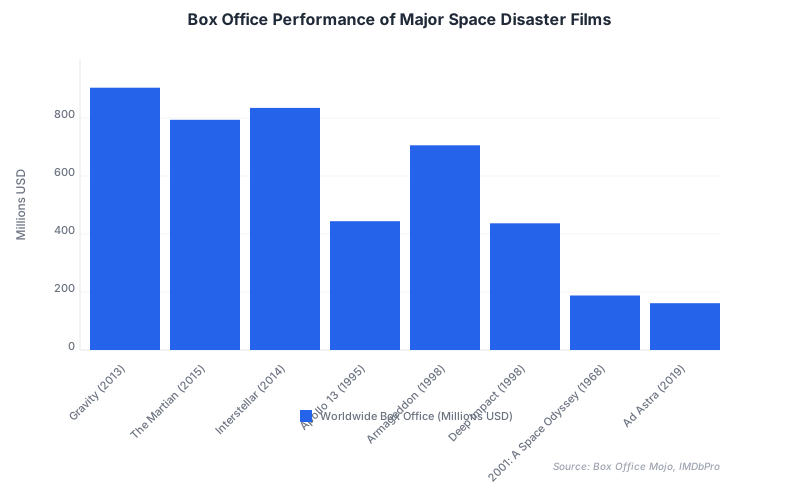
The commercial success of space disaster films is inseparable from their visual impact. Modern CGI has made it possible to create convincing spacecraft, space stations, and alien worlds that were impossible just decades ago. Gravity earned over $723 million worldwide largely due to groundbreaking visual effects that made audiences feel they were truly floating in space[3].
These films benefit from the "technological sublime"—the awe-inspiring combination of advanced filmmaking techniques with subject matter showcasing human achievement. Even as spacecraft explode on screen, audiences marvel at both the fictional technology depicted and the real technology creating the illusion.
Premium formats like IMAX have proven particularly lucrative. Interstellar generated substantial IMAX revenue as part of its $677 million worldwide gross, with premium screenings representing a disproportionate share of earnings[4]. The immersive nature of large-format projection enhances the claustrophobic and agoraphobic elements that make space disasters psychologically effective.
The Hero's Journey in Extreme Isolation
Space disaster narratives tap into archetypal storytelling patterns that resonate across cultures. The isolated protagonist facing impossible odds mirrors the classic hero's journey, but with a unique twist—the "underworld" is literally the void of space. This creates "compressed mythology," with all the elements of epic storytelling condensed into a survival scenario.
Protagonists must overcome not just external threats, but psychological challenges like despair and loneliness. This internal journey resonates with audiences facing their own struggles, making space a metaphor for personal adversity. When Mark Watney in The Martian "sciences the hell" out of his survival problems, he embodies the modern heroic ideal of using intelligence and persistence to overcome impossible challenges.
The redemptive arc common to these films—where characters discover inner strength and reconnect with humanity—provides emotional payoff that justifies the intense anxiety of disaster sequences. This pattern of suffering followed by transcendence has deep roots in human storytelling traditions.
Cultural Anxieties About Technology and Progress
The popularity of space disaster films may reflect broader anxieties about technological progress and humanity's relationship with nature. As real-world space exploration accelerates, these films serve as outlets for collective fears about cosmic exploration risks. The interest in Project Hail Mary—where humanity's survival depends on a desperate space mission—reflects contemporary concerns about climate change and existential threats.
These narratives often contain subtle critiques of human hubris. Disasters typically result from technological failure or human error, suggesting our tools and ambitions may outpace our wisdom. Yet paradoxically, solutions usually involve more technology and ingenuity, reflecting our conflicted relationship with progress.
The timing of successful space disaster films often correlates with technological anxiety or space program developments. Gravity arrived during debates about NASA funding and the Space Shuttle retirement. The Martian coincided with renewed Mars exploration interest. These films let audiences vicariously experience both the wonder and terror of space exploration without leaving Earth.
International Appeal and Universal Themes
Space disaster films have proven remarkably successful internationally, often earning more overseas than domestically. Gravity earned $438 million internationally compared to $274 million in North America[5]. This global appeal stems from universal survival themes and minimal cultural specificity required to understand space-based narratives.
The visual nature of these films transcends language barriers. Much of the tension and spectacle communicates through imagery and sound rather than dialogue, making them ideal for global distribution where subtitles might diminish impact.
Space exploration represents one of humanity's few truly collective endeavors. The International Space Station and collaborative missions create a sense that space is humanity's shared frontier rather than any single nation's domain. This universality helps space disaster films avoid political sensitivities that might limit other genres in certain markets.
Economic Factors and Market Positioning
From a commercial perspective, space disaster films occupy a valuable entertainment niche. They combine elements of multiple successful genres—action, thriller, science fiction, and human drama—while offering unique selling points that differentiate them from terrestrial disasters or generic action movies.
Production costs, while substantial, are often justified by multiple revenue streams. Beyond theatrical release, these films perform well in premium formats, home video, and streaming platforms. The visual spectacle driving initial success continues attracting viewers in home contexts, particularly as home theater technology improves.
Marketing campaigns can leverage both spectacle and human drama, appealing to different audience segments. The scientific accuracy many films strive for generates positive publicity and educational tie-ins, extending cultural impact beyond pure entertainment.
The apparent success of space disaster films might reflect survivorship bias rather than a reliable formula. For every Gravity or The Martian, there are underperforming films like Ad Astra and Life that suggest the subgenre's track record is more mixed than selective examples indicate. What we're seeing may be the outsized influence of a few breakout hits creating the illusion of a consistently profitable category.
The box office success of these films could have more to do with star power and directorial pedigree than space disaster elements specifically. Gravity succeeded with Sandra Bullock and Alfonso Cuarón, The Martian with Matt Damon and Ridley Scott, and Interstellar with Christopher Nolan's brand recognition. Strip away the A-list talent, and the space disaster premise alone might prove far less commercially viable than the psychological theories suggest.
Key Takeaways
- Space disaster films exploit "benign masochism," allowing audiences to safely experience extreme fear and isolation in controlled environments
- Advanced visual effects technology creates convincing space environments that drive box office success, particularly in premium formats like IMAX
- These narratives tap into archetypal storytelling while serving as outlets for cultural anxieties about technology, progress, and existential threats
- Universal themes and visual storytelling create strong international appeal, with films often earning more overseas than domestically
- Space disaster films occupy a valuable commercial niche, combining multiple genres while offering unique spectacle across various distribution platforms
- Success may depend more on star power and directorial talent than the space disaster premise itself, suggesting the formula's reliability remains unproven
References
- Rozin, Paul, et al. "Glad to be sad, and other examples of benign masochism." Judgment and Decision Making, 2013.
- "Gravity (2013)." Box Office Mojo. https://www.boxofficemojo.com/title/tt1454468/
- "Interstellar (2014)." Box Office Mojo. https://www.boxofficemojo.com/title/tt0816692/
- McClintock, Pamela. "Box Office Milestone: 'Gravity' Crosses $700M Worldwide." The Hollywood Reporter, 2013.