
Why does the price of oil spike every time there's conflict in the Middle East?

When tensions flare between Iran and Israel, oil prices spike. When conflicts erupt across the Middle East, energy markets convulse. This pattern has repeated for over half a century, yet it still catches investors off guard. Why does a region containing just 5% of the world's population wield such outsized power over global energy prices—often before a single barrel of oil is actually disrupted?
The answer lies in a perfect storm of geography, economics, and market psychology that has made the Middle East the world's most critical energy chokepoint. Understanding this dynamic reveals how modern oil markets operate on fear as much as fundamentals, creating a system where the mere threat of conflict can send shockwaves through the global economy.
The Middle East's Stranglehold on Global Oil
The Middle East's outsized influence stems from its overwhelming dominance in global petroleum. The region holds approximately 48% of the world's proven oil reserves, with Saudi Arabia alone controlling about 17% of the global total[1]. Persian Gulf countries collectively produce around 30% of the world's crude oil and control nearly 40% of global exports[2].
Iran exemplifies this concentration of power. As the world's fourth-largest oil producer, it holds roughly 9% of global proven reserves and pumps 3.8 million barrels daily[3]. But Iran's true leverage comes from its strategic location along the Strait of Hormuz, giving it potential control over far more oil than it actually produces.
This creates what economists call "supplier concentration risk"—when a handful of producers control a massive share of any market, disruptions to even one major supplier can trigger disproportionate price swings. The International Energy Agency has repeatedly warned that this geographic concentration makes global oil markets dangerously vulnerable[4].
The World's Most Dangerous Bottleneck
Geography amplifies the Middle East's market power through critical transportation chokepoints. The Strait of Hormuz—a narrow waterway between Iran and Oman—serves as the world's most important oil transit route, with roughly 21% of global petroleum flowing through daily[5].
Iran's ability to threaten this strait represents what military strategists call "asymmetric capability"—the power to inflict economic damage far exceeding the country's relative strength. History proves this vulnerability: during the Iran-Iraq War's "Tanker War" phase, attacks on Gulf shipping sent oil prices soaring despite minimal actual supply disruptions[6].
Other critical infrastructure includes the Suez Canal, through which about 12% of global oil trade passes, and various pipeline networks connecting Middle Eastern production to world markets[7]. The interconnected nature of these routes means conflict in one area can create global bottlenecks.
Fear Factor: How Psychology Drives Oil Prices
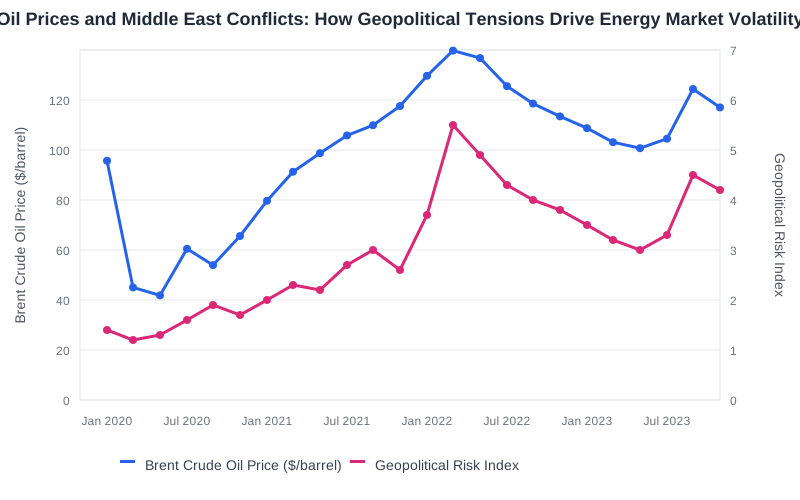
Oil markets don't just respond to physical supply and demand—they react to emotions, expectations, and fears. Energy economists have identified the "geopolitical risk premium"—extra costs built into oil prices to account for potential future disruptions[8].
This fear factor can add $5-15 per barrel during Middle Eastern tensions, even when no actual supply disruptions occur. When drones attacked Saudi Aramco facilities in 2019, oil prices spiked over 15% in a single day, despite Saudi assurances that production would quickly resume[9].
Behavioral economics reveals why: traders exhibit "loss aversion," reacting more strongly to potential supply losses than equivalent gains. This psychological bias means conflict threats drive prices up more dramatically than peace agreements drive them down[10].
The 24/7 nature of global trading amplifies these effects. News of Middle Eastern tensions can trigger algorithmic responses within milliseconds, creating rapid price movements that become self-reinforcing as other traders react to the initial spikes.
Lessons from History's Oil Shocks
Historical patterns reveal the Middle East's consistent ability to roil energy markets. The 1973 Arab Oil Embargo saw prices quadruple from $3 to $12 per barrel, demonstrating how the region could weaponize energy exports[11].
The 1979 Iranian Revolution removed 5.6 million barrels daily from global markets, driving prices from $13 to $34 per barrel over 18 months[12]. The 2003 Iraq War pushed oil above $37 per barrel amid fears of broader regional chaos.
Even conflicts not directly involving major producers affect prices through contagion effects. The 2006 Israel-Lebanon War saw crude spike despite Lebanon's minimal production, as traders feared the conflict might spread to Iran or disrupt regional shipping[13].
These precedents have created "institutional memory" in oil markets—traders have learned to anticipate disruptions during Middle Eastern conflicts, leading to preemptive price increases that often exceed actual supply impacts.
Iran's Unique Power to Disrupt
Iran's position makes it uniquely capable of influencing oil markets through both direct and indirect means. Beyond its substantial production, Iran maintains influence over regional proxy groups and has demonstrated sophisticated capabilities for targeting energy infrastructure.
The Revolutionary Guard Corps has developed advanced methods for attacking oil facilities and shipping, as shown in the 2019 Aramco strikes and various tanker incidents in the Persian Gulf[14]. These capabilities create "escalation dominance"—the ability to inflict economic costs while maintaining plausible deniability.
Iran's nuclear program adds another layer of complexity. The 2018 reimposition of U.S. sanctions removed approximately 1.5 million barrels daily from global supply, pushing up prices even without active military conflict[15].
The country's proxy network means conflicts involving Iranian-backed groups in Yemen, Lebanon, or Iraq can trigger broader escalation fears, affecting oil prices even when Iran isn't directly fighting.
Modern Markets Amplify Ancient Risks
Today's interconnected global economy amplifies oil price shocks across multiple sectors. The financialization of commodity markets has created new pathways for geopolitical risks to affect prices through derivative trading, ETFs, and algorithmic systems[16].
Central bank policies can amplify oil movements during crises. When investors flee to safe-haven assets during Middle Eastern conflicts, currency flows affect oil prices since crude trades primarily in dollars[17].
Oil market integration with broader financial markets means geopolitical premiums can be influenced by factors beyond supply and demand, including debt concerns, inflation expectations, and monetary policy. During 2020 Iran-U.S. tensions following Qasem Soleimani's assassination, oil spiked due to both supply concerns and broader market risk-aversion[18].
The Limits of Market Stabilization
Governments have developed tools to combat oil price volatility, though with mixed success. The U.S. Strategic Petroleum Reserve, containing over 600 million barrels, represents the world's largest emergency stockpile and has been deployed multiple times during geopolitical crises[19].
The International Energy Agency coordinates emergency responses among member countries. During the 2011 Libyan conflict, IEA members released 60 million barrels to offset supply disruptions[20].
However, these mechanisms face limitations when market psychology drives prices beyond levels justified by actual supply disruptions. The fear component of oil spikes often proves resistant to strategic reserve releases, particularly when traders anticipate extended instability.
OPEC's role as stabilizer has evolved, with the organization sometimes increasing production to offset disruptions while other times maintaining discipline to support higher prices. The group's response depends heavily on key members' interests, particularly Saudi Arabia's relationship with conflict participants.
The relationship between Middle Eastern conflicts and oil spikes may be more self-fulfilling prophecy than genuine supply risk. With U.S. shale production, Canadian oil sands, and strategic reserves providing unprecedented supply flexibility, today's markets are fundamentally different from the 1970s—yet traders react as if old vulnerabilities still exist, creating artificial volatility disconnected from supply realities.
Rather than conflicts driving oil prices, causation may increasingly run in reverse: oil speculation during geopolitical tensions could destabilize the very regions it claims to respond to. When algorithms automatically bid up futures at the first sign of Middle Eastern unrest, the resulting economic pressures on both importing and oil-dependent economies may actually exacerbate regional conflicts, creating a dangerous feedback loop benefiting only financial speculators.
Key Takeaways
- The Middle East's 48% share of global oil reserves and control of critical chokepoints like the Strait of Hormuz creates systemic vulnerability in world energy markets
- Market psychology drives oil spikes before actual disruptions occur, with geopolitical risk premiums adding $5-15 per barrel during Middle Eastern tensions
- Iran's dual role as major producer and regional power with asymmetric warfare capabilities makes it uniquely able to influence global energy markets
- Historical precedents from the 1973 embargo through recent conflicts have created institutional memory leading to preemptive price increases during Middle Eastern crises
- Modern financial market interconnectedness amplifies oil volatility through derivatives, currency effects, and broader risk sentiment during geopolitical crises
- Strategic petroleum reserves and international coordination provide limited effectiveness against psychologically-driven price spikes during extended conflicts
References
- BP. "Statistical Review of World Energy 2023." BP Energy Economics, 2023.
- U.S. Energy Information Administration. "Saudi Arabia Country Analysis." EIA International Energy Data, 2023.
- U.S. Energy Information Administration. "Iran Country Analysis." EIA International Energy Data, 2023.
- International Energy Agency. "Oil Market Report - December 2023." IEA Publications, 2023.
- U.S. Energy Information Administration. "World Oil Transit Chokepoints." EIA Analysis, 2023.
- Sick, Gary. "The Partial Negotiator: Algeria and the U.S. Hostages in Iran." Foreign Affairs, Vol. 65, No. 4, 1987.
- U.S. Energy Information Administration. "Suez Canal and SUMED Pipeline." EIA Transit Chokepoints Analysis, 2023.
- Kilian, Lutz and Murphy, Daniel P. "The Role of Inventories and Speculative Trading in the Global Market for Crude Oil." Journal of Applied Econometrics, Vol. 29, 2014.
- Reuters. "Saudi Aramco says output fully back to normal after attacks." Reuters Energy, September 25, 2019.
- Baumeister, Christiane and Kilian, Lutz. "Forty Years of Oil Price Fluctuations: Why the Price of Oil May Still Surprise Us." Journal of Economic Perspectives, Vol. 30, No. 1, 2016.
- U.S. Department of State. "Oil Embargo, 1973-1974." Office of the Historian.
- Hamilton, James D. "Oil and the Macroeconomy since World War II." Journal of Political Economy, Vol. 91, No. 2, 1983.
- Mouawad, Jad. "Oil Prices Soar on Mideast Tensions." The New York Times, July 17, 2006.
- Faucon, Benoit and Lubold, Gordon. "U.S. Blames Iran for Tanker Attacks in Gulf of Oman." The Wall Street Journal, June 14, 2019.
- U.S. Energy Information Administration. "Iran's crude oil production has fallen since U.S. sanctions were re-imposed." EIA Today in Energy, December 19, 2018.
- Cheng, Ing-Haw and Xiong, Wei. "Financialization of Commodity Markets." Annual Review of Financial Economics, Vol. 6, 2014.
- Zhang, Yue-Jun and Wei, Yi-Ming. "The crude oil market and the gold market: Evidence for cointegration, causality and price discovery." Resources Policy, Vol. 35, No. 3, 2010.
- DiChristopher, Tom. "Oil jumps 4% after US kills top Iranian military commander." CNBC Energy, January 3, 2020.
- U.S. Department of Energy. "Strategic Petroleum Reserve." Office of Fossil Energy and Carbon Management, 2023.
- International Energy Agency. "IEA makes available 60 million barrels of oil from emergency reserves to market." IEA News, June 23, 2011.