
Why does Netflix keep raising prices when streaming competition is getting fiercer?

In an era where new streaming services launch monthly and consumers have more entertainment options than ever, Netflix's decision to consistently raise subscription prices seems counterintuitive. The streaming giant continues increasing costs across all tiers, with recent hikes bringing its premium plan above $20 monthly in key markets like the United States. This raises a fundamental question: why would Netflix risk alienating price-sensitive customers when rivals like Disney+, Apple TV+, and Amazon Prime Video are aggressively competing for market share?
The answer lies in a complex interplay of content costs, market positioning, subscriber behavior, and long-term strategy that reveals how Netflix views its role in the evolving entertainment landscape. Far from being a desperate cash grab, these price increases reflect a calculated bet on the company's unique value proposition and its ability to maintain pricing power in an increasingly crowded market.
The Economics of Content Creation and Acquisition
Netflix's pricing strategy is fundamentally driven by the astronomical costs of producing and acquiring premium content. The company spends over $17 billion annually on content[1]—a figure that dwarfs most traditional television networks' budgets. This massive investment stems from Netflix's recognition that exclusive, high-quality content serves as the primary differentiator in the streaming wars.
Unlike traditional networks that rely heavily on advertising revenue, Netflix operates on a subscription-only model requiring direct consumer payment to fund content creation. When the company greenlit expensive productions like "The Crown" (reportedly costing $100 million for its first season) or "Stranger Things" (with total production costs reaching hundreds of millions across multiple seasons), these investments must be recouped entirely through subscriber fees.
The content arms race has intensified as competitors entered the market. Disney's $71.3 billion acquisition of 21st Century Fox provided extensive content assets[2] that later supported Disney+. Similarly, Apple has committed billions to original programming despite having no prior content creation experience. This competitive pressure forces Netflix to continuously invest in new content, creating an upward spiral of costs ultimately passed to consumers.
Market Position and Pricing Power
Netflix's willingness to raise prices reflects confidence in maintaining pricing power despite increased competition. The company has positioned itself as the premium option in streaming, similar to how Apple commands higher smartphone prices despite Android alternatives. Several key factors support this positioning.
First, Netflix maintains the largest and most diverse content library among streaming services. While competitors like Disney+ excel in specific genres, Netflix offers something for virtually every viewer preference—from international series like "Squid Game" to documentaries, comedy specials, and children's programming. This breadth creates what economists call "consumer surplus"—value consumers receive beyond what they pay.
Second, the company benefits from "subscription inertia." Once consumers establish viewing habits and integrate a service into their entertainment routine, they become less price-sensitive. Netflix has cultivated this loyalty through personalized recommendations, seamless user experience across devices, and the psychological investment viewers make in following ongoing series.
Netflix's global scale also provides unique advantages justifying premium pricing. Operating in over 190 countries allows the company to amortize content costs across a massive subscriber base and invest in local programming appealing to diverse international audiences. This global reach enables Netflix to offer content that smaller, regionally-focused competitors simply cannot match.
Subscriber Behavior and Price Elasticity
Netflix's pricing decisions are informed by extensive data on subscriber behavior and price sensitivity. The company has conducted numerous price tests across different markets and demographic segments, providing insights into how various consumer groups respond to price changes. This data suggests Netflix's core subscriber base demonstrates relatively low price elasticity—demand doesn't decrease proportionally with price increases.
Several factors contribute to this reduced price sensitivity. For many households, streaming services represent a small portion of overall entertainment spending compared to alternatives like movie theaters, cable television, or live events. A Netflix subscription, even at $20 monthly, costs less than two movie tickets in many markets, making price increases feel relatively modest in context.
Additionally, Netflix benefits from "bundling effects." Many subscribers don't view their Netflix subscription as a standalone purchase but as part of a broader entertainment package including other streaming services, gaming subscriptions, or music platforms. When Netflix raises prices, subscribers often evaluate the increase against total entertainment spending rather than considering cancellation.
Company data also reveals that subscriber churn following price increases tends to be temporary. While some customers may cancel immediately after a price hike, many return within several months, particularly when new popular content launches. This pattern suggests Netflix's content quality and user experience create sufficient switching costs to retain most subscribers long-term.
Strategic Positioning Against Competitors
Rather than competing primarily on price, Netflix has chosen to differentiate through quality and innovation. This strategy reflects lessons from other industries where price-based competition often leads to a "race to the bottom" destroying profitability for all players. By maintaining premium pricing, Netflix signals confidence in its value proposition and avoids commoditization that has affected industries like airlines or telecommunications.
The competitive landscape actually supports this premium positioning. Many Netflix competitors aren't pure-play streaming businesses but extensions of larger corporate strategies. Disney+ promotes Disney's broader entertainment ecosystem, including theme parks and merchandise. Amazon Prime Video functions as a Prime membership benefit. Apple TV+ represents a small component of Apple's services revenue strategy.
These different business models mean competitors may subsidize their streaming services to achieve other strategic objectives, but they also suggest direct price competition may not be sustainable long-term. Netflix's focus on profitability through subscription revenue creates a more sustainable business model supporting continued investment in content and technology.
Furthermore, Netflix's pricing strategy helps establish market expectations for streaming service valuations. By demonstrating consumers will pay premium prices for quality content, Netflix creates space for the entire industry to maintain higher price points, ultimately benefiting all streaming providers.
Long-term Financial Sustainability
Netflix's price increases reflect a broader strategic shift toward financial sustainability and profitability. After years of prioritizing subscriber growth over profitability, the company has pivoted to focus on generating positive cash flow and returning shareholder value. This transition requires balancing subscriber acquisition with revenue per user optimization.
The company's mature markets, particularly North America and Europe, show limited potential for dramatic subscriber growth. In these regions, Netflix must extract more value from existing subscribers rather than simply adding new ones. Price increases represent the most direct method of increasing revenue per user without proportionally increasing costs.
This profitability focus also positions Netflix better for potential economic downturns. Companies with sustainable unit economics can weather challenging periods more effectively than those dependent on continuous growth funding. By establishing profitable operations, Netflix reduces vulnerability to changes in capital market conditions or investor sentiment.
The pricing strategy also supports Netflix's international expansion efforts. Revenue generated from premium-priced mature markets helps subsidize content creation and market entry costs in developing regions where Netflix may need lower prices to build market share. This cross-subsidization model requires maintaining high margins in established markets.
Netflix's frequent price increases could signal underlying financial pressure rather than market confidence. As the company faces mounting debt from its $17 billion annual content spending and slowing subscriber growth in mature markets, raising prices may be a desperate attempt to maintain profitability rather than a calculated premium positioning strategy.
The streaming giant's pricing strategy might backfire during economic uncertainty, as consumers increasingly view entertainment subscriptions as discretionary expenses. While Netflix assumes low price elasticity among its user base, a prolonged recession could reveal that subscribers are more price-sensitive than the company's internal data suggests, potentially triggering mass cancellations that undermine the entire premium positioning approach.
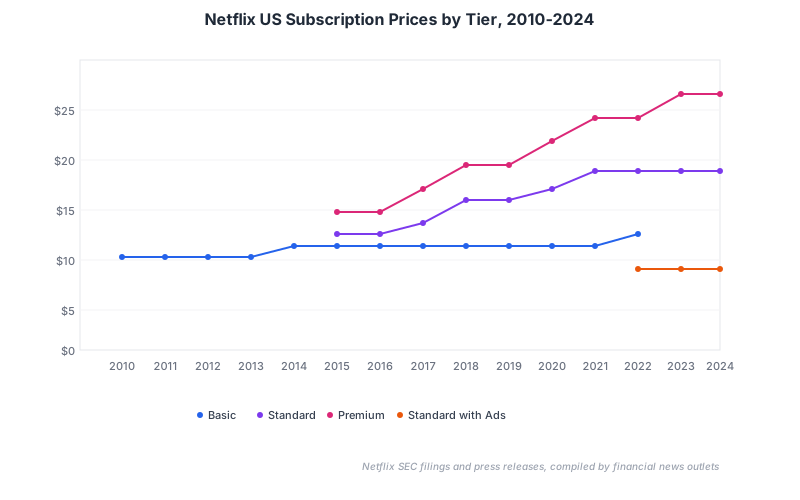
Key Takeaways
- Netflix's price increases are primarily driven by escalating content costs, with the company spending over $17 billion annually on programming
- The streaming giant maintains pricing power through its diverse content library, global scale, and strong subscriber loyalty despite increased competition
- Subscriber behavior data indicates relatively low price sensitivity among Netflix's core user base, with temporary churn patterns following price hikes
- Netflix's premium positioning strategy differentiates it from competitors who often subsidize streaming services as part of broader corporate strategies
- The focus on profitability over pure subscriber growth reflects a strategic shift toward financial sustainability in mature markets
- Cross-subsidization from high-margin mature markets supports international expansion and continued content investment
References
- Netflix, Inc. "Form 10-K Annual Report." Securities and Exchange Commission, 2023.
- Barnes, Brooks. "Disney Completes Fox Acquisition." The New York Times, March 20, 2019.