The 15 Greatest Sports Dynasties That Fell from Grace, Ranked by Magnitude of Collapse
The rise and fall of sporting dynasties represents one of the most compelling narratives in athletics. While we celebrate the creation of legendary teams, there's an equally fascinating—and often tragic—story in their decline. Some dynasties fade gracefully into retirement; others collapse spectacularly, leaving fans and analysts to dissect what went wrong. This ranking examines 15 dramatic falls from grace in sports history, measured by the speed of decline, the magnitude of the gap between peak glory and subsequent failure, and the underlying causes of collapse.
This analysis considers several key factors: the height of the dynasty's success, the speed and severity of the collapse, the underlying causes of the decline, and the lasting impact on the sport and its fans. Cases where championship-level teams fell to relegation, bankruptcy, or complete irrelevance are weighted more heavily than gradual declines. The most shocking collapses—those that defied prediction—rank highest.
#15: Manchester United (2013-2020)
Sir Alex Ferguson's retirement in 2013 marked the end of Manchester United's 26-year dominance of English football. Under Ferguson, United won 13 Premier League titles, but his departure triggered a seven-year period that saw the club cycle through five managers and fail to win a single league title. The 2013-14 season was particularly striking—United finished seventh, a dramatic drop from their championship position the previous year.
What makes this collapse notable is the speed: from champions to seventh place in a single season. However, United's financial resources and continued presence in European competitions prevent this from ranking higher. They remained competitive enough to attract world-class players like Paul Pogba and later Cristiano Ronaldo, even if league titles proved elusive.
#14: Pittsburgh Steelers (1980-1988)
The Steelers' 1970s dynasty captured four Super Bowl titles in six years (1974, 1975, 1978, 1979), establishing them as the NFL's premier franchise. But the 1980s brought a harsh reality check. The team's aging core—Terry Bradshaw, Franco Harris, Lynn Swann—either retired or declined rapidly. Pittsburgh managed just two playoff appearances from 1980-1988, including a dismal 5-11 record in 1988.
The Steelers' fall ranks lower because it was largely predictable—aging superstars inevitably decline. Unlike higher-ranked entries, Pittsburgh rebuilt successfully, returning to championship form in the 1990s under Bill Cowher and later Mike Tomlin.
#13: UCLA Basketball (1976-1995)
John Wooden's UCLA Bruins won 10 NCAA championships between 1964 and 1973, including seven consecutive titles from 1967-1973. Wooden's retirement in 1975 began a two-decade struggle to recapture that dominance. The Bruins managed just one Final Four appearance from 1976-1995, a notable drought for college basketball's most successful program.
UCLA's decline was gradual rather than catastrophic, which limits its ranking. The program remained respectable, recruiting top talent and maintaining its academic reputation. The fall was more about impossibly high expectations than genuine failure.
#12: New York Islanders (1985-1993)
The Islanders' four consecutive Stanley Cup championships (1980-1983) represented one of hockey's greatest dynasties. But poor management decisions—including trading away key players and draft picks—quickly dismantled the championship core. By 1989, the team missed the playoffs entirely, and the early 1990s brought some of the worst seasons in franchise history.
The Islanders' collapse was particularly painful because it was self-inflicted. Management changes and ownership's cost-cutting measures destroyed a team that should have remained competitive for years. The franchise became a cautionary tale about the importance of front-office stability.
#11: Miami Heat (2015-2019)
LeBron James's departure in 2014 ended Miami's championship window that produced two NBA titles in 2012 and 2013. The Heat's subsequent decline was swift—they missed the playoffs in 2015 and 2017, posting losing records in three of four seasons. Dwyane Wade's aging and Chris Bosh's career-ending blood clots left the franchise scrambling for relevance.
Miami's fall ranks in the middle because it was largely expected after losing the league's best player. The Heat also recovered relatively quickly, reaching the NBA Finals in 2020 with Jimmy Butler leading a surprising playoff run.
#10: Montreal Canadiens (1980-1993)
The Canadiens won four consecutive Stanley Cups from 1976-1979 and remained competitive through the mid-1980s. However, the late 1980s and early 1990s brought unprecedented struggles for hockey's most successful franchise. Montreal's extended absence from playoff contention marked the end of an era of sustained excellence.
What makes Montreal's decline significant is the franchise's historic standards. The Canadiens had won 24 Stanley Cups, and their fall from grace represented a seismic shift in NHL power dynamics. The team's inability to adapt to the modern game's speed and skill requirements exposed organizational challenges.
#9: San Francisco 49ers (2003-2010)
The 49ers' 1980s and 1990s dynasty produced five Super Bowl titles and defined NFL excellence. But the 2000s brought unthinkable mediocrity to Candlestick Park. San Francisco posted eight consecutive seasons without a playoff appearance (2003-2010), including a franchise-worst 2-14 record in 2004. The team cycled through seven head coaches in eight years, creating organizational chaos.
The 49ers' collapse was particularly jarring because they had maintained competitive standards even after Joe Montana and Steve Young's departures. The complete organizational breakdown under ownership changes and front-office instability showed how quickly excellence can evaporate in professional sports.
#8: AC Milan (2012-2022)
AC Milan's dominance in European football spanned decades, with the club winning seven European Cups/Champions League titles between 1963 and 2007. The 2007 Champions League victory represented the peak of a golden era featuring Kaká, Andrea Pirlo, and Paolo Maldini. But financial constraints and poor management decisions triggered a devastating decline.
Milan struggled to qualify for the Champions League consistently in the 2010s, an unthinkable drought for one of football's most successful clubs. The team was relegated to Europa League competition, selling star players and struggling to compete domestically. Only recent investment has begun to restore the club's competitive edge.
#7: Dallas Cowboys (1997-2021)
The Cowboys' 1990s dynasty captured three Super Bowl titles in four years (1992, 1993, 1995), establishing "America's Team" as the NFL's premier franchise. But the subsequent quarter-century brought unprecedented frustration to Dallas. The Cowboys managed just five playoff wins from 1997-2021, despite maintaining high regular-season expectations and massive payrolls.
Dallas's collapse is particularly notable for its duration and the franchise's continued prominence despite poor results. Owner Jerry Jones's involvement with football operations and frequent coaching changes created instability that prevented championship-caliber teams from achieving their potential. The gap between expectations and results became a defining characteristic of the franchise.
#6: Brazil National Football Team (2006-2018)
Brazil's football dominance defined the sport for decades, with five World Cup victories establishing the Seleção as football's greatest national team. But the 2006 World Cup began a shocking decline that culminated in the 2014 home tournament disaster. Brazil's 7-1 semifinal loss to Germany represented one of football's most stunning upsets, a result that shocked the global football community.
The collapse continued through 2018, with Brazil failing to reach a World Cup final for 20 years despite possessing world-class talent. The team's inability to perform in crucial moments, combined with tactical confusion and internal pressure, showed how even the most successful sporting nations can lose their way.
#5: New York Yankees (2008-2016)
The Yankees' late 1990s dynasty captured four World Series titles in five years (1996, 1998, 1999, 2000), establishing modern baseball's most successful era. But the 2008-2016 period brought unexpected mediocrity to the Bronx. Despite maintaining baseball's highest payroll, New York missed the playoffs in four of nine seasons and failed to reach a World Series for eight years.
The Yankees' decline was shocking because of the franchise's resources and championship culture. Poor draft selections, aging veterans, and questionable free-agent signings created a roster imbalance that even unlimited spending couldn't fix. The organization's inability to develop homegrown talent exposed systemic problems within the dynasty's foundation.
#4: Leicester City (2016-2023)
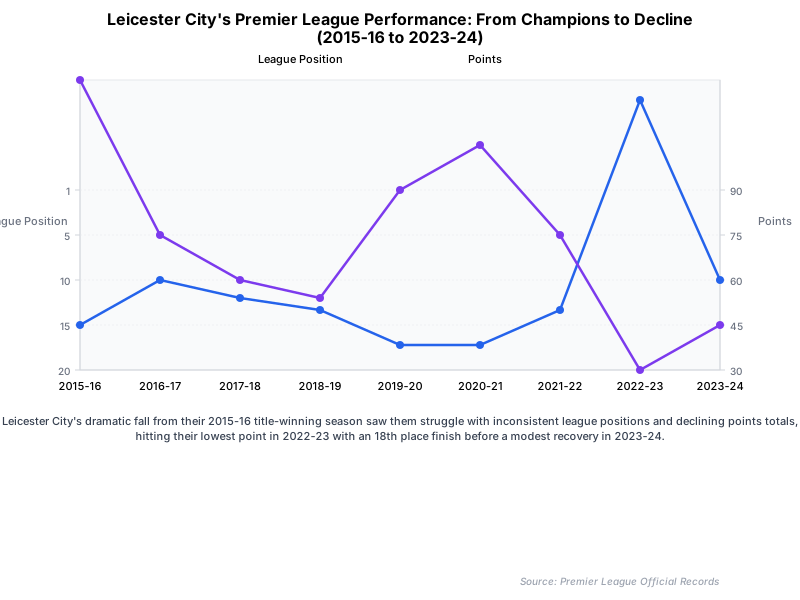
Leicester City's 2015-16 Premier League title remains one of sport's greatest fairy tales, achieved at odds bookmakers offered around 5000-1. But the subsequent decline was equally dramatic. The Foxes were relegated to the Championship in 2023, just seven years after their miraculous title triumph. The team's fall included a disastrous 2022-23 season where they won just two of their first 16 matches.
Leicester's collapse ranks highly because of the speed and severity of the decline. From Premier League champions to second-tier football in seven years represents one of English football's most dramatic falls. The club's inability to build on their success, combined with poor transfer decisions and managerial instability, showed how quickly sporting miracles can turn to nightmares.
#3: Detroit Red Wings (2009-2022)
The Red Wings' 25-year playoff streak (1991-2016) represented NHL history's longest postseason run, including four Stanley Cup championships. But the dynasty's end brought unprecedented suffering to Hockeytown. Detroit missed the playoffs six consecutive seasons (2017-2022), posting some of the worst records in franchise history and becoming a consistent bottom-feeder.
The Red Wings' collapse was particularly brutal because of the organization's championship culture and development system. The team's inability to transition from aging veterans to young talent exposed how difficult it is to maintain excellence across generations. Detroit's fall from perennial contender to rebuilding project shocked the hockey world.
#2: Italy National Football Team (2008-2018)
Italy's football excellence peaked with the 2006 World Cup victory, followed by the 2012 European Championship final appearance. But the Azzurri's subsequent collapse was catastrophic. Italy failed to qualify for the 2018 World Cup—their first absence since 1958—losing a playoff to Sweden in one of football's most shocking upsets.
The failure to reach Russia 2018 represented a sporting earthquake that reverberated globally. Italy's tactical rigidity, aging squad, and inability to develop young talent created a perfect storm of mediocrity. For a nation with four World Cup titles, missing football's premier tournament was unthinkable. The collapse forced a complete organizational overhaul and cultural reset.
#1: Golden State Warriors (2019-2022)
The Warriors' dynasty captured three NBA championships in four years (2015, 2017, 2018) and won a record 73 regular-season games in 2015-16. But Kevin Durant's departure and devastating injuries to Stephen Curry and Klay Thompson triggered an unprecedented collapse. Golden State posted one of the league's worst records (15-50) in 2019-20, followed by missing the playoffs entirely in 2021.
The Warriors' fall ranks first because of its shocking nature and speed. From NBA champions to one of the league's worst teams in two seasons defied basketball logic. The organization that revolutionized modern basketball with small-ball lineups and three-point shooting suddenly couldn't compete at any level. While injuries explain the decline, the magnitude of the collapse—from dynasty to disaster in 24 months—represents sport's most dramatic fall from grace.
The ranking methodology may inadvertently penalize dynasties that collapsed gradually but catastrophically in favor of those that fell suddenly but recovered quickly. The Golden State Warriors' ranking as #1 despite making the Finals just two years after their worst record suggests the article values narrative shock over lasting competitive damage—raising the question of whether a five-year decline into irrelevance represents a "greater" fall than a two-year crater followed by resurrection.
By focusing exclusively on Western sports franchises and clubs, this analysis may systematically undervalue collapses in cricket, rugby, and other sports where dynasties can fall just as dramatically but with less English-language media documentation. A comprehensive ranking might find comparable "falls from grace" in these sports, but these simply don't register in Western sports discourse—suggesting the rankings reflect media visibility rather than objective magnitude of collapse.
Key Takeaways
- The most dramatic collapses involve championship-level teams falling to complete irrelevance within 2-3 seasons, rather than gradual declines over decades
- Self-inflicted wounds—poor management, organizational instability, and financial mismanagement—create more shocking falls than predictable aging or external factors
- Dynasties built around aging superstars face inevitable decline, but those with strong organizational cultures and development systems typically transition more successfully
- International competitions amplify the impact of collapse, as failures on the world stage carry greater psychological and cultural weight than domestic disappointments
- Modern sports' financial and media pressures create environments where dynasties can collapse faster than ever before, making sustained excellence increasingly difficult to maintain