Conspiracy Theorists Are Actually More Rational Than You Think — And That's the Real Problem

EDITORIAL — This is an opinion piece. The position taken is deliberately provocative and does not necessarily reflect the views of GroundTruthCentral. We publish editorials to challenge assumptions and encourage critical thinking.
The Comfortable Lie About Conspiracy Thinking
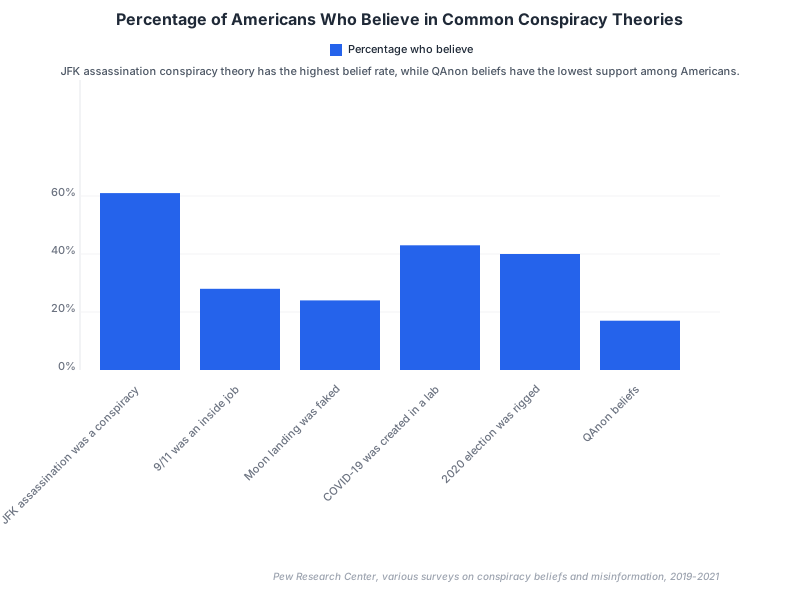
The mainstream view treats conspiracy theories as a kind of mental illness. Analysts point to cognitive biases: confirmation bias, proportionality bias, the fundamental attribution error. The implication is clear — these people are broken thinkers who can't process information correctly. This framework is seductive because it places conspiracy theorists in a separate category from "normal" people. It suggests that better media literacy education or stronger critical thinking skills would solve the problem. Politicians and pundits regularly invoke this narrative, dismissing entire movements as victims of "misinformation" who need to be educated back to reality. But this comfortable story falls apart under scrutiny. Consider the claim that the 2020 U.S. presidential election was "stolen." Polls suggest that a substantial portion of Republicans believe this. Are we really prepared to argue that tens of millions of Americans suddenly developed cognitive disorders between 2016 and 2020?The Rational Conspiracy Theorist
Here's what actually happened: millions of people made rational inferences based on the information they accessed. If your primary news sources spent months telling you that mail-in voting was rife with fraud, that voting machines were hackable, that poll watchers were being excluded, and that statistical anomalies suggested manipulation — and if these sources had been generally reliable in your experience — then believing the election was stolen becomes a perfectly logical conclusion. This phenomenon can be understood through "epistemic bubbles" versus "echo chambers." An epistemic bubble simply omits information — you don't hear the other side. An echo chamber actively distorts information by systematically undermining outside sources. Both can produce "rational" conspiracy belief. Consider QAnon, perhaps the most elaborate conspiracy theory of our time. To outsiders, the idea that a secret cabal of Satan-worshipping pedophiles controls world governments seems absurd. But examine the logical structure: if you accept certain premises about elite corruption (not unreasonable given actual scandals like Jeffrey Epstein), if you believe mainstream media systematically covers up elite crimes (again, not without precedent), and if you trust certain alternative information sources, then the QAnon narrative follows logically. The believers aren't failing at reasoning — they're reasoning perfectly well from corrupted premises. This is far more dangerous than simple irrationality because you can't fix it with better logic or critical thinking skills.When Paranoia Meets Pattern Recognition
The most unsettling aspect of modern conspiracy theories is how often they contain kernels of genuine insight. Conspiracy theorists are frequently right about the existence of problems, even when they're wrong about the specifics. Take the widespread belief that pharmaceutical companies prioritize profits over public health. This isn't paranoid delusion — it's documented reality. Purdue Pharma's role in the opioid crisis, Merck's concealment of heart attack risks from Vioxx, and various pharmaceutical settlements for illegal marketing practices all demonstrate that corporate misconduct in this sector is real and consequential.Between 2009 and 2020, pharmaceutical companies paid over $38 billion in settlements for various violations including off-label marketing, kickbacks to physicians, and failure to disclose safety risks. Source: Public Citizen analysis of Department of Justice settlements.
The Information Warfare Problem
The rational conspiracy theorist emerges in an environment where information itself has become weaponized. We're not dealing with simple misinformation anymore — we're dealing with sophisticated influence operations designed to exploit rational thinking processes. Foreign disinformation campaigns, for example, often amplify real contradictions and genuine grievances to sow division rather than simply spreading false information. This creates a perverse situation where conspiracy theorists often have better pattern recognition than mainstream audiences. They notice coordinated messaging campaigns, they spot astroturfing operations, they identify when narratives shift suspiciously across multiple platforms simultaneously. Their mistake isn't in noticing these patterns — it's in assuming that coordination always implies conspiracy. When major social media platforms simultaneously banned certain controversial figures, conspiracy theorists saw confirmation of coordinated censorship. Were they wrong to notice the coordination? The platforms claimed independent decision-making, but the timing was remarkably synchronized. The conspiracy theorists' error wasn't in noticing the coordination — it was in assuming malicious intent rather than considering alternative explanations like liability concerns or competitive pressure.The Expertise Problem
Perhaps most troubling is how rational conspiracy thinking emerges from the legitimate crisis of expertise in modern society. When authorities consistently fail or mislead, skepticism becomes a survival strategy. The Iraq War offers a perfect case study. In 2003, virtually the entire foreign policy establishment insisted that Saddam Hussein possessed weapons of mass destruction. The few voices raising doubts were marginalized as unserious or unpatriotic. Yet the skeptics were right, and the experts were catastrophically wrong. Someone who lived through this debacle might reasonably conclude that expert consensus is often manufactured rather than genuine. When the same institutions later insist on other claims — about financial markets before 2008, about pandemic responses, about climate change — why should a rational person automatically defer to their authority? The problem compounds when expertise becomes increasingly specialized and opaque. Most people can't evaluate epidemiological models or climate data directly. They must choose which experts to trust based on secondary cues: institutional affiliation, media coverage, peer consensus. But when these institutions have documented track records of failure or corruption, choosing alternative sources becomes rational. Dr. Anthony Fauci's shifting recommendations on mask-wearing during the COVID-19 pandemic illustrate this dynamic. His evolving guidance, whether justified by changing scientific understanding or strategic considerations, validated some people's fundamental assumption that authorities sometimes provide incomplete or strategic information rather than pure scientific truth.The Rationality of Distrust
Consider the position of someone who has watched decades of institutional failure: Church sexual abuse scandals, corporate accounting fraud, intelligence agency missteps, financial industry corruption, pharmaceutical company deception, media manipulation. At what point does distrust become the rational default position? The conspiracy theorist's error isn't in being suspicious — it's in assuming that powerful actors are more competent and coordinated than they actually are. But this error stems from a rational assessment that these actors are often dishonest about their motivations and capabilities. Take the lab leak theory for COVID-19's origins. For a significant period, this possibility was dismissed or discouraged by many mainstream sources and social media platforms. Yet the theory was always scientifically plausible, and some of the dismissals appeared to be based more on political considerations than evidence. The people who continued investigating lab leak possibilities weren't being irrational — they were following evidence despite social pressure. Their mistake was sometimes in overstating the certainty of their conclusions, but their fundamental approach was more scientifically sound than premature consensus that shut down inquiry.Why This Makes Everything Worse
Recognizing the rationality of conspiracy thinking doesn't make the problem easier to solve — it makes it nearly impossible. You can't reason someone out of a position they reasoned themselves into using sound logical processes. You can't debunk a theory that's unfalsifiable by design. You can't restore trust in institutions that have genuinely lost credibility. The standard responses to conspiracy theories — fact-checking, media literacy, expert testimony — all assume that the problem is cognitive rather than epistemic. They assume people are thinking badly rather than thinking well with bad information. This approach fails because it doesn't address the underlying information environment that makes conspiracy theories rational. Worse, these responses often confirm conspiracy theorists' suspicions about coordinated manipulation. When fact-checkers consistently favor establishment positions, when media literacy programs implicitly promote trust in mainstream sources, when expert testimony comes from institutions with conflicts of interest, skeptics reasonably conclude that these are propaganda operations rather than good-faith efforts at truth-seeking. The real problem isn't that conspiracy theorists are irrational — it's that they're rational actors in an irrational information environment. They're responding logically to a system that has genuinely lost the capacity to generate reliable knowledge and trustworthy institutions.The Uncomfortable Solution
If conspiracy theorists are often thinking rationally, then the solution isn't to fix their thinking — it's to fix the conditions that make conspiracy thinking rational. This requires acknowledging some uncomfortable truths about our information ecosystem and power structures. First, we must admit that many conspiracy theories contain accurate observations about real problems. Elite coordination does occur. Institutions do lie. Powerful actors do manipulate information for their benefit. Dismissing these observations as "conspiracy thinking" only drives legitimate concerns toward more extreme explanations. Second, we must recognize that expertise has become corrupted by conflicts of interest and institutional capture. When pharmaceutical companies fund medical research, when fossil fuel companies fund climate studies, when tech companies fund digital policy research, the resulting "expert consensus" is inevitably compromised. Rational people notice these conflicts and adjust their trust accordingly. Third, we must acknowledge that information warfare is real and sophisticated. Foreign adversaries, corporate interests, and political factions all deploy advanced techniques to manipulate public opinion. Conspiracy theorists aren't imagining these campaigns — they're noticing real patterns, even if they sometimes misinterpret their significance. The path forward requires rebuilding institutions that deserve trust rather than demanding trust in untrustworthy institutions. It requires creating information systems that reward accuracy over engagement. It requires acknowledging uncertainty rather than manufacturing false consensus. Most importantly, it requires recognizing that in a world where conspiracy theories often turn out to be true, the label "conspiracy theorist" has lost its power to discredit. When mass surveillance is revealed, when elite networks are exposed, when alternative theories gain credibility, the boundary between rational skepticism and paranoid delusion becomes increasingly blurred.While some conspiracy theories have contained kernels of truth, this may reflect the "broken clock" phenomenon rather than superior analytical skills. The thousands of false conspiracy theories that never gained legitimacy—from chemtrails to flat earth beliefs—suggest that conspiracy thinking's occasional accuracy stems from volume rather than methodology, much like how even poor stock pickers sometimes beat the market through sheer chance.
The apparent "rationality" of conspiracy theorists might actually demonstrate selective reasoning rather than genuine critical thinking. Proponents of this view contend that conspiracy believers often apply rigorous skepticism only to information that contradicts their worldview while accepting confirming evidence uncritically—a pattern that resembles motivated reasoning more than the systematic doubt that characterizes scientific inquiry.
The Argument
- Many conspiracy theorists follow rational thought processes but operate with different information inputs than mainstream audiences
- Conspiracy theories often contain kernels of genuine insight about real institutional failures and elite coordination
- The crisis of expertise and documented institutional deception makes skepticism a rational default position for many people
- Standard responses to conspiracy theories fail because they assume cognitive rather than epistemic problems
- The solution requires rebuilding trustworthy institutions rather than demanding trust in compromised ones