Do We Have a Moral Obligation to Preserve the Night Sky for Future Generations?
On a clear night in 1994, a massive earthquake struck Los Angeles, knocking out power across the city. Emergency services reportedly received calls from panicked residents reporting a "giant, silvery cloud" in the sky—their first glimpse of the Milky Way. Whether or not this account is precisely accurate, it captures a real phenomenon: the systematic erasure of humanity's oldest teacher, the night sky.
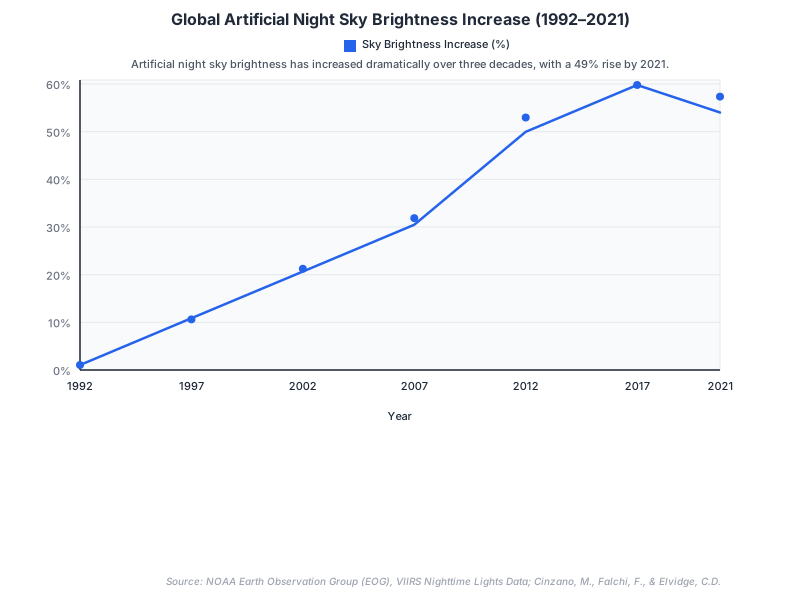
Today, more than 80% of the world's population lives under light-polluted skies. As artificial lighting expands globally, pristine night skies retreat to remote corners of the Earth and designated "dark sky reserves." We face a profound ethical question: Do we have a moral obligation to preserve the night sky for future generations?
The Case for Cosmic Stewardship
The strongest argument for preserving dark skies rests on intergenerational obligations—duties we owe to people not yet born. For 200,000 years of human existence, every person had access to the same celestial theater: the Milky Way's sweep, the dance of planets, constellations marking seasons and navigation routes. The night sky was humanity's first book, calendar, and compass.
Rachel Carson argued in Silent Spring that we hold the Earth "in trust" for future generations. Under this trusteeship model, we are temporary custodians, not owners, of natural resources. Permanently altering humanity's relationship with the cosmos without consent from future generations constitutes a form of temporal colonialism—imposing our preferences on people who cannot advocate for themselves.
The utilitarian calculus also favors preservation. The benefits of artificial lighting, while real, concentrate in the present generation and urban populations. The costs—complete loss of dark skies—compound across all future generations. The aggregate harm likely outweighs present benefits.
There's also a compelling argument from cultural preservation. Indigenous communities worldwide have maintained sophisticated astronomical knowledge systems for millennia. The Lakota navigate by the Milky Way; Aboriginal Australians use stellar patterns for navigation and seasonal ceremonies. Light pollution severs living cultural traditions passed down for thousands of years. The Mauna Kea controversy illustrates how astronomical sites carry deep cultural significance beyond their scientific value.
The Developmental Argument
Perhaps the most powerful case comes from child development and education. Some developmental psychologists argue that humans possess an innate attraction to natural environments, including open skies and celestial patterns. Children growing up without access to natural darkness may miss a fundamental developmental experience.
Concerning trends suggest this is already happening. Many urban children cannot identify basic constellations, don't understand lunar phases, and believe stars are artificial lights. We may be raising the first generation in human history that is cosmically illiterate.
Maria Montessori wrote that the child who learns to read the night sky develops "cosmic consciousness"—an understanding of humanity's place in the universe that fosters humility and wonder. Denying future generations this cosmic education may stunt their intellectual and spiritual development in ways we don't yet fully understand.
The Rights of Nature Perspective
A more radical argument emerges from the "rights of nature" movement. In 2017, New Zealand granted legal personhood to the Whanganui River, recognizing its intrinsic right to exist. Similar frameworks have been applied to forests, mountains, and ecosystems worldwide. Could the night sky itself possess rights?
Environmental philosopher Aldo Leopold argued for an expanded moral community including non-human nature. In his "Land Ethic," he wrote: "A thing is right when it tends to preserve the integrity, stability, and beauty of the biotic community." The night sky, while not biological, is part of Earth's natural system. Light pollution disrupts the navigation of migrating birds, the reproductive cycles of sea turtles, and the pollination patterns of night-blooming plants.
From this perspective, we owe future humans a dark sky—and we owe it to the night sky itself and the countless species that evolved under natural darkness. The moral community extends beyond humans to include the cosmic environment that shaped all terrestrial life.
The Case Against Cosmic Obligation
But serious challenges confront the dark sky preservation argument. The most fundamental questions whether future generations can have rights at all. Philosopher Derek Parfit's "non-identity problem" suggests that our current actions determine which future people exist. If we choose different lighting policies, we create a world where entirely different individuals are born. Can people who wouldn't exist under alternative policies be harmed by our choices?
More practically, dark sky preservation may reflect the luxury preferences of a privileged few. Artificial lighting saves lives. Street lights are associated with crime reduction in many contexts, though researchers debate the magnitude. Hospital lighting enables 24-hour medical care. Industrial lighting supports manufacturing jobs. Asking developing nations to limit lighting—and by extension, economic development—to preserve stargazing opportunities for affluent astronomy enthusiasts seems deeply inequitable.
Economist Julian Simon argued that human ingenuity consistently overcomes resource constraints. Perhaps the loss of natural dark skies will drive innovation in space-based astronomy, virtual reality star experiences, or other technological solutions. Future generations may not mourn natural darkness any more than we mourn subsistence farming or horse-drawn transportation.
The Technological Optimist Response
Technological progress may make dark sky preservation less urgent. The James Webb Space Telescope reveals cosmic wonders far beyond what the naked eye can see from even the darkest earthbound location. Virtual and augmented reality systems are approaching the point where they can simulate perfect dark sky experiences. Future generations may access cosmic education and wonder through digital means that surpass what natural darkness provides.
This technological substitution argument suggests that preserving "natural" experiences for their own sake reflects romantic nostalgia rather than genuine moral obligation. If future generations can experience the cosmos more fully through technology, aren't we serving them better by enabling technological development rather than constraining it through lighting restrictions?
Some technology entrepreneurs argue that the real moral obligation to future generations is maximizing technological progress and economic growth. From this perspective, lighting restrictions that slow development actually harm future generations, who would benefit more from increased prosperity than preserved darkness.
The Precautionary Principle
Environmental ethicists often invoke the precautionary principle: when facing potential irreversible harm with scientific uncertainty, we should err on the side of caution. The loss of dark skies is certainly irreversible on any meaningful human timescale—natural darkness cannot be restored without eliminating artificial lighting entirely.
But the precautionary principle cuts both ways. Restricting lighting development could cause irreversible harm by slowing economic progress in developing nations, potentially condemning millions to prolonged poverty. The moral weight of preventing immediate human suffering may outweigh speculative future benefits of dark sky preservation.
Moreover, we face deep uncertainty about what future generations will actually value. They may develop entirely different relationships with nature and cosmos than we imagine. Imposing our current aesthetic and spiritual preferences on people centuries in the future could constitute temporal tyranny.
A Framework for Cosmic Ethics
The tension between these positions suggests we need a more nuanced framework. Philosopher Bryan Norton's "convergence hypothesis" offers a useful approach: environmental policies serving both human welfare and ecological integrity tend to converge on similar solutions. Applied to light pollution, this suggests focusing on policies that reduce unnecessary lighting while maintaining essential illumination for safety and development.
The International Dark-Sky Association has promoted "smart lighting" standards that minimize sky glow while preserving ground-level illumination. LED technology allows precise directional control, reducing light waste while maintaining safety benefits. Some cities have demonstrated that dark sky preservation is compatible with modern urban life.
This approach acknowledges both the legitimate needs of current populations and the legitimate claims of future generations. It rejects both the extreme position that any lighting restriction is unacceptable and the extreme position that natural darkness must be preserved at any cost.
The Cultural Diversity Challenge
One weakness in pro-preservation arguments is their tendency to universalize particular cultural values. The Western romantic tradition venerating "pristine" nature may not resonate with cultures that see human environmental modification as natural and appropriate. Many urban populations worldwide have developed rich cultural traditions around artificial lighting—from Tokyo's neon aesthetics to Diwali's festival lights.
Philosopher Val Plumwood warned against "ecological colonialism"—imposing Western environmental values on non-Western cultures. The demand for dark sky preservation could privilege the aesthetic preferences of affluent, rural, primarily Western populations over the practical needs and cultural values of urban, developing, and non-Western communities.
Any moral obligation to preserve dark skies must be balanced against obligations to respect cultural diversity and support human development. A truly ethical approach requires inclusive dialogue about lighting policies rather than top-down preservation mandates.
Taking a Stand
After weighing these arguments, I believe we do have a significant moral obligation to preserve access to natural dark skies for future generations—but this obligation is not absolute and must be balanced against other moral imperatives.
The strongest case rests on three foundations. First, the irreversibility of light pollution creates a special obligation under the precautionary principle. Unlike many environmental changes, the loss of dark skies cannot be undone without eliminating the infrastructure that created it. This irreversibility demands heightened caution.
Second, the developmental and educational arguments are compelling. The capacity for cosmic wonder and spatial reasoning that comes from experiencing natural darkness appears fundamental to human development. We would not accept policies systematically denying children access to books, art, or music. Why should we accept policies denying them the night sky?
Third, the convergence approach shows that preserving dark skies often aligns with other goals. Smart lighting policies can maintain safety and development benefits while reducing sky glow.
However, this obligation is not absolute. Where lighting restrictions would significantly impede poverty reduction, public safety, or cultural expression, those concerns may outweigh dark sky preservation. The goal should be minimizing unnecessary light pollution while respecting legitimate human needs.
The weakness in this position is that it still reflects particular cultural values about "natural" experiences. Future generations may genuinely prefer technological alternatives to natural darkness. But given the irreversibility of the choice and deep uncertainty about future preferences, the burden of proof should rest on those who would eliminate natural darkness entirely.
If we accept that future generations will possess technological capabilities we cannot imagine, we might be overestimating our obligation to preserve darkness as a natural resource. Just as we don't feel obligated to preserve horse-drawn transportation, future humans equipped with advanced neural interfaces or perfect synthetic cosmic experiences may regard our dark-sky preservation efforts as quaintly paternalistic—a well-intentioned but ultimately unnecessary constraint on their freedom to reshape their environment.
The moral framing of night sky preservation may reflect a luxury value system available primarily to wealthy nations and affluent communities. For a farmer gaining electric lighting for the first time, or an urban resident whose street lights reduce violent crime, the choice between darkness and illumination is not aesthetic but a question of safety, productivity, and opportunity—suggesting that our obligation to future generations might be better served by ensuring they have the freedom to make their own lighting choices rather than inheriting our current environmental constraints.
Key Takeaways
- Light pollution is expanding globally and threatens to eliminate natural dark skies within decades, affecting billions of future people
- Strong arguments for preservation include intergenerational justice, cultural continuity, child development, and ecological integrity
- Counter-arguments emphasize safety benefits of lighting, economic development needs, and technological alternatives to natural darkness
- The precautionary principle supports preservation given the irreversibility of light pollution and uncertainty about future values
- Smart lighting policies offer a middle path that reduces sky glow while maintaining essential illumination
- Any preservation obligation must be balanced against respect for cultural diversity and human development needs