
The Case Against Modern Athletic Performance: We've Optimized Humans Into Fragility

EDITORIAL — This is an opinion piece. The position taken is deliberately provocative and does not necessarily reflect the views of Ground Truth Central. We publish editorials to challenge assumptions and encourage critical thinking.
The modern athlete is a marvel of human optimization—and therein lies the problem. We have engineered our sports heroes into biomechanical perfection so exquisite, so finely tuned, that they have become as fragile as Formula 1 cars: capable of extraordinary performance, but only under the most controlled conditions. The very pursuit of athletic excellence that was supposed to showcase human resilience has instead created a generation of athletes who are paradoxically more vulnerable than their predecessors.
Consider this: Abebe Bikila won the 1960 Olympic marathon in Rome running barefoot. Today's elite marathoners require custom-fitted carbon fiber shoes, precisely timed nutrition, and environmental conditions monitored to the degree. We've gained seconds on the clock but lost something fundamental about human adaptability.
The Myth of Linear Athletic Progress
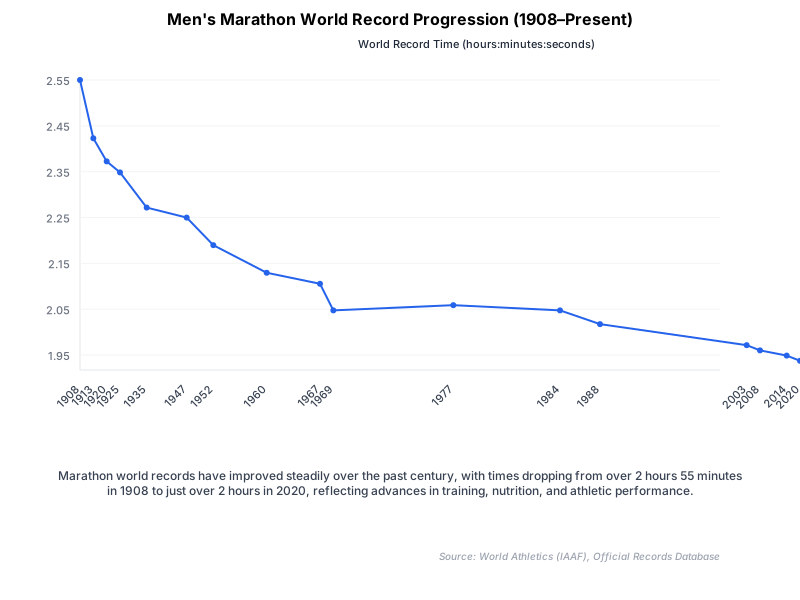
The conventional narrative celebrates our march toward ever-greater athletic achievement. Marathon world records have dropped significantly over the decades. Swimming times have plummeted thanks to full-body suits and improved pool design. We point to these numbers as proof of human advancement.
But this narrative obscures a troubling reality: we've achieved these gains not by making humans more robust, but by making conditions more artificial. Modern athletic performance increasingly depends on technological augmentation, environmental control, and biomechanical specialization that renders athletes exquisitely adapted to narrow circumstances—and poorly equipped for anything outside those parameters.
The 2021 Tokyo Olympics illustrated this tension. The games were marked by heat-related challenges, with athletes struggling against conditions that would have been routine for competitors of previous generations. When Novak Djokovic withdrew from the Olympic mixed doubles citing exhaustion, some observers pointed to it as revealing the brittleness underlying modern athletic optimization—though such individual cases can reflect multiple causes beyond systemic fragility.
The Specialization Trap
Modern athletic training has embraced hyperspecialization with religious fervor. Young athletes are funneled into single sports earlier than ever, their bodies molded from childhood into instruments designed for one specific type of movement. The result is athletic savants: swimmers whose shoulders are architectural marvels for their stroke but who struggle with basic rotational movements, runners whose legs are precision pistons that break down when asked to perform lateral motion.
Compare this to Jim Thorpe, who won Olympic gold in both the pentathlon and decathlon at the 1912 Olympics and played professional football, baseball, and basketball. Thorpe's versatility wasn't an accident—it reflected a training philosophy that valued adaptability over optimization. (His Olympic medals were later stripped due to his prior professional play, which violated amateur-only rules at the time.)
Today's equivalent would be unthinkable. Can you imagine Usain Bolt attempting a decathlon? Or Serena Williams playing professional basketball? The very suggestion seems absurd because we've created athletes who are magnificent within their domain but helpless outside it. We've traded the Renaissance ideal of the complete athlete for the factory model of human specialization.
The Tommy John surgery illustrates this problem. Named after the first pitcher to undergo the procedure in 1974, this elbow reconstruction was once rare and career-threatening. Now it's routine, and some observers suggest young pitchers sometimes seek it out preventatively. We've created throwing motions so mechanically efficient that they may exceed the structural limits of human anatomy.
The Technology Dependency Crisis
Modern athletes are cyborgs in all but name. They depend on an ecosystem of technological support that would have been incomprehensible to previous generations. Elite runners wear shoes with carbon fiber plates that provide measurable performance benefits. Swimmers compete in suits engineered at the molecular level. Cyclists ride machines that cost more than most people's cars and require constant technical support.
Strip away this technological scaffolding, and modern athletes often perform worse than their low-tech predecessors. The 2009 swimming world championships, held just before high-tech suits were banned, saw numerous world records broken. When the suits were outlawed, many of those records became significantly harder to break. We had briefly created superhuman swimmers, then returned them to merely human status.
This technological dependency extends beyond equipment to training and recovery. Modern athletes require teams of specialists: biomechanics experts, sports psychologists, recovery specialists, nutritionists. They train in climate-controlled facilities, sleep in altitude chambers, and monitor their bodies with sensors that track everything from heart rate variability to muscle oxygen saturation.
The irony is striking: in our quest to optimize human performance, we've made athletes more dependent on external support systems than ever before. Remove the technological infrastructure, and many would struggle to perform at levels that their predecessors achieved as a matter of course.
The Injury Question
Perhaps the most contentious evidence in this argument concerns injury rates. Some observers contend that despite advances in sports medicine, training science, and recovery protocols, modern athletes are more injury-prone than ever. Professional sports injury reports have become more detailed and comprehensive over time.
However, this raises an important question: have injury rates actually increased, or have we simply become better at detecting and documenting injuries? A 1960s athlete with a stress fracture simply continued running, while today's athlete is diagnosed and rested. Without controlling for reporting standards and competition frequency, the "injury epidemic" remains difficult to prove conclusively.
One perspective holds that we've pushed human performance so close to physiological limits that the margin for error has virtually disappeared. Modern training loads are calibrated to extract maximum adaptation while theoretically avoiding breakdown, but this leaves no buffer for the unexpected stresses of actual competition.
Consider elite distance runners. Training methods pioneered by coaches like Arthur Lydiard emphasized high mileage and aerobic development. Today's elite marathoners often run lower weekly mileage but at intensities so precisely calibrated that a single poorly timed workout can derail months of preparation. The result, proponents of this view contend, is athletes who are simultaneously more capable and more fragile than their predecessors.
The Mental Fragility Factor
Physical optimization has been accompanied by what some analysts argue is an equally troubling trend toward mental fragility. Modern athletes are products of systems that control every variable, anticipate every challenge, and eliminate every uncertainty. When faced with truly unexpected circumstances, they may lack the psychological resilience that comes from navigating genuine adversity.
The 2021 Olympics provided a notable illustration when Simone Biles withdrew from competition citing mental health concerns. While her decision was courageous and necessary, it highlighted how even our most elite athletes can be psychologically challenged by pressure. This isn't a criticism of Biles specifically, but rather an observation about a system that creates athletes so finely tuned that they may lack the psychological calluses that come from regular exposure to failure and uncertainty.
Compare this to athletes like Muhammad Ali, who fought through political controversy, legal battles, and forced exile, or Billie Jean King, who competed while simultaneously fighting for gender equality in sports. These athletes developed resilience through adversity, not in spite of it.
The Lost Art of Adaptation
Perhaps most troubling is what we've lost in our pursuit of optimization: the ability to adapt. Historical athletic achievements are filled with stories of athletes succeeding despite adverse conditions, not because conditions were perfect. Jesse Owens set records on various track surfaces. Pelé played his greatest games on fields that would be considered unfit for professional play by today's standards.
These athletes succeeded not because they were less capable than modern competitors, but because they were more adaptable. They developed the ability to perform under variable conditions because variable conditions were the norm, not the exception.
Modern sports have largely eliminated this variability. Professional tennis is played on meticulously maintained surfaces that provide consistent bounce and pace. Golf courses are manicured to eliminate natural irregularities that once defined the sport. Even outdoor sports like cycling and marathon running increasingly take place on courses selected specifically to optimize performance.
We've created athletic environments that are essentially laboratories: controlled, predictable, and optimized for peak performance. But laboratories are terrible preparation for the real world, where conditions are messy, unpredictable, and often hostile to optimization.
The Diminishing Returns of Perfection
The law of diminishing returns suggests that as we approach the limits of human performance, each incremental improvement requires exponentially greater investment. We're now spending enormous resources—financial, technological, and human—to achieve gains measured in hundredths of seconds or millimeters.
Recent marathon world record improvements have required years of development of specialized shoes, pacers, course selection, and environmental conditions. The return on investment, measured in pure performance terms, is minimal. But the cost in terms of athletic authenticity and human adaptability is enormous.
We've reached the point where meaningful performance improvements require such specialized conditions that they bear little resemblance to the sports they're supposed to represent. Some record-breaking performances have required conditions so artificial that they couldn't be considered official world records. We're optimizing athletes for conditions that don't exist in nature.
The Path Forward: Embracing Productive Adversity
The solution isn't to abandon athletic progress, but to redefine what progress means. Instead of optimizing for peak performance under ideal conditions, we should optimize for robust performance under variable conditions. This means embracing what we might call "productive adversity"—training and competition conditions that build resilience rather than requiring perfect support systems.
Some sports are already moving in this direction. CrossFit has gained popularity partly because it emphasizes adaptability over specialization. Ultra-endurance events like the Marathon des Sables force athletes to be self-sufficient and adaptable. These competitions produce athletes who may not achieve the absolute peak performances possible under optimal conditions, but who demonstrate genuine human resilience.
We should also reconsider our relationship with technology in sports. Rather than asking "How can technology help athletes perform better?" we should ask "How can we preserve the essentially human elements of athletic competition?" This might mean equipment restrictions, environmental variability, or competition formats that reward adaptability over optimization.
Reclaiming Human Resilience
The ultimate goal of athletic competition should be to celebrate and develop human capability, not to demonstrate the effectiveness of technological and environmental optimization. When we create athletes who are magnificent but fragile, we're not advancing human potential—we're constraining it within increasingly narrow parameters.
True athletic greatness lies not in perfect performance under perfect conditions, but in the ability to perform well despite imperfect conditions. It's found in the athlete who can adapt, overcome, and succeed when carefully laid plans fall apart. One perspective holds that we've optimized this quality out of modern sports, and we're all poorer for it.
The choice before us is clear: we can continue down the path of ever-greater optimization, creating athletes who are simultaneously more capable and more fragile, or we can rediscover the value of robust, adaptable human performance. The former may produce faster times and higher scores, but the latter produces something far more valuable: genuine human excellence.
The article's central claim—that optimization breeds fragility—may confuse specialization with weakness. Modern marathoners like Eliud Kipchoge have won under genuinely adverse conditions (Rio's heat and humidity) despite training in controlled environments, suggesting that specialized preparation for variable competition conditions may be sufficient adaptation. If injury rates have truly increased, the data may reflect improved medical reporting and detection rather than actual fragility; a 1960s athlete with a stress fracture simply continued running, while today's athlete is diagnosed and rested. Without controlling for reporting standards and competition frequency, the "injury epidemic" remains unproven.
The comparison to historical athletes like Jim Thorpe and Abebe Bikila suffers from survivor bias—we remember the exceptional few who thrived despite poor conditions, not the many whose careers ended prematurely from preventable injuries. Modern sports medicine has extended athletic careers and prevented injuries that would have been career-ending decades ago, which could be viewed as expanded human capability rather than fragility. The question may not be whether today's athletes are weaker, but whether we've chosen to optimize for specific achievements (faster times, higher scores) rather than general adaptability—a values choice, not an empirical failure.
The Argument
- Modern athletic optimization has created performers who are magnificent under ideal conditions but fragile when those conditions change
- Hyperspecialization and technology dependency have reduced athletes' adaptability compared to previous generations
- The elimination of variability in training and competition has produced athletes unprepared for genuine adversity
- True athletic progress should emphasize robust performance under variable conditions rather than peak performance under optimal conditions