How Do International Conflicts Shape Which Athletes Compete at the Olympics?
The Historical Pattern of Olympic Boycotts
The modern Olympic era has witnessed numerous large-scale boycotts driven by international conflicts. The 1980 Moscow Olympics and 1984 Los Angeles Olympics serve as the most prominent examples. The 1980 boycott, led by the United States in response to the Soviet invasion of Afghanistan, ultimately involved 66 nations. This massive diplomatic protest fundamentally altered the competitive landscape, with American swimmers and track athletes notably absent from Moscow. The Soviet-led counter-boycott of the 1984 Los Angeles Olympics involved 14 Eastern Bloc nations. While officially citing security concerns, it was widely understood as retaliation. These twin boycotts demonstrated how Cold War tensions could split the Olympic movement along ideological lines. Beyond these headline-grabbing mass boycotts, smaller-scale diplomatic protests have consistently shaped Olympic participation. South Africa's exclusion from the Olympics between 1964 and 1988 due to apartheid policies eliminated competitive teams in rugby, cricket, and distance running. Rhodesia faced similar restrictions during this period, preventing athletes from competing under that national designation.Individual Athletes as Diplomatic Pawns
International conflicts often place individual athletes at the intersection of sporting ambitions and state policies. Iranian judoka Saeid Mollaei's 2019 defection after being ordered to lose matches to avoid potentially facing Israeli opponents exemplifies this dynamic. Mollaei subsequently competed for the Refugee Olympic Team at the 2021 Tokyo Olympics, illustrating the complex pathways athletes navigate when home country policies conflict with Olympic ideals. Belarusian sprinter Kristina Timanovskaya's 2021 Tokyo Olympics experience further demonstrated how domestic political conflicts erupt onto the Olympic stage. After criticizing her coaching staff on social media, Timanovskaya was forced to seek asylum rather than return to Belarus. She later competed for Poland at subsequent international competitions. Russian and Belarusian athletes competing as neutrals since 2022 represents a significant recent example of conflict-driven participation changes. Following Russia's invasion of Ukraine, the International Olympic Committee recommended that sports federations consider Russian and Belarusian athlete participation on a case-by-case basis. This policy requires individual athletes to demonstrate separation from state policies to compete, fundamentally altering traditional national Olympic representation.Recognition and Sovereignty Through Olympic Participation
The Olympics have long served as a venue for asserting national identity and sovereignty. New nations view Olympic participation as crucial for international recognition. The dissolution of Yugoslavia created multiple new Olympic teams: Croatia, Slovenia, Bosnia and Herzegovina, and North Macedonia each established separate Olympic committees. Montenegro did the same following its 2006 independence. This fragmentation dramatically altered competitive landscapes in sports where Yugoslavia had dominated—particularly basketball, water polo, and handball. The Taiwan-China dispute continues to shape Olympic participation through the "Chinese Taipei" designation, a compromise allowing Taiwanese athletes to compete while avoiding direct challenges to China's territorial claims. This arrangement has persisted for decades as an institutionalized diplomatic solution. Kosovo's recognition as an independent Olympic nation in 2014, despite Serbian objections, illustrates how the International Olympic Committee can validate new states through sporting recognition. Kosovo's subsequent Olympic successes, particularly judoka Majlinda Kelmendi's 2016 gold medal, provided powerful symbols of national achievement for the world's newest nation.Economic Sanctions and Athletic Infrastructure
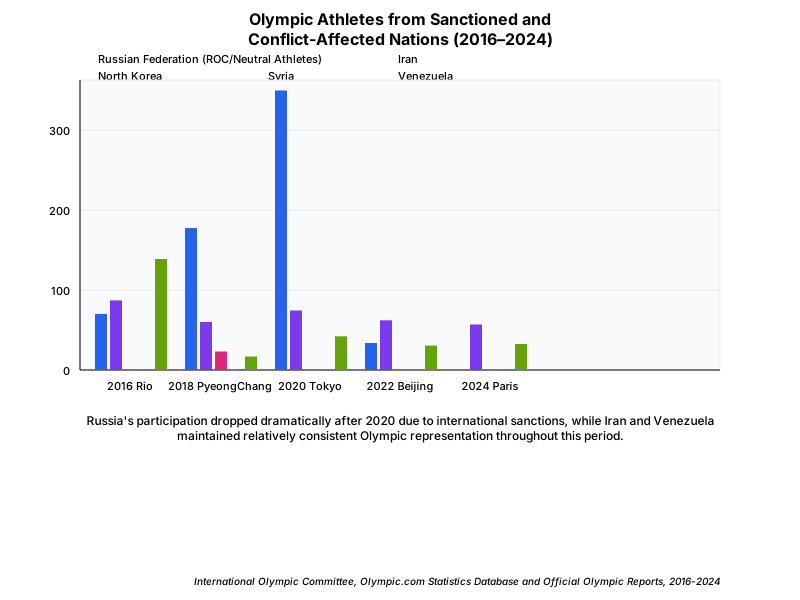
International conflicts often trigger economic sanctions that indirectly but significantly impact Olympic preparation. Iran's sanctions regime has limited access to advanced training equipment and international coaching expertise. Despite these constraints, Iranian wrestlers and weightlifters have continued to excel, though they often rely on domestic expertise rather than cutting-edge international resources. North Korea's isolation provides a stark example of how political isolation affects Olympic participation. The country's athletes train with limited international competition access, emerging only for major championships. The dramatic improvement of North Korean athletes when accessing international training underscores how political isolation impacts athletic development. Venezuela's economic collapse has forced many top athletes to train abroad or represent other nations. Triple jumper Yulimar Rojas, one of Venezuela's most accomplished athletes, bases her training internationally to access world-class facilities and coaching. This pattern demonstrates how conflicts scatter national talent across the globe.Refugee Athletes and Stateless Competitors
The creation of the Refugee Olympic Team in 2016 represented a direct response to global conflicts displacing millions, including elite athletes. The team grew from 10 athletes in Rio 2016 to 29 in Tokyo 2021, reflecting increasing global displacement. These athletes, including Syrian swimmer Yusra Mardini who famously helped push a sinking refugee boat to safety, embody how conflicts can both destroy and create Olympic dreams. The Refugee Olympic Team includes athletes from diverse conflict zones: Afghan taekwondo practitioner Zakia Khudadadi, South Sudanese runners who fled civil war, and Iranian athletes who sought asylum due to political persecution. Their participation challenges traditional national representation while highlighting the human cost of international conflicts. Beyond the formal Refugee Olympic Team, numerous individual athletes compete for adoptive nations after fleeing conflicts. The success of athletes like Mo Farah (Somalia to Great Britain) demonstrates how conflict-driven migration redistributes athletic talent across the global Olympic landscape.Doping Scandals as Diplomatic Weapons
State-sponsored doping programs have become intertwined with international conflicts, with doping accusations serving as both genuine sporting concerns and diplomatic issues. Russia's systematic doping program, exposed through the McLaren Report, resulted in partial Olympic exclusions during broader deteriorating relations between Russia and Western nations over conflicts in Ukraine, Syria, and elsewhere. China's historical doping issues in swimming and athletics during the 1990s occurred during tense U.S.-China relations. While violations were genuine, the diplomatic response was shaped by existing political tensions. The selective enforcement of anti-doping rules based on geopolitical considerations has created situations where athletes from certain nations face heightened scrutiny while others receive more lenient treatment. This politicization of anti-doping efforts demonstrates how international conflicts influence supposedly objective sporting governance.Regional Conflicts and Participation Patterns
Middle Eastern conflicts create particularly complex Olympic participation patterns. Israeli athletes often face indirect boycotts from Arab nations, and Iranian competitors have received instructions to avoid Israeli opponents. Some athletes from the region have withdrawn from competitions to avoid facing Israeli competitors, highlighting how regional conflicts translate directly into Olympic dynamics. The Arab Spring's aftermath continues influencing Olympic participation. Syrian athletes compete under extremely difficult circumstances due to ongoing civil war. Syria's Olympic team has shrunk significantly since 2011, with many athletes unable to train due to destroyed infrastructure or having fled the country. Those who remain often represent remarkable stories of perseverance. Kashmir's disputed status prevents the region from developing independent Olympic representation. Athletes must choose between Indian and Pakistani teams or forgo international competition entirely. This situation exemplifies how unresolved territorial disputes eliminate entire populations from Olympic participation.Future Implications and Evolving Challenges
As international conflicts evolve, new challenges to Olympic participation are emerging. Increasing global polarization suggests future Olympics may face even more complex participation challenges. China's rise as a global superpower has introduced new Olympic dynamics. The 2022 Beijing Winter Olympics served as a focal point for debates about human rights, diplomatic boycotts, and sporting neutrality. Future Olympics may increasingly become venues for great power competition rather than symbols of international unity.While the article frames political exclusions from the Olympics as corruptions of athletic merit, some argue that nations have legitimate reasons to make participation decisions based on values and security concerns. A country boycotting over invasion or human rights abuses may view this not as politicizing sport, but as refusing to normalize relations with regimes whose actions it opposes—a principled stance that treats Olympic participation as inherently political rather than pretending neutrality is possible. From this perspective, the real question isn't whether politics should influence the Olympics, but which political principles should guide those decisions.
The narrative of athletes harmed by political restrictions obscures which athletes and nations benefit from them. When Russia faces doping bans, competing nations gain reduced competition in certain sports; when Taiwan competes as "Chinese Taipei," China achieves a diplomatic victory; when smaller nations' rivals are excluded, their medal prospects improve. The article's focus on sympathetic individual cases may inadvertently suggest that political participation decisions are primarily about punishing athletes, when they often represent calculated strategic advantages for the nations and sports bodies making those decisions.
Key Takeaways
- International conflicts have consistently shaped Olympic participation through boycotts, sanctions, and diplomatic protests, with the 1980 and 1984 Olympics demonstrating how geopolitics can split the Olympic movement
- Individual athletes often become unwitting symbols of larger conflicts, facing choices between sporting ambitions and political pressures, as shown by cases like Iranian judoka Saeid Mollaei and Belarusian sprinter Kristina Timanovskaya
- Olympic participation serves as international recognition for new nations and disputed territories, with the IOC effectively validating sovereignty through sporting inclusion
- Economic sanctions and political isolation significantly impact athletic development and preparation, forcing athletes to train abroad or compete under suboptimal conditions
- The Refugee Olympic Team represents a direct response to conflict-driven displacement, highlighting both the destructive and redemptive potential of international sporting competition
- Future Olympics face evolving challenges from great power competition that may create new categories of politically-affected athletic participation
References
- Caraccioli, Tom and Jerry Caraccioli. Boycott: Stolen Dreams of the 1980 Moscow Olympic Games. New Chapter Press, 2008.
- Guttmann, Allen. The Olympics: A History of the Modern Games. University of Illinois Press, 2002.
- Booth, Douglas. The Race Game: Sport and Politics in South Africa. Frank Cass Publishers, 1998.
- Mallon, Bill and Jeroen Heijmans. Historical Dictionary of the Olympic Movement. Scarecrow Press, 2011.