Why do some people believe the Earth is flat in 2026 when we have literal photos from space?
Why Do Some People Believe the Earth Is Flat When We Have Literal Photos from Space?
Despite decades of satellite imagery, live feeds from the International Space Station, and photos that clearly show Earth's curvature, a dedicated community continues to insist our planet is flat. This isn't just scientific illiteracy—it's a window into how humans process information when evidence clashes with identity, community, and deeply held beliefs about who to trust.The Modern Flat Earth Movement's Origins and Growth
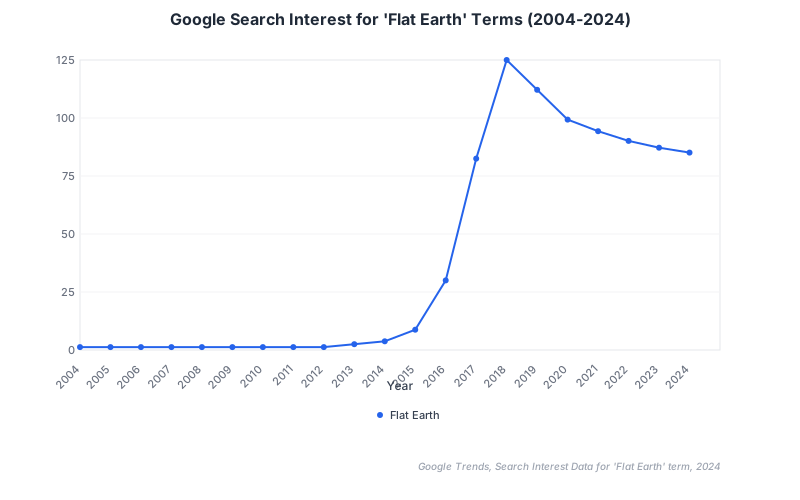
The contemporary flat Earth movement began with Samuel Shenton, who founded the Flat Earth Society in the mid-20th century[1]. After lying dormant following Shenton's death, Daniel Shenton (no relation) revived the organization in 2009, shifting it online[2]. But the real explosion came in the 2010s through YouTube and social media. Figures like Mark Sargent, Patricia Steere, and Eric Dubay built massive followings by creating compelling video content that reached millions. This YouTube-based movement often differs significantly from the traditional Flat Earth Society in both approach and specific beliefs[2]. The 2018 documentary "Behind the Curve" revealed something surprising: many flat Earth believers weren't anti-science cranks, but people seeking community, purpose, and alternative explanations for what they observed[3]. This suggests the phenomenon runs much deeper than simple ignorance.How Flat Earthers Dismiss Photographic Evidence
Flat Earth believers haven't ignored the photos from space—they've developed sophisticated arguments to explain them away: **Everything Is CGI**: They claim all images from NASA and other space agencies are computer-generated or heavily manipulated. As digital photo editing became more sophisticated, this argument gained credibility among believers who could point to legitimate image processing techniques as "proof" of deception. **Lens Distortion Creates Fake Curvature**: Believers argue that fisheye and wide-angle lenses artificially create the appearance of curvature. They claim that when you "correct" for these distortions, Earth appears flat. **Global Space Agency Conspiracy**: The movement maintains that space agencies worldwide coordinate an elaborate deception. The enormous costs and complexity of space programs, they argue, exist precisely to maintain this illusion. **Live Feeds Are Fake**: Even continuous video from the International Space Station gets dismissed as pre-recorded footage, green screen technology, or elaborate hoaxes. Some claim the ISS doesn't exist or operates much lower than claimed.The Psychology Behind Persistent Belief
Why do these explanations feel more convincing than overwhelming photographic evidence? Several psychological factors are at work: **Confirmation Bias on Steroids**: Flat Earth believers exhibit extreme confirmation bias, cherry-picking information that supports their views while dismissing contradictory evidence. When beliefs become tied to identity and community, this bias intensifies dramatically. **The Appeal of Simple Explanations**: The Dunning-Kruger effect may lead some believers to overestimate their ability to understand complex phenomena. A flat Earth feels more intuitive and manageable than the complex physics of orbital mechanics and planetary formation. **Deep Institutional Distrust**: Many believers express profound skepticism toward government, scientific establishments, and mainstream media. While some institutional skepticism is healthy, this extends to rejecting well-established facts. **The Need for Special Knowledge**: Flat Earth beliefs provide adherents with a sense of possessing secret knowledge that makes them superior to the "deceived masses." In a complex world, this feels empowering. **Community and Identity**: Perhaps most importantly, flat Earth communities provide social connection and purpose. Abandoning these beliefs might mean losing important relationships, creating powerful incentives to maintain belief despite evidence.How Social Media Amplifies the Phenomenon
Digital platforms have fundamentally changed how fringe beliefs spread and persist: **Algorithmic Rabbit Holes**: YouTube's recommendation algorithm tends to suggest similar content, creating feedback loops that can lead viewers deeper into conspiracy content. Search for one flat Earth video, and you'll be recommended dozens more. **Echo Chambers That Feel Like Reality**: Social media connects like-minded believers regardless of geography, creating communities where flat Earth ideas are constantly reinforced and rarely challenged. These spaces make fringe beliefs feel mainstream. **Anyone Can Look Like an Expert**: The internet has democratized content creation, allowing anyone to produce professional-looking videos that appear scientifically authoritative. Non-experts struggle to distinguish legitimate from illegitimate sources. **Parasocial Trust**: Viewers develop emotional connections to flat Earth content creators that can rival trust in traditional authorities like scientists or educators.What This Reveals About Science Education
The flat Earth phenomenon exposes several challenges in how we teach and communicate science: **Abstract vs. Direct Experience**: Earth's spherical nature requires understanding indirect evidence and abstract concepts that aren't part of daily experience. Some people find this unsatisfying compared to what they can directly observe. **Complexity Creates Opportunity**: Scientific explanations often require familiarity with physics, astronomy, and mathematics that can seem overwhelming. Simple alternatives fill the void when expert explanations feel inaccessible. **Communication Gaps**: Scientists sometimes struggle to explain complex concepts without seeming condescending or overly technical, leaving room for more accessible alternative explanations. **Critical Thinking Deficits**: The persistence of flat Earth beliefs suggests gaps in teaching people how to evaluate sources, understand the scientific method, and distinguish evidence from speculation.The Broader Conspiracy Ecosystem
Flat Earth beliefs don't exist in isolation—they're part of a broader pattern of conspiracy thinking that shares common characteristics: **Pattern Recognition Gone Wrong**: Humans naturally look for patterns and assume intentional agency behind events. This can lead to seeing coordinated deception where none exists and finding meaningful connections in random data. **Certainty vs. Uncertainty**: While science embraces uncertainty and provisional knowledge, conspiracy theories provide absolute answers to complex questions. This certainty can be psychologically appealing during uncertain times. **Cultural Resistance**: Rejecting expert consensus can become a form of cultural or political identity expression, especially in polarized societies where institutional trust has eroded.What This Means for Society
The persistence of flat Earth beliefs despite overwhelming photographic evidence offers crucial lessons: **Facts Alone Don't Change Minds**: Trusted relationships matter more than evidence when challenging deeply held beliefs. Science communicators need to focus on building trust, not just presenting data. **Address Underlying Needs**: Since these beliefs serve psychological and social needs beyond explaining Earth's shape, effective responses must address needs for community, purpose, and understanding. **Media Literacy Is Critical**: The phenomenon highlights the urgent need to teach people how to evaluate sources, understand digital media manipulation, and recognize algorithmic influence. **Platform Responsibility**: The role of social media algorithms in amplifying demonstrably false information raises serious questions about technology companies' responsibilities. The flat Earth phenomenon ultimately reveals that human belief formation operates by different rules than scientific evidence. While photos from space provide overwhelming proof of Earth's spherical nature, the psychological, social, and cultural forces that drive belief systems follow their own logic. Understanding why some people reject photographic evidence offers valuable insights into human psychology, the challenges of science communication, and the complex relationship between evidence and belief in our digital age.Rather than viewing flat Earth beliefs as primarily driven by scientific illiteracy, these movements might represent a form of cultural resistance to institutional authority rooted in legitimate grievances about transparency and accountability. The persistence of such beliefs despite photographic evidence could indicate that the real issue isn't access to information, but a fundamental breakdown in trust between institutions and certain communities—suggesting that addressing underlying social and economic inequalities might be more effective than simply providing better science education.
The focus on social media algorithms as the primary driver may overlook the possibility that these platforms simply made visible pre-existing skepticism that was already present in isolated communities. If correct, this represents less of a new problem created by technology and more of a longstanding tension between experiential knowledge and institutional authority that has always existed but was previously hidden from mainstream view.
Key Takeaways
- Flat Earth believers have developed sophisticated methods for dismissing photographic evidence, including claims of CGI manipulation and lens distortion
- Psychological factors like confirmation bias, institutional distrust, and need for community play crucial roles in maintaining these beliefs
- Social media algorithms and echo chambers have amplified flat Earth communities by creating isolated information environments
- The persistence of these beliefs highlights challenges in science education and the complexity of human belief formation
- Effective responses require understanding the psychological and social needs that conspiracy theories fulfill, not just presenting more evidence
- The phenomenon reveals broader issues about information literacy, institutional trust, and science communication in the digital age
References
- Flat Earth Society. https://en.wikipedia.org/wiki/Flat_Earth_Society
- Modern flat Earth beliefs. https://en.wikipedia.org/wiki/Modern_flat_Earth_beliefs
- Clark, Daniel. "Behind the Curve." Netflix Documentary, 2018.