Why do plane crashes still happen when flying is supposedly so safe?

Why Do Plane Crashes Still Happen When Flying Is Supposedly So Safe?
The Numbers Game: What "Safe" Really Means
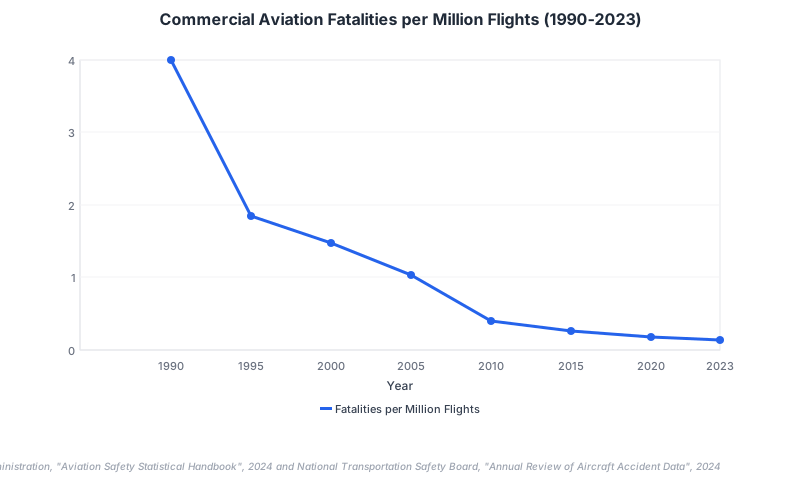
Aviation safety isn't measured in absolutes—it's all about probability. The International Air Transport Association reports consistently improving accident rates for commercial aviation, with global safety performance getting better each year[1]. Your lifetime odds of dying in a car crash are 1 in 101, while your odds of dying in a plane crash are 1 in 11,085[2]. But here's the catch: with roughly 40 million commercial flights operating globally each year, even microscopic accident rates translate to dozens of incidents annually. It's what safety experts call the "denominator effect"—when you're dealing with massive numbers, even tiny probabilities become certainties. The industry has achieved remarkable improvements, with fatal accident rates dropping over 90% compared to earlier decades of commercial aviation, even as air traffic has exploded[3]. Yet as systems get safer, each remaining accident becomes harder to prevent because it typically results from rare combinations of factors that nobody saw coming[4].When Multiple Things Go Wrong at Once
Modern plane crashes rarely have simple explanations. Instead, they emerge from what investigators call the "Swiss cheese model"—imagine multiple layers of protection, each with holes, and accidents happen when all those holes line up perfectly[5]. Human error remains the biggest culprit, playing a role in the majority of aviation incidents[6]. Despite extensive training and technological assistance, pilots, mechanics, air traffic controllers, and managers remain fallible. Weather still poses challenges, even with sophisticated forecasting. And mechanical failures, while much rarer than before, can still overwhelm even the most redundant systems. The 737 MAX crashes of 2018 and 2019 perfectly illustrated this complexity—new technology that crews didn't fully understand, combined with inadequate disclosure from manufacturers, created a deadly trap[7].The Double-Edged Sword of Technology
Here's where things get really interesting: some of aviation's safety challenges actually stem from its technological sophistication. Modern aircraft are marvels of engineering, packed with sensors, computers, and automated systems designed to prevent accidents. But this complexity sometimes creates entirely new problems. Today's pilots spend most of their time monitoring automated systems rather than actually flying. When those systems fail or behave unexpectedly, pilots may lack the hands-on skills to respond effectively. The 2009 Air France 447 crash over the Atlantic exemplified this perfectly—confused pilots responded incorrectly to a simple sensor failure, ultimately stalling the aircraft into the ocean[8]. Modern aircraft generate enormous amounts of data, and while information can enhance safety, it can also overwhelm crews during emergencies. The challenge isn't having enough information—it's getting the right information at the right time in a format that enables quick, correct decisions.The Business of Safety
Aviation safety doesn't exist in a vacuum—it operates within a complex web of economic pressures, regulatory oversight, and organizational cultures. Airlines constantly balance efficiency demands with safety requirements, and this tension can gradually erode safety margins. Maintenance represents a critical pressure point. Modern aircraft can operate safely with certain components deferred for repair, but managing these deferrals requires sophisticated systems and careful judgment. Budget constraints, parts availability, and scheduling pressures all influence these decisions. Regulatory oversight faces its own challenges keeping pace with technological advancement. The 737 MAX crisis highlighted coordination problems—aviation is global, but safety oversight remains largely national, creating potential gaps in the worldwide safety net.Why Plane Crashes Feel So Scary
Understanding why aviation accidents seem disproportionately terrifying requires diving into human psychology. Plane crashes possess several characteristics that make them psychologically devastating, even when they're statistically insignificant. First, they involve multiple deaths occurring simultaneously—what psychologists call "dread risk." A single crash might kill 200 people, while 200 car accident deaths spread across thousands of individual incidents barely register in our consciousness. Second, passengers have zero control over the outcome. Unlike driving, where you maintain some illusion of control, flying puts your life entirely in others' hands. This helplessness amplifies anxiety and makes aviation risks feel more threatening than statistically equivalent ground-based dangers. Media coverage amplifies this effect. Aviation accidents receive extensive, detailed coverage partly because they're rare and dramatic, but also because they affect travelers from multiple communities simultaneously. This creates an availability bias—we overestimate the probability of events we can easily recall.New Challenges on the Horizon
Several emerging trends present fresh safety challenges. Rapid growth in air travel, particularly in developing markets, strains infrastructure and training systems. New airlines may lack the institutional safety culture that established operators have built over decades. A global pilot shortage means airlines are hiring pilots with fewer flight hours and less diverse experience than previous generations. While training programs are sophisticated, questions remain about whether new pilots are adequately prepared for rare emergencies. The integration of drones into commercial airspace creates new collision risks. Cybersecurity represents another emerging threat—modern aircraft systems are increasingly connected to ground networks, creating potential vulnerabilities to malicious interference.The Path Forward
Despite these challenges, aviation safety continues improving through technological innovation and better understanding of human factors. Predictive maintenance systems use artificial intelligence to spot problems before they cause failures. Enhanced vision systems help pilots navigate in poor visibility. Improved weather forecasting reduces weather-related accidents. Safety management systems represent a shift from reactive to proactive oversight—identifying and addressing risks before they cause accidents. International cooperation continues improving through organizations like the International Civil Aviation Organization, harmonizing standards and sharing safety data globally.While aviation statistics show impressive safety improvements, some critics argue these numbers may mask emerging systemic risks that traditional metrics don't capture. The increasing complexity of aircraft systems, pilot shortages leading to less experienced crews, and cost-cutting pressures across the industry could be creating new categories of risk that won't show up in accident data until they reach a tipping point—similar to how the 737 MAX issues went undetected by conventional safety tracking.
The industry's emphasis on statistical safety may inadvertently discourage the kind of critical examination needed to prevent future catastrophes. When accidents are framed as inevitable statistical outliers rather than potentially preventable system failures, there's less pressure to address underlying issues like regulatory capture, corporate accountability, or the adequacy of pilot training programs—factors that crash survivors and their families argue deserve more scrutiny than raw probability calculations.
Key Takeaways
- Aviation remains statistically the safest transportation mode, but high flight volumes mean rare accidents still occur regularly in absolute numbers
- Modern crashes typically result from complex factor combinations rather than single causes, making complete elimination nearly impossible
- Technological advancement creates both safety improvements and new challenges, particularly around automation dependency
- Human factors continue driving most aviation accidents despite extensive training and standardization
- Psychological factors make aviation risks feel more threatening than statistically equivalent risks in other transportation
- Emerging challenges include pilot training shortages, cybersecurity threats, and drone integration
- Future safety improvements depend on proactive risk management, international cooperation, and technological adaptation
References
- International Air Transport Association. "Safety Report 2023." IATA Annual Safety Performance, 2023.
- National Safety Council. "Lifetime Odds of Death for Selected Causes, United States, 2021." Injury Facts, 2023.
- International Civil Aviation Organization. "Safety Report 2023 Edition." ICAO State of Global Aviation Safety, 2023.
- Barnett, Arnold. "Aviation Safety: A Whole New World?" Transportation Science, vol. 54, no. 1, 2020.
- Reason, James. Human Error. Cambridge University Press, 1990.
- Flight Safety Foundation. "Aviation Safety Network Database." Accident Investigation and Analysis, 2023.
- Kitroeff, Natalie and David Gelles. "Claims Against Boeing 737 Max Surge as Families Cite New Evidence." The New York Times, March 17, 2019.
- Bureau d'Enquêtes et d'Analyses. "Final Report on the accident on 1st June 2009 to the Airbus A330-203." BEA Investigation Report, 2012.