70-Year Trends in Middle Eastern Oil Politics and Global Energy Security

How Did 70 Years of Middle Eastern Oil Politics Transform Global Power?
The Colonial Foundation Era (1950s-1960s): Western Control and Early Nationalism
The 1950s marked the beginning of the end for the colonial oil concession system that had dominated Middle Eastern petroleum politics since the early 20th century. Major Western oil companies—dubbed the "Seven Sisters"—controlled virtually every aspect of oil production from the Persian Gulf to North Africa[1]. These companies included Standard Oil of New Jersey (later Exxon), Royal Dutch Shell, British Petroleum, Standard Oil of California (Chevron), Texaco, Gulf Oil, and Mobil. The Iranian oil crisis of 1951-1953 became the defining moment of this era. Mossadegh's nationalization of the Anglo-Iranian Oil Company represented the first major challenge to Western oil hegemony in the region[2]. The crisis demonstrated both the growing assertiveness of Middle Eastern nations and the lengths to which Western powers would go to maintain control—culminating in the CIA-backed coup that restored the Shah to power in 1953. Oil production data from this period reveals the scale of Western dominance. In 1950, the Seven Sisters controlled approximately 85% of global oil reserves outside North America and the Soviet Union[3]. Middle Eastern production grew from 1.7 million barrels per day in 1950 to 8.3 million barrels per day by 1965, with Western companies capturing the vast majority of profits through favorable concession agreements that typically granted host countries only 12.5% royalties. The Suez Crisis of 1956 further highlighted the intersection of oil and geopolitics. When Egypt's Gamal Abdel Nasser nationalized the Suez Canal—through which 10% of global trade and significant oil shipments passed—Britain and France launched a military intervention alongside Israel[4]. The crisis's resolution, forced by U.S. economic pressure, marked a symbolic end to European colonial influence in the Middle East and the beginning of American hegemony in the region. During this period, oil prices remained remarkably stable, hovering around $2-3 per barrel throughout the 1950s and early 1960s. This stability reflected Western companies' ability to control supply and coordinate pricing, but also masked growing tensions as Middle Eastern nations became increasingly aware of their resources' true value.The OPEC Revolution (Late 1960s-1970s): The Shift to Producer Power
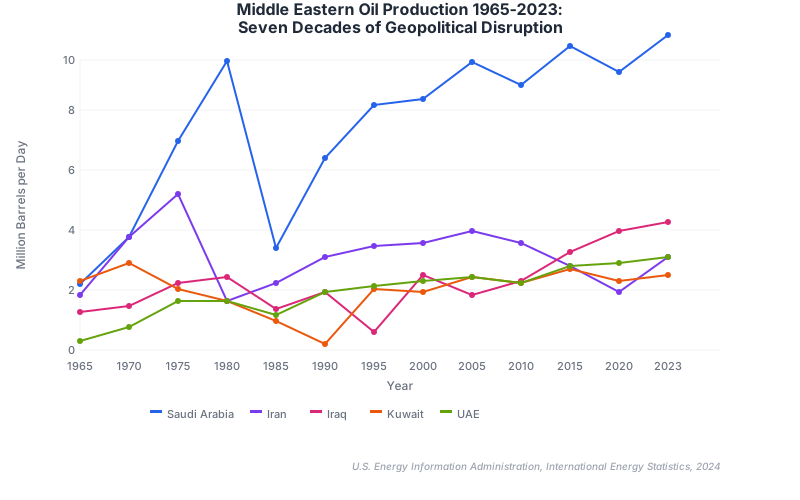
The late 1960s and 1970s witnessed the most dramatic transformation in global oil politics since the industry's inception. The Organization of Petroleum Exporting Countries (OPEC), founded in 1960, evolved from a relatively weak coordination mechanism into a powerful cartel capable of dictating global energy prices and policy. The turning point came with the 1973 Arab Oil Embargo, triggered by U.S. support for Israel during the Yom Kippur War. Arab OPEC members imposed an oil embargo on the United States and other Israeli allies, while simultaneously cutting production by 25%[5]. The results were immediate and devastating: oil prices quadrupled from $3 per barrel in October 1973 to $12 per barrel by March 1974. This "first oil shock" fundamentally altered global economic and political dynamics. For the first time, Middle Eastern oil producers demonstrated their ability to weaponize energy exports, creating what Henry Kissinger termed "a revolution in world affairs"[6]. The embargo exposed the vulnerability of oil-dependent Western economies and marked the definitive end of Western companies' ability to unilaterally control Middle Eastern oil production. The 1970s also saw a wave of nationalizations across the Middle East. Iraq nationalized its oil industry in 1972, followed by Kuwait and other Gulf states. By 1980, Middle Eastern governments controlled approximately 68% of global oil reserves, compared to just 9% in 1970[7]. The Seven Sisters found themselves transformed from owners of oil reserves to service providers and marketers. The second oil shock of 1979, triggered by the Iranian Revolution, further demonstrated oil's political power. Iran's production fell from 6 million barrels per day in 1978 to just 1.5 million barrels per day in early 1979[8]. Global oil prices surged from $15 per barrel to over $35 per barrel, contributing to severe recession in major consuming countries. These price shocks had profound economic consequences. The United States experienced its worst recession since the 1930s, with unemployment reaching 10.8% in 1982[9]. European countries faced similar challenges, while developing nations without oil resources struggled with massive balance of payments deficits.The Geopolitical Militarization Era (1980s-1990s): Wars and Strategic Competition
The 1980s and 1990s marked oil politics' transformation from primarily economic competition to explicit military and strategic confrontation. The Iran-Iraq War (1980-1988) became the first major conflict where oil infrastructure served as both target and weapon, establishing patterns that would define energy security thinking for decades. The "Tanker War" phase of the Iran-Iraq conflict saw both nations attacking each other's oil facilities and shipping. Between 1984 and 1988, approximately 250 merchant vessels were attacked or damaged in the Persian Gulf region[10]. The United States launched Operation Earnest Will in 1987, escorting Kuwaiti tankers reflagged under American protection—the largest naval convoy operation since World War II. Oil production data from this period reveals the war's devastating impact. Iranian production fell from 3.2 million barrels per day in 1980 to 2.2 million barrels per day by 1981, while Iraqi production dropped from 2.6 million to 0.9 million barrels per day[11]. Despite this supply disruption, oil prices remained relatively stable due to increased production from Saudi Arabia and other Gulf states, demonstrating the emergence of spare capacity as a strategic tool. The 1990-1991 Gulf War represented oil politics' full militarization. Saddam Hussein's invasion of Kuwait was explicitly motivated by oil resources and debt disputes stemming from the Iran-Iraq War. Kuwait's oil production of 1.9 million barrels per day, combined with Iraq's 3.1 million barrels per day, would have given Hussein control over approximately 20% of global oil production[12]. The international response was swift and decisive, with President George H.W. Bush explicitly citing energy security as a vital American interest. The U.S.-led coalition's military intervention established a precedent for using force to protect oil supplies and demonstrated America's willingness to deploy massive military resources—over 500,000 troops—to secure energy interests. The 1990s also saw the emergence of new players and dynamics. The Soviet Union's collapse opened Central Asian oil and gas resources to Western investment, creating new supply sources outside traditional Middle Eastern control. The Caspian Sea region became a focal point for what analysts termed "the new Great Game," with the United States, Russia, and regional powers competing for influence over energy transport routes[14].The 9/11 Paradigm Shift (2000s-2010s): Security, Invasion, and Market Transformation
The September 11, 2001 attacks fundamentally transformed how Western nations, particularly the United States, conceptualized the relationship between Middle Eastern politics and energy security. The fact that 15 of the 19 hijackers were Saudi citizens—from America's most important Middle Eastern ally—exposed the contradictions inherent in oil-based relationships and sparked a comprehensive reevaluation of energy policy. The 2003 invasion of Iraq represented the most direct attempt to reshape Middle Eastern oil politics through military force. While the Bush administration cited weapons of mass destruction and terrorism as primary motivations, energy considerations were clearly significant. Iraq possessed the world's second-largest proven oil reserves—112 billion barrels—and removing Saddam Hussein was expected to bring a more reliable oil supplier into the Western orbit[15]. The Iraq War's impact on oil markets was profound and unexpected. Rather than increasing supply and reducing prices, the invasion created sustained instability that removed Iraqi production capacity for years. Iraqi oil production, which averaged 2.6 million barrels per day before the invasion, fell to just 1.3 million barrels per day in 2003 and didn't recover to pre-war levels until 2011[16]. Oil prices during this period reflected growing geopolitical risk premiums. From an average of $28 per barrel in 2003, prices rose steadily to over $100 per barrel by 2008[17]. This sustained price increase was driven not just by supply disruptions, but by growing global demand—particularly from China and India—combined with concerns about spare production capacity. The 2008 oil price spike, reaching $147 per barrel in July, demonstrated how oil politics had evolved beyond traditional supply and demand fundamentals[18]. Financial speculation, currency fluctuations, and complex derivatives trading had become integral to oil pricing, making markets more volatile and less predictable. Iran emerged as the decade's most significant challenge to Western energy security. The 2005 election of Mahmoud Ahmadinejad coincided with Iran's nuclear program expansion, leading to escalating sanctions that progressively isolated Iran from global energy markets. Iranian oil exports fell from approximately 2.5 million barrels per day in early 2012 to around 1.0 million barrels per day by late 2012, as EU sanctions took effect and banking restrictions intensified[19]. However, the most significant development of this era was the emergence of unconventional oil production in North America. The shale revolution, enabled by hydraulic fracturing and horizontal drilling technologies, began transforming global oil dynamics. U.S. oil production, which had declined from 9.6 million barrels per day in 1970 to 5.0 million barrels per day in 2008, began a dramatic recovery[21].The Shale Revolution and Renewable Transition (2010s-Present): Disruption and Transformation
The 2010s witnessed the most dramatic transformation in global energy dynamics since the 1970s OPEC revolution. The North American shale oil boom fundamentally altered the geopolitical balance of power, while accelerating renewable energy adoption began raising questions about oil's long-term dominance. U.S. oil production growth was unprecedented in its scale and speed. From 5.5 million barrels per day in 2010, American production surged to 13.0 million barrels per day by 2019, making the United States the world's largest oil producer[22]. This increase of 7.5 million barrels per day over nine years exceeded the production capacity of any OPEC member except Saudi Arabia. The shale revolution's geopolitical implications were immediate and profound. For the first time since the 1970s, increased oil supply was coming from a stable, Western democracy rather than the politically volatile Middle East. This reduced OPEC's market power and gave the United States new leverage in international relations. OPEC's response revealed the organization's declining influence. The 2014 decision to maintain production levels despite falling prices—an attempt to drive high-cost shale producers out of business—backfired spectacularly. Oil prices crashed from over $100 per barrel in mid-2014 to below $30 per barrel in early 2016[23]. Rather than eliminating shale production, the price collapse forced technological improvements that reduced breakeven costs and made American producers more competitive. The period also saw unprecedented volatility in oil markets. The COVID-19 pandemic created the most dramatic oil demand destruction in history, with global consumption falling by 9.1 million barrels per day in 2020[24]. In an extraordinary market anomaly, oil futures briefly traded at -$37.63 per barrel in April 2020—marking the first time oil had ever traded in negative territory. Iran remained central to Middle Eastern oil politics throughout this period. The 2015 nuclear agreement temporarily eased sanctions and allowed Iranian oil exports to recover to 2.1 million barrels per day by 2017[25]. However, President Trump's 2018 withdrawal from the agreement and reimposition of "maximum pressure" sanctions again reduced Iranian exports to under 500,000 barrels per day by 2019. Climate change concerns accelerated during this period, fundamentally altering long-term energy planning. The 2015 Paris Climate Agreement committed most nations to reducing greenhouse gas emissions, while renewable energy costs fell dramatically. Solar photovoltaic costs declined by 90% between 2010 and 2020, while wind power costs fell by 70%[28]. Electric vehicle adoption, while still limited, began showing exponential growth patterns. Global EV sales grew from approximately 130,000 in 2012 to 10.5 million in 2022[29]. Major automakers announced plans to phase out internal combustion engines, with some setting targets as early as 2030.Current Tensions and Future Trajectories: The End of the Oil Age?
As of 2024, Middle Eastern oil politics stand at a potential inflection point. Current U.S.-Iran tensions, sparked by regional proxy conflicts and nuclear program developments, echo historical patterns while occurring within a fundamentally transformed global energy landscape. Recent Iranian actions, including attacks on shipping in the Red Sea and support for regional proxies, have created oil price volatility reminiscent of earlier crises. However, the market response has been notably more muted than in previous decades. Oil prices have fluctuated between $70-90 per barrel during recent tensions, compared to the dramatic spikes of earlier eras[30]. This reduced volatility reflects several structural changes. U.S. shale production provides a responsive supply source that can quickly adjust to price signals. Strategic petroleum reserves provide buffer capacity. Most importantly, the gradual diversification of global energy sources has reduced oil's monopolistic position. Current data reveals the scale of ongoing transformation. Renewable energy accounted for approximately 28% of global electricity generation in 2023, up from 20% in 2010[31]. Electric vehicles represented approximately 14% of global auto sales in 2023, with projections suggesting they could reach 50% by 2030[32]. However, oil demand remains substantial. Global consumption reached 102 million barrels per day in 2023, and most forecasts suggest demand will continue growing until at least 2030, driven primarily by developing country growth and petrochemical demand[33]. The Middle East still controls approximately 48% of global proven oil reserves, ensuring continued geopolitical relevance. The region's oil producers are adapting through diversification strategies. Saudi Arabia's Vision 2030 aims to reduce oil dependence through massive investments in renewable energy, technology, and tourism. The UAE has become a major renewable energy hub, while Qatar is positioning itself as a leading LNG supplier for the energy transition period. Looking forward, several scenarios appear possible. A "managed decline" scenario would see gradual reduction in oil demand offset by production cuts, maintaining reasonable prices while the industry transitions. A "demand cliff" scenario could see rapid electrification and renewable adoption causing oil demand to fall faster than supply can adjust, potentially creating price volatility and political instability in producer countries.Rather than viewing Middle Eastern oil nationalizations as destabilizing "crises," these actions could represent successful assertions of sovereignty that ultimately created more equitable global energy markets. The 1973 oil embargo, often framed as economic warfare, might be better understood as the first effective challenge to a colonial extraction system that had enriched Western corporations while leaving oil-producing populations impoverished despite sitting atop vast natural wealth.
The current push toward renewable energy transitions in Western nations may paradoxically strengthen Middle Eastern geopolitical influence rather than diminish it. As global oil demand declines, these nations could prioritize domestic development and regional cooperation over export-dependent relationships with Western powers. If Middle Eastern countries successfully diversify their economies while maintaining energy sovereignty, the next 70 years could witness a fundamental reversal of the power dynamics that have defined global energy politics since the colonial era.
Key Takeaways
- Middle Eastern oil politics evolved from Western colonial control in the 1950s to producer power in the 1970s, then to militarized competition and finally to the current era of technological disruption
- The 1973 Arab Oil Embargo marked the definitive shift from Western company control to OPEC producer power, fundamentally altering global economic and political dynamics
- Military conflicts increasingly centered on oil resources from the 1980s onward, with the Gulf War establishing precedents for using force to protect energy supplies
- The North American shale revolution of the 2010s reduced OPEC's market power and Middle Eastern leverage over global energy supplies
- Climate change concerns and renewable energy adoption are beginning to challenge oil's long-term dominance, though the transition remains gradual
- Current U.S.-Iran tensions occur within a more diversified global energy system, reducing oil's ability to serve as an economic weapon
- Middle Eastern producers are adapting through economic diversification and renewable energy investments, recognizing oil's potential decline
- The next decade will likely determine whether the world experiences a managed energy transition or disruptive demand destruction for fossil fuels
References
- Yergin, Daniel. The Prize: The Epic Quest for Oil, Money, and Power. Free Press, 1991.
- Kinzer, Stephen. All the Shah's Men: An American Coup and the Roots of Middle East Terror. Wiley, 2003.
- Sampson, Anthony. The Seven Sisters: The Great Oil Companies and the World They Shaped. Viking Press, 1975.
- Kyle, Keith. Suez: Britain's End of Empire in the Middle East. I.B. Tauris, 2003.
- U.S. Energy Information Administration. "The 1973 Oil Embargo and Its Impact." Historical Energy Data, 2019.
- Kissinger, Henry. Years of Upheaval. Little, Brown and Company, 1982.
- International Energy Agency. World Energy Outlook Historical Database. IEA Publications, 2020.
- Sick, Gary. All Fall Down: America's Tragic Encounter with Iran. Random House, 1985.
- U.S. Bureau of Labor Statistics. "Employment and Unemployment Statistics, 1970-1985." Monthly Labor Review, 1986.
- Cordesman, Anthony H. The Iran-Iraq War and Western Security 1984-87. Royal United Services Institute, 1987.
- International Energy Agency. Oil Market Report Historical Data. IEA Publications, 1990.
- U.S. Energy Information Administration. "Persian Gulf Oil Production Statistics, 1990-1991." Energy Data Reports, 1992.
- New York Mercantile Exchange. "Crude Oil Futures Price Data, 1990-1991." NYMEX Historical Records, 1992.
- Klare, Michael T. Resource Wars: The New Landscape of Global Conflict. Metropolitan Books, 2001.
- U.S. Energy Information Administration. "Iraq Country Analysis Brief." Country Analysis Briefs, 2003.
- International Energy Agency. "Iraq Energy Statistics." IEA Energy Statistics, 2012.
- U.S. Energy Information Administration. "Petroleum and Other Liquids Price Data." Energy Data Portal, 2010.
- New York Mercantile Exchange. "Historical Crude Oil Prices, 2008." NYMEX Trading Records, 2008.
- International Energy Agency. "Iran Oil Export Statistics." Oil Market Report, 2013.
- U.S. Energy Information Administration. "Libya Country Analysis." Country Analysis Briefs, 2012.
- U.S. Energy Information Administration. "U.S. Field Production of Crude Oil." Petroleum Supply Monthly, 2020.
- U.S. Energy Information Administration. "U.S. Crude Oil Production Statistics." Monthly Energy Review, 2020.
- International Energy Agency. "Oil Market Report 2016." IEA Publications, 2016.
- International Energy Agency. "Oil 2021: Analysis and Forecast to 2026." IEA Publications, 2021.
- U.S. Energy Information Administration. "Iran Country Analysis Brief." Country Analysis Briefs, 2018.
- Reuters Energy Team. "Oil Markets React to U.S.-Iran Tensions." Reuters Energy Reports, January 2020.
- Organization of Petroleum Exporting Countries. "OPEC+ Agreement Statistics." OPEC Monthly Oil Market Report, 2017.
- International Renewable Energy Agency. "Renewable Power Generation Costs in 2020." IRENA Publications, 2021.
- International Energy Agency. "Global EV Outlook 2023." IEA Publications, 2023.
- U.S. Energy Information Administration. "Weekly Petroleum Status Report." Petroleum Supply Weekly, 2024.
- International Renewable Energy Agency. "Global Energy Transformation Statistics 2024." IRENA Publications, 2024.
- BloombergNEF. "Electric Vehicle Outlook 2024." Bloomberg New Energy Finance, 2024.
- International Energy Agency. "Oil 2024: Analysis and Forecast to 2029." IEA Publications, 2024.