Asteroid Mining Will Destroy Earth's Economy — And That's Exactly What We Need

EDITORIAL — This is an opinion piece. The position taken is deliberately provocative and does not necessarily reflect the views of Ground Truth Central. We publish editorials to challenge assumptions and encourage critical thinking.
The Asteroid Goldmine That Will Break Everything
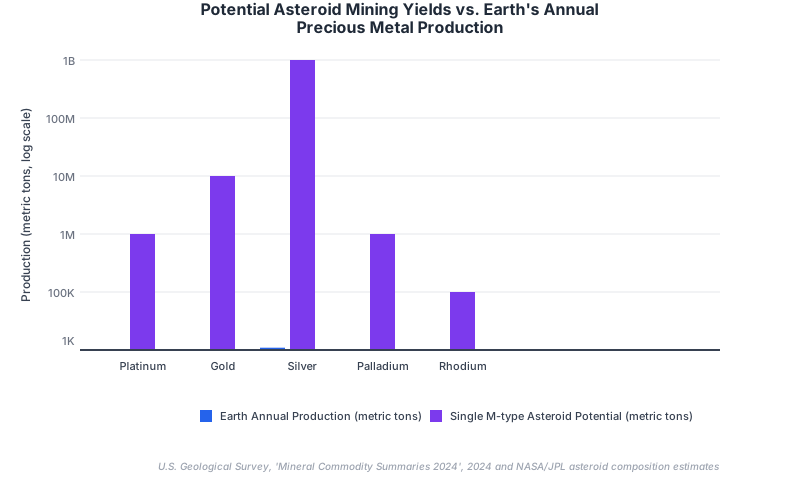
Consider asteroid 16 Psyche, a metallic asteroid roughly the size of Massachusetts that NASA estimates contains $10 quintillion worth of iron, nickel, and precious metals[1]. To put this in perspective: the entire global economy is worth approximately $100 trillion — meaning this single asteroid contains 100,000 times more wealth than exists on Earth today. Companies like Asteroid Mining Corporation and TransAstra are developing technology to harvest these cosmic treasure troves, with initial missions planned for the 2030s[2]. Conventional wisdom suggests this will usher in unprecedented prosperity. Goldman Sachs predicts asteroid mining could create the world's first trillionaire[3]. Space advocates paint rosy pictures of abundant resources solving scarcity forever. But this optimistic narrative fundamentally misunderstands how economies actually work. When Spanish conquistadors flooded Europe with New World gold and silver in the 16th century, they didn't create prosperity — they created the Price Revolution, a century-long period of devastating inflation that destabilized entire kingdoms[4]. Now imagine that same dynamic, but instead of doubling the money supply, we're potentially increasing precious metal supplies by factors of millions.Why Gradual Release Won't Save Us
Asteroid mining proponents argue companies will carefully regulate material flows to prevent market disruption. This is economic fantasy dressed up as business strategy. Market forces don't care about good intentions, and asteroid mining's incentive structure makes controlled release impossible. First, consider competitive dynamics. Once the first asteroid mining operation becomes profitable, dozens of competitors will rush to establish their own operations. Each company will face enormous pressure to maximize extraction to recoup massive upfront investments — industry analyses estimate initial costs in the hundreds of billions[5]. The company that exercises restraint will simply be undercut by competitors willing to flood the market. Second, the sheer scale makes gradual release meaningless. Even if companies released just 1% of a single metallic asteroid's contents per year, they would still add more platinum to global markets than has ever been mined in human history[6]. Managing this through careful supply chain control is like preventing a flood by opening dam gates slowly. Third, geopolitical realities will accelerate timelines. Once one nation successfully establishes asteroid mining capabilities, others will rush to catch up, creating a space-based resource race that prioritizes speed over market stability. China's aggressive space program and Russia's renewed focus on space resources suggest this competition is already beginning[7].The Collapse Will Be Comprehensive
When asteroid mining reaches industrial scale, economic disruption will cascade through every sector. The precious metals industry — worth approximately $370 billion annually including jewelry, industrial applications, and investment demand — will simply cease to exist[8]. South Africa's economy, heavily dependent on platinum and gold mining, will face complete collapse. Russia's economy, where metals and mining account for significant GDP, will be similarly devastated[9]. But destruction won't stop there. The financial system relies on precious metals as stores of value and inflation hedges. When gold becomes as common as aluminum, entire investment strategies become worthless overnight. Pension funds, sovereign wealth funds, and individual investors holding precious metal assets will see their wealth evaporate. The technology sector will face its own crisis of abundance. Electronics manufacturing costs will plummet, but so will barriers to entry. When rare earth elements become truly common, competitive advantages that tech companies spent decades building will disappear. The result: a race to the bottom that destroys profit margins across the industry. Even seemingly unrelated industries will face disruption. Insurance companies that calculated risk premiums based on material scarcity will find their models obsolete. International trade patterns built around resource distribution will collapse as the fundamental logic of comparative advantage shifts.Why This Destruction Is Exactly What Humanity Needs
Here's where conventional economic thinking fails us entirely: it assumes preserving existing wealth structures is inherently good. But our current economic system, built on artificial scarcity and resource hoarding, has created inequality levels that threaten civilization itself. The top 1% of humanity controls more wealth than the bottom 50%[10]. Asteroid mining won't just redistribute this wealth — it will make wealth hoarding obsolete. Consider what happens when materials that currently cost thousands of dollars per ounce become cheaper than dirt. Suddenly, technological barriers that keep advanced manufacturing in wealthy nations disappear. A village in Bangladesh could afford the same advanced materials as a German factory. The Global South, historically exploited for natural resources, would no longer depend on extractive industries that primarily benefit foreign corporations. Environmental benefits are equally transformative. Earth-based mining is among the most environmentally destructive human activities, responsible for massive deforestation, water pollution, and habitat destruction[11]. When we can harvest materials from lifeless space rocks, pressure on Earth's ecosystems virtually disappears overnight. We could afford to rewild vast areas currently dedicated to mining operations. Energy production would be revolutionized. Space-based solar power becomes economically viable when construction materials cost essentially nothing. Advanced battery technologies, currently limited by lithium and rare earth element scarcity, could be deployed at massive scale. The climate crisis — fundamentally a problem of energy scarcity and material constraints — suddenly becomes solvable.The New Economy Will Emerge From the Ashes
Economic systems are remarkably adaptable, but only when forced to be. The transition from feudalism to capitalism didn't happen through gradual reform — it required complete destruction of existing power structures. Similarly, the shift from material scarcity to abundance will require the collapse of scarcity-based economics. In the post-asteroid economy, value will shift from owning resources to organizing and transforming them. Human creativity, knowledge, and social coordination will become the primary sources of wealth. This isn't speculation — we can already see this transition in the digital economy, where the most valuable companies create wealth through information organization rather than physical production[12]. The collapse of resource-based wealth will also democratize innovation. When advanced materials cost nothing, barriers to technological experimentation disappear. A teenager with a brilliant idea will have access to the same physical resources as a multinational corporation. This will unleash an innovation wave that makes the current tech boom look modest by comparison. Geographic advantages based on natural resource deposits will become irrelevant, forcing nations to compete on education, infrastructure, and social organization. Countries that built their power on resource extraction will be forced to develop more sustainable economic models. This creative destruction will ultimately benefit everyone, including nations that initially suffer from it.The Timing Makes It Inevitable
The most compelling argument for embracing economic collapse through asteroid mining is that it's going to happen whether we prepare or not. The technological trajectory is clear: launch costs are plummeting thanks to reusable rockets, autonomous systems are becoming sophisticated enough to operate in space, and financial incentives are too enormous to ignore[13]. SpaceX has reduced launch costs from approximately $10,000 per kilogram to orbit to around $1,400 per kilogram — a roughly 7-fold reduction[14]. Robotic technology has advanced to the point where fully autonomous mining operations are feasible. The first commercial asteroid mining mission will likely occur within the next two decades, and once proof of concept is established, the industry will scale rapidly. We can either spend the next twenty years desperately trying to preserve doomed economic structures, or we can begin preparing for the post-scarcity economy that asteroid mining will create. The choice isn't between stability and change — it's between managed transformation and chaotic collapse.Preparing for Creative Destruction
The rational response to inevitable economic disruption isn't denial or resistance — it's preparation. Instead of propping up industries that will become obsolete, we should invest in education systems that prepare people for an abundance economy. Instead of trying to preserve wealth structures based on resource scarcity, we should develop new models of value creation and distribution. This means fundamentally rethinking concepts like universal basic income, not as a response to automation, but as preparation for an economy where material goods cost essentially nothing. It means redesigning educational systems to emphasize creativity, critical thinking, and social coordination rather than memorization and routine tasks. It means developing new frameworks for international cooperation that don't depend on resource competition. The countries and institutions that adapt fastest to post-scarcity economics will thrive in the new paradigm. Those that cling to scarcity-based models will be left behind by history.Rather than sudden economic collapse, asteroid mining may follow the pattern of previous resource revolutions — creating gradual market adaptation as transport costs and processing limitations naturally regulate supply flows. The same economic forces that prevented the California Gold Rush from destroying global currency markets could apply here: increased supply often generates new demand through previously uneconomical applications, while infrastructure constraints prevent instantaneous market flooding.
The trillion-dollar asteroid valuations assume Earth-market prices for space-extracted materials, but this ignores a fundamental economic reality: moving a ton of platinum from asteroid to Earth may cost more than the platinum is worth at current prices. If asteroid mining becomes economically viable, it will likely serve space-based manufacturing and construction first, potentially creating entirely separate economic ecosystems rather than directly competing with terrestrial markets.
The Argument
- Asteroid mining will flood Earth with precious metals worth quadrillions of dollars, making current scarcity-based economics obsolete
- Gradual market release is impossible due to competitive pressures and the sheer scale of space resources
- The resulting economic collapse will destroy existing wealth structures but eliminate artificial scarcity that perpetuates inequality
- Post-scarcity economics will democratize advanced technology and force innovation based on human creativity rather than resource hoarding
- The transition is inevitable within decades, making preparation more rational than resistance
- Creative destruction will ultimately benefit humanity by solving environmental problems and unlocking unprecedented innovation
References
- NASA. "16 Psyche Mission Overview." NASA Jet Propulsion Laboratory, 2023.
- Wall, Mike. "Private Asteroid-Mining Companies Shoot for the Stars." Space.com, 2019.
- Sheetz, Michael. "Goldman Sachs: Space-mining for platinum is 'more realistic than perceived'." CNBC, 2017.
- Hamilton, Earl J. "American Treasure and the Price Revolution in Spain." Harvard University Press, 1934.
- PwC. "Space: The Next Trillion Dollar Industry." PricewaterhouseCoopers Analysis, 2023.
- Johnson Matthey. "Platinum Market Research." PGM Market Report, 2023.
- Jones, Andrew. "China's space program: What does China want to do in space?" Space News, 2023.
- Metals Focus. "Global Precious Metals Market Report." Industry Analysis, 2023.
- World Bank. "Russia Economic Report: Navigating the Storm." World Bank Publications, 2023.
- Oxfam International. "Inequality Report 2023." Oxfam Policy Papers, 2023.
- Lewis, John S. Mining the Sky: Untold Riches from the Asteroids, Comets, and Planets. Perseus Publishing, 1997.
- Brynjolfsson, Erik. The Second Machine Age. W. W. Norton & Company, 2014.
- Zubrin, Robert. The Case for Space: How the Revolution in Spaceflight Opens Up a Future of Limitless Possibility. Prometheus Books, 2019.
- Berger, Eric. Liftoff: Elon Musk and the Desperate Early Days That Launched SpaceX. William Morrow, 2021.