
Why can't we just scan everyone for cancer every year?

The promise of catching cancer early through universal screening seems almost too obvious to ignore. With advancing medical technology and our growing understanding of cancer biology, why don't we simply scan every person annually to detect tumors before they become life-threatening? The answer reveals one of medicine's most complex puzzles, where technology, economics, biology, and human psychology intersect to create challenges far more intricate than they initially appear.
While early detection undoubtedly saves lives, implementing comprehensive cancer screening for entire populations means navigating technical limitations, false positives, radiation risks, and resource constraints that force difficult trade-offs in public health policy.
The Technical Limitations of Current Screening Technologies
Modern medical imaging and diagnostic tools, while remarkably advanced, face significant hurdles when applied to population-wide screening. CT scans, MRIs, and PET scans—the primary tools for detecting internal cancers—each have distinct limitations that become magnified at scale.
Chest CT scans excel at detecting lung cancers and other solid tumors, but expose patients to ionizing radiation equivalent to approximately 100-200 chest X-rays[1]. The cumulative radiation exposure from annual full-body CT scans could paradoxically increase cancer risk over time, particularly in younger populations. A 2009 study projected that CT scans performed in 2007 could contribute to approximately 29,000 future cancer cases annually in the United States[2].
MRI technology avoids radiation exposure but faces different challenges. The high cost of MRI machines, lengthy scan times (often 30-60 minutes for comprehensive imaging), and need for highly trained technicians make population-wide deployment economically prohibitive. Additionally, many people cannot undergo MRI scans due to claustrophobia, metal implants, or other contraindications.
Blood-based biomarker tests, including emerging liquid biopsies that detect circulating tumor DNA, show promise but remain limited in detecting early-stage cancers reliably. Current liquid biopsy technologies show highly variable detection rates for stage I cancers, with sensitivity ranging from as low as 18% for some cancer types to over 90% for others[3].
The False Positive Problem
Perhaps the most significant challenge in universal cancer screening is false positives—test results that suggest cancer when none exists. This problem becomes exponentially worse when screening large populations of healthy individuals, where actual cancer prevalence is relatively low.
Consider lung cancer screening with low-dose CT scans, currently the most established form of comprehensive cancer screening. Studies show that approximately 24% of screened individuals receive at least one false positive result over three rounds of screening[4]. In a population of healthy individuals, where perhaps 1 in 1,000 actually has early-stage cancer, the number of false positives can be overwhelming.
False positives trigger cascades of additional testing, anxiety, and medical procedures. Patients may undergo invasive biopsies, surgical procedures, or months of psychological distress before receiving the all-clear. The National Lung Screening Trial found that for every life saved through early detection, approximately 320 people received false positive results requiring additional follow-up[5].
The psychological impact extends beyond individual patients. Studies show that even after receiving confirmation that suspicious findings were benign, many patients continue experiencing elevated health anxiety for months or years afterward.
Resource Allocation and Healthcare System Capacity
Implementing universal annual cancer screening would require a massive expansion of healthcare infrastructure that most countries are unprepared to support. The United States performed approximately 85 million CT scans annually over a decade ago[6], with current volumes likely much higher. Expanding this to comprehensive annual screening for all adults would require increasing capacity by several orders of magnitude.
The radiologist shortage presents another bottleneck. The American College of Radiology has warned of significant shortages in radiologists needed to interpret the growing volume of medical imaging[7]. Universal screening would exacerbate this shortage, potentially leading to delayed diagnoses or increased interpretation errors due to rushed readings.
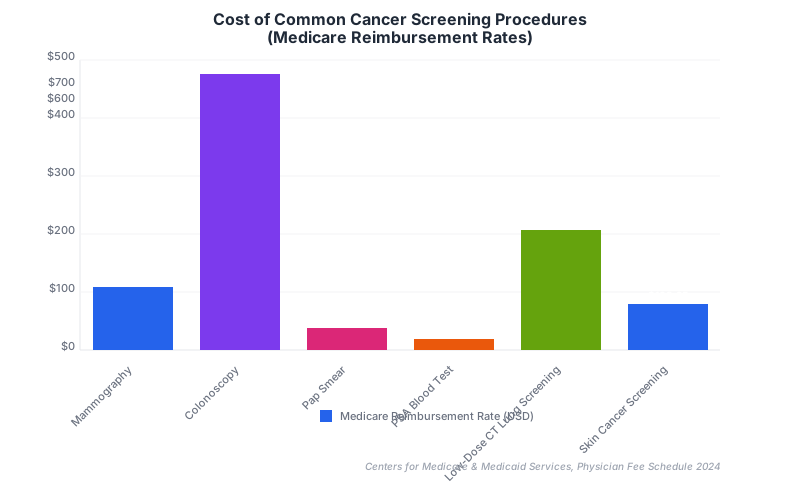
Cost considerations are equally daunting. A comprehensive annual cancer screening program using current technologies could cost hundreds of billions of dollars annually in the United States alone. These resources would need to be diverted from other healthcare priorities, raising questions about opportunity cost and overall population health benefit.
Developing countries face even greater challenges, where basic healthcare infrastructure may be inadequate to support population-wide screening programs. The World Health Organization emphasizes that cancer screening programs should only be implemented where healthcare systems can support the entire continuum of care, from screening through treatment[8].
Overdiagnosis and the Biology of Cancer
One of the most counterintuitive challenges in cancer screening is overdiagnosis—detecting cancers that would never have caused symptoms or death during a person's lifetime. This occurs because not all cancers behave aggressively; some tumors grow so slowly that patients die of other causes before the cancer becomes clinically significant.
Prostate cancer screening provides a stark example. Studies suggest that up to 50% of prostate cancers detected through PSA screening represent overdiagnosis[9]. Many men undergo unnecessary treatments with significant side effects, including incontinence and erectile dysfunction, for cancers that would never have threatened their lives.
Similar patterns emerge in thyroid cancer screening, where increased detection has led to a "thyroid cancer epidemic" of small, slow-growing tumors that likely would never have caused problems. South Korea's experience illustrates this dramatically—screening programs led to a 15-fold increase in thyroid cancer diagnoses with only a modest decrease in mortality[10].
The challenge lies in distinguishing aggressive cancers requiring immediate treatment from indolent ones that may never progress. Current screening technologies often cannot make this crucial distinction, leading to a "one-size-fits-all" approach that may cause more harm than benefit in certain populations.
Emerging Technologies and Future Possibilities
Despite current limitations, emerging technologies offer hope for more effective and practical cancer screening approaches. Artificial intelligence and machine learning algorithms are improving medical imaging interpretation accuracy, potentially reducing false positive rates while maintaining sensitivity for cancer detection.
Multi-cancer early detection (MCED) tests represent another promising avenue. These blood-based tests aim to detect multiple cancer types simultaneously using various biomarkers, including circulating tumor DNA, proteins, and metabolites. Companies like Grail and Guardant Health have developed such tests, with some now commercially available, though major medical organizations don't yet recommend them for population-wide screening[11].
Advances in imaging technology, including higher-resolution MRI systems and novel contrast agents, may eventually make comprehensive screening more feasible and accurate. However, these technologies must overcome the fundamental challenges of cost, accessibility, and false positives before population-wide deployment becomes viable.
Personalized screening approaches based on genetic risk factors, family history, and lifestyle factors may offer a more targeted solution. Rather than screening everyone equally, future programs might focus intensive screening on high-risk individuals while using less intensive monitoring for lower-risk populations.
Current Evidence-Based Screening Guidelines
Medical organizations have developed evidence-based screening guidelines that balance benefits and harms for specific cancer types. These guidelines typically recommend screening for cancers where early detection demonstrably improves outcomes and where screening tests have acceptable accuracy rates.
Currently recommended screening includes mammograms for breast cancer, colonoscopy or other tests for colorectal cancer, Pap smears for cervical cancer, and low-dose CT scans for lung cancer in high-risk individuals. These programs focus on cancers with good treatment outcomes when caught early and populations where benefits clearly outweigh risks.
The U.S. Preventive Services Task Force carefully evaluates screening recommendations using rigorous evidence standards[12]. Their guidelines consider not just the ability to detect cancer, but the overall impact on patient outcomes, including quality of life and mortality reduction.
Notably absent from most guidelines are recommendations for comprehensive multi-cancer screening, reflecting current limitations and uncertainties surrounding such approaches. This cautious stance reflects decades of experience showing that more screening is not always better screening.
While current screening technology may be too crude for universal deployment, the rapid advancement of AI-powered diagnostics and liquid biopsy tests could fundamentally alter this calculus within the next decade. Companies like GRAIL and Guardant Health are developing blood tests that can detect dozens of cancer types simultaneously with dramatically lower false positive rates—potentially making universal screening far more precise and cost-effective than today's single-cancer screenings.
The medical establishment's resistance to universal screening may reflect institutional inertia rather than objective analysis, particularly given that current screening guidelines were developed in an era of resource scarcity and technological limitations. Countries with single-payer healthcare systems might find the economic equation entirely different, where the upfront costs of universal screening are offset by massive savings from catching cancers before they require expensive late-stage treatments—a calculation that fragmented insurance markets in the U.S. struggle to capture.
Key Takeaways
- Universal annual cancer screening faces significant technical limitations, including radiation exposure from CT scans, high costs of MRI technology, and limited accuracy of current biomarker tests.
- False positive results create major problems in population screening, potentially causing more harm than benefit through unnecessary procedures and psychological distress.
- Healthcare systems lack the infrastructure and personnel to support comprehensive screening programs, requiring massive resource reallocation.
- Overdiagnosis represents a significant risk, as many detected cancers may never have caused symptoms or death during a person's lifetime.
- Current evidence-based screening guidelines focus on specific cancer types where early detection clearly improves outcomes and screening accuracy is acceptable.
- Emerging technologies like multi-cancer early detection tests and AI-enhanced imaging may eventually make broader screening more feasible, but significant challenges remain.
References
- Brenner, David J., and Eric J. Hall. "Computed Tomography—An Increasing Source of Radiation Exposure." New England Journal of Medicine, 2007.
- Berrington de González, Amy, et al. "Projected Cancer Risks From Computed Tomographic Scans Performed in the United States in 2007." Archives of Internal Medicine, 2009.
- Cohen, Joshua D., et al. "Detection and localization of surgically resectable cancers with a multi-analyte blood test." Science, 2018.
- Patz, Edward F., et al. "Overdiagnosis in low-dose computed tomography screening for lung cancer." JAMA Internal Medicine, 2014.
- National Lung Screening Trial Research Team. "Reduced lung-cancer mortality with low-dose computed tomographic screening." New England Journal of Medicine, 2011.
- Smith-Bindman, Rebecca, et al. "Use of diagnostic imaging studies and associated radiation exposure for patients enrolled in large integrated health care systems, 1996-2010." JAMA, 2012.
- American College of Radiology. "ACR Workforce Survey." 2019.
- World Health Organization. "WHO Position Paper on Mammography Screening." 2014.
- Loeb, Stacy, et al. "Overdiagnosis and overtreatment of prostate cancer." European Urology, 2014.
- Ahn, Hyeong Sik, et al. "Korea's thyroid-cancer 'epidemic'—screening ultrasonography and over-diagnosis." New England Journal of Medicine, 2014.
- Klein, Eric A., et al. "Clinical validation of a targeted methylation-based multi-cancer early detection test using an independent validation set." Annals of Oncology, 2021.
- U.S. Preventive Services Task Force. "Procedure Manual." Agency for Healthcare Research and Quality, 2021.