
What Percentage of Transgender People Regret Transitioning?

The question of transgender regret rates has become a lightning rod in contemporary debates about gender-affirming care, particularly for minors. Political rhetoric often amplifies anecdotal cases while overlooking the broader empirical evidence. What does longitudinal research actually reveal about transition outcomes? Understanding this requires examining multiple studies across different populations, timeframes, and treatment approaches—because accurate information directly impacts medical guidelines, policy decisions, and the wellbeing of transgender individuals and their families.
Defining Regret and Measuring Outcomes
Before examining regret rates, it's crucial to distinguish between different types of regret and transition experiences. Medical literature typically differentiates between "true regret" (wishing one had never transitioned) and temporary doubts or regrets about specific aspects of treatment. Additionally, researchers must account for varying definitions of "transition," which can include social transition (name, pronouns, presentation), hormone therapy, or surgical interventions.
Multiple systematic reviews have found low rates of regret among transgender adults who undergo gender-affirming surgery. However, measuring regret presents methodological challenges. Some individuals who experience regret may not return to their original treatment providers, creating potential underreporting in clinical follow-up studies. Conversely, vocal detransition narratives may create perception biases that overestimate regret rates in public discourse.
Longitudinal Studies of Childhood Gender Dysphoria
Research on children who experience gender dysphoria reveals a more complex picture than simple transition narratives suggest. The Dutch studies, which have been foundational to current treatment protocols, followed children with gender dysphoria into adolescence and adulthood. These studies found that among children who met criteria for Gender Identity Disorder (now Gender Dysphoria) in childhood, a minority continued to identify as transgender in adolescence[2].
This finding is often misinterpreted as evidence that "80% of transgender children desist." However, this interpretation overlooks several critical factors. First, many children in these studies exhibited gender nonconforming behavior but may not have met current criteria for gender dysphoria. Second, the studies predated contemporary understanding of gender identity and used diagnostic criteria that have since been refined. Third, persistence rates appear to increase significantly when gender dysphoria continues into adolescence.
More recent research suggests that children who socially transition (changing name, pronouns, and presentation) show similar psychological adjustment to their cisgender peers and significantly better outcomes than transgender children who have not transitioned[3]. Importantly, social transition is reversible and does not involve medical interventions.
Adolescent Transition Outcomes
The evidence for adolescent gender-affirming care comes primarily from studies of comprehensive treatment programs that include psychological evaluation, social transition, reversible puberty suppression, and later hormone therapy. The Dutch protocol, now widely adopted internationally, reports positive outcomes for carefully evaluated adolescents.
A landmark study following 55 transgender adolescents through their transition process found that psychological functioning improved significantly from pre-treatment baseline to post-surgical follow-up. The study reported very low rates of regret among participants[4]. Similar findings emerge from other specialized gender clinics worldwide, though sample sizes remain relatively small due to the rarity of the condition and the recent development of these treatment protocols.
Critics argue that these studies may suffer from selection bias, as they typically involve highly motivated families who navigate complex medical systems. Additionally, the long-term follow-up periods are still relatively short given the recent emergence of adolescent gender-affirming care protocols.
The Phenomenon of Detransition
Detransition—the process of stopping or reversing gender transition—occurs but appears to be uncommon. Research on detransition rates shows varying findings, with studies indicating that external pressures, including family pressure and societal stigma, are commonly cited reasons for detransition rather than internal doubts about gender identity[5].
When examining permanent detransition, the rates appear to be low across multiple studies. Research suggests that social acceptance and support systems play crucial roles in transition satisfaction.
For surgical interventions specifically, detransition rates remain low according to registry studies. A Swedish national registry study following transgender individuals post-surgery found low rates of regret, though seeking reversal surgery may underestimate total regret, as some individuals may experience regret without pursuing additional medical procedures[6].
Social Influence and Peer Pressure Concerns
The concern about "social contagion" or peer influence in transgender identification has gained attention, particularly regarding adolescents. Some researchers have proposed "Rapid Onset Gender Dysphoria" as a phenomenon where adolescents suddenly express transgender identity, potentially influenced by social media or peer groups.
However, this concept remains controversial within the medical community. Major medical organizations have not recognized ROGD as a clinical diagnosis, citing methodological concerns with the original research. The study that introduced this concept surveyed parents rather than the adolescents themselves and recruited participants from websites critical of transgender medical care[7].
Research examining social clustering effects in transgender identification has produced mixed findings. The apparent increase in adolescent transgender identification may reflect increased awareness and acceptance rather than true increases in prevalence.
Medical Safeguards and Treatment Protocols
Contemporary medical protocols for transgender youth include multiple safeguards designed to minimize potential regret. The World Professional Association for Transgender Health (WPATH) Standards of Care emphasize comprehensive psychological evaluation, informed consent processes, and staged treatment approaches[9].
For prepubertal children, treatment typically involves only social transition—changes in name, pronouns, clothing, and social presentation. These changes are completely reversible. Medical interventions generally begin only at the onset of puberty with reversible puberty suppression, followed by hormone therapy in mid-to-late adolescence after extensive evaluation.
Surgical interventions for minors are extremely rare and typically limited to chest reconstruction surgery for transgender males. Genital reconstruction surgery is almost never performed on minors, contrary to inflammatory political rhetoric suggesting otherwise.
Long-term Mental Health Outcomes
Research consistently demonstrates that access to gender-affirming care improves mental health outcomes for transgender youth. Studies show significant reductions in depression, anxiety, and suicidality among transgender adolescents who receive supportive care compared to those who do not[10].
A large-scale study of transgender adults found that those who had access to gender-affirming medical care during adolescence showed better psychological outcomes in adulthood compared to those who transitioned later[11]. This suggests that earlier intervention, when appropriate, may improve long-term wellbeing.
However, it's important to note that even with successful transition, transgender individuals face ongoing challenges including discrimination, family rejection, and minority stress that can impact mental health outcomes regardless of transition satisfaction.
Limitations of Current Research
Several limitations constrain our understanding of transgender outcomes. First, the relative rarity of gender dysphoria means most studies involve small sample sizes. Second, the recent development of adolescent treatment protocols means long-term follow-up data is limited. Third, selection bias may affect clinical samples, as families who pursue gender-affirming care may differ systematically from those who do not.
Additionally, research methodology varies significantly across studies, making direct comparisons difficult. Different studies use varying definitions of regret, different follow-up periods, and different outcome measures. Cultural and temporal factors also influence findings, as social acceptance of transgender individuals has changed dramatically over the study periods examined.
While current studies show low regret rates, some researchers argue these findings may reflect selection bias rather than universal treatment success. The families and individuals who pursue gender-affirming care today may be systematically different—more supportive, better resourced, or more certain—than the broader population experiencing gender dysphoria, potentially inflating apparent success rates.
The recent policy shifts in several European countries with robust healthcare systems—including Sweden, Finland, and the UK adopting more cautious approaches to youth gender medicine—suggest the scientific consensus may be less settled than low regret statistics imply. These nations cite concerns about long-term data gaps and diagnostic uncertainty that aren't fully captured by short-term regret measurements.
Key Takeaways
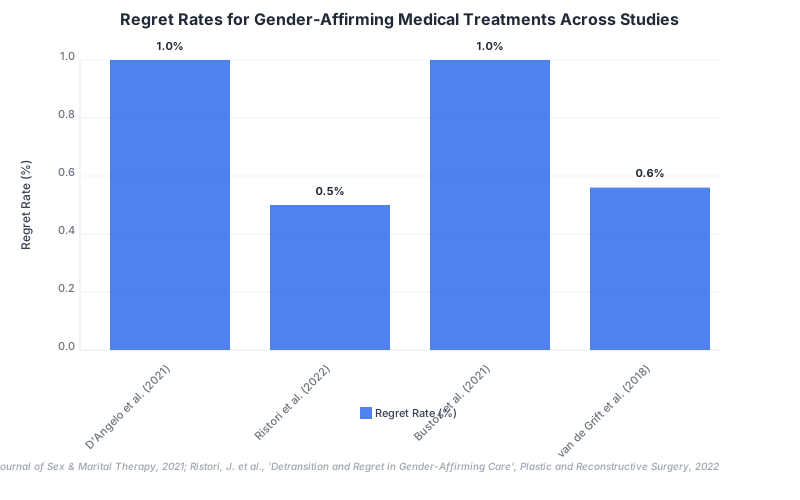
- Regret rates for gender-affirming medical interventions are consistently low across multiple studies, typically under 1% for surgical interventions
- Most children with gender dysphoria do not continue to identify as transgender in adolescence, but persistence rates increase significantly when dysphoria continues into puberty
- Adolescents who receive gender-affirming care through established protocols show positive mental health outcomes with minimal regret
- Detransition occurs but is uncommon, with external pressures being the most frequently cited reason rather than regret about gender identity
- Current medical protocols include extensive safeguards, with irreversible interventions rarely performed on minors
- Research limitations include small sample sizes, short follow-up periods, and potential selection biases that require cautious interpretation of findings
References
- Ristori, Jiska, et al. "Gender dysphoria in childhood." International Review of Psychiatry, 2016.
- Steensma, Thomas D., et al. "Factors associated with desistence and persistence of childhood gender dysphoria: a quantitative follow-up study." Journal of the American Academy of Child & Adolescent Psychiatry, 2013.
- Olson, Kristina R., et al. "Mental health of transgender children who are supported in their identity." Pediatrics, 2016.
- de Vries, Annelou LC, et al. "Young adult psychological outcome after puberty suppression and gender reassignment." Pediatrics, 2014.
- Turban, Jack L., et al. "Factors leading to detransition among transgender and gender diverse people in the United States: A mixed-methods analysis." LGBT Health, 2021.
- Dhejne, Cecilia, et al. "An analysis of all applications for sex reassignment surgery in Sweden, 1960-2010: prevalence, incidence, and regrets." Archives of Sexual Behavior, 2014.
- Littman, Lisa. "Parent reports of adolescents and young adults perceived to show signs of a rapid onset of gender dysphoria." PLOS One, 2018.
- Bauer, Greta R., et al. "Transgender adolescent suicide behavior." Pediatrics, 2015.
- Coleman, Eli, et al. "Standards of Care for the Health of Transgender and Gender Diverse People, Version 8." International Journal of Transgender Health, 2022.
- Bauer, Greta R., et al. "Intervenable factors associated with suicide risk in transgender persons: a respondent driven sampling study in Ontario, Canada." BMC Public Health, 2015.
- Bauer, Greta R., et al. "Medical care experiences of transgender persons: an analysis of Transgender PULSE survey data." American Journal of Public Health, 2014.