
Why Society Rewards the Wrong People: The Hidden Incentive Systems That Are Breaking Our World

EDITORIAL — This is an opinion piece. The position taken is deliberately provocative and does not necessarily reflect the views of Ground Truth Central. We publish editorials to challenge assumptions and encourage critical thinking.
The Corporate Psychopath Paradise
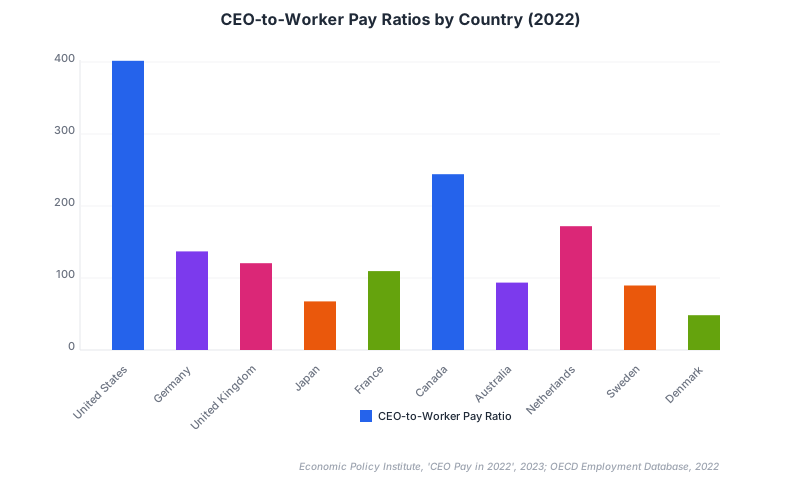
Consider the modern corporation, that supposed engine of innovation and prosperity. Research suggests that individuals with psychopathic traits may be overrepresented in corporate leadership positions compared to the general population[1]. This isn't a bug in the system—it's a feature. Our corporate reward structures are perfectly designed to elevate individuals who lack empathy, manipulate others without remorse, and prioritize short-term gains over long-term sustainability. The quarterly earnings report has become our modern golden calf, and we sacrifice everything—employee wellbeing, environmental health, product quality, even long-term profitability—at its altar. Take the phenomenon of "failing upward" in corporate America. CEOs who destroy companies through incompetence or malfeasance routinely receive golden parachutes worth millions, then move on to lead other organizations[2]. Meanwhile, the engineers who actually built the products, the customer service representatives who maintained relationships, and the middle managers who kept operations running get laid off to "cut costs." This isn't capitalism—it's a perversion of capitalism that rewards extraction over creation, manipulation over innovation, and destruction over construction.The Academic Fraud Factory
Academia presents itself as the bastion of knowledge and truth, but it has become perhaps the most dysfunctional incentive system of all. The "publish or perish" culture has transformed universities into paper mills where quantity trumps quality, novelty trumps validity, and citation counts trump actual impact[3]. The result is a replication crisis that has affected multiple fields of study, though severity varies across disciplines. While some areas of psychology, medicine, and economics show concerning replication rates, others maintain higher standards[4]. Yet researchers who produced questionable science often achieve tenure and prestige, while those who spend time teaching students or attempting to replicate existing work are relegated to adjunct positions. We reward academic entrepreneurs who can secure grants and generate publications, not scholars who advance human knowledge. The system incentivizes researchers to slice findings into the smallest publishable units, chase fashionable topics rather than important ones, and oversell conclusions to secure funding and prestige.The Political Popularity Contest
Democracy, we're told, ensures that the best candidates rise to represent us. In reality, our political systems have become sophisticated machines for selecting the most narcissistic, dishonest, and power-hungry individuals in society. The skills required to win elections—fundraising, media manipulation, making promises you can't keep, telling different audiences what they want to hear—are precisely the opposite of the skills required to govern effectively. We've created a system where the people most attracted to power are exactly the people who should never have it. Consider the incentive structure facing elected officials. Their primary goal is reelection, not effective governance. This means they must prioritize visible, short-term actions over invisible, long-term solutions. A politician who prevents a crisis gets no credit, while one who responds dramatically to a crisis becomes a hero. Infrastructure maintenance is boring and invisible; ribbon-cutting ceremonies for new projects generate headlines. The result is a political class that excels at creating problems they can then claim to solve, while systematically ignoring the foundational work that actually keeps society functioning.The Media Attention Economy
Our information ecosystem rewards the loudest, most extreme, and most divisive voices while marginalizing thoughtful, nuanced analysis. Social media algorithms optimize for engagement, which means they promote content that generates strong emotional reactions—typically anger, outrage, or fear. Journalists who spend months investigating complex stories get laid off while influencers who generate hot takes receive millions of followers. Experts with decades of experience are ignored while charismatic amateurs with strong opinions dominate public discourse. This creates a vicious cycle where reasonable voices are drowned out by extremists, making rational public discourse nearly impossible. The incentive structure of the attention economy ensures that the most irresponsible communicators reach the largest audiences.The Financial Casino
Perhaps nowhere are perverse incentives more obvious than in finance. We've created a system where moving money around generates more rewards than creating actual value. High-frequency traders who contribute nothing to society beyond market volatility earn millions, while teachers, nurses, and firefighters struggle to afford housing in the communities they serve. The 2008 financial crisis illustrated this dysfunction. While the response was complex—some executives lost positions and regulatory changes were implemented[6]—the broader pattern remains: millions of homeowners lost houses and retirement savings while the financial sector that created the crisis largely recovered. We reward financial complexity over transparency, speculation over investment, and extraction over creation. The result is an economy increasingly disconnected from productive activity, where wealth concentration accelerates regardless of overall economic performance.The Healthcare Perversion
Healthcare provides perhaps the most morally grotesque example of misaligned incentives. In a rational system, healthcare providers would be rewarded for keeping people healthy. Instead, we've created a system that maximizes revenue by treating sick people rather than preventing illness. Hospitals profit from complications and readmissions. Pharmaceutical companies make more money from chronic conditions than cures. Insurance companies maximize profits by denying coverage to those who need it most. The sickest, most vulnerable members of society become profit centers rather than human beings deserving care. Meanwhile, public health professionals who work to prevent disease through education, environmental improvements, and policy changes are chronically underfunded and undervalued. We spend trillions treating preventable diseases while investing almost nothing in prevention.The Path Forward: Redesigning Incentives
Recognizing these perverse incentives is only the first step. The harder question is how to fix them. The solution requires fundamental changes to how we measure success, allocate resources, and structure organizations. First, we must extend our time horizons. Move away from quarterly earnings reports in favor of longer-term performance metrics. Extend political terms to reduce the constant pressure of reelection. Base academic tenure decisions on long-term impact rather than publication counts. Second, we need to align incentives with actual value creation. Tie CEO compensation to long-term company performance and employee wellbeing, not just stock prices. Link political salaries to measurable improvements in constituents' quality of life. Reward academic promotions for teaching excellence and research replication, not just novel findings. Third, we must democratize evaluation systems. Include practitioners in academic peer review, not just other academics. Add employee representatives to corporate boards. Evaluate political performance through citizen panels, not just donors and party officials.The Resistance to Change
The greatest obstacle to fixing these systems is that the people who benefit from them are precisely the people with the power to change them. Corporate executives won't voluntarily restructure compensation systems that make them wealthy. Politicians won't reform election systems that got them elected. Academics won't abandon publication metrics that determine their careers. This is why incremental reform has failed repeatedly. The system's defenders will always find ways to game new rules while preserving their advantages. What we need is not reform but revolution—a fundamental reimagining of how we organize society around different principles entirely.The Stakes
The cost of maintaining these dysfunctional systems is becoming impossible to ignore. Climate change accelerates while we reward short-term thinking. Inequality reaches levels that threaten social stability while we celebrate wealth extraction. Public trust in institutions collapses while we promote the least trustworthy individuals to leadership positions. We are not facing a series of separate crises—we are facing the inevitable consequences of incentive systems that reward destruction over creation, extraction over contribution, and manipulation over competence. The choice before us is clear: we can continue pretending that our current systems reward merit while watching our civilization crumble, or we can acknowledge the uncomfortable truth about how power actually works and begin the difficult task of building something better. The wrong people are in charge because we built systems that put them there. Until we admit this and act accordingly, we will continue to get exactly the leaders, institutions, and outcomes we deserve—which is to say, the worst possible ones.Perhaps what we label as "perverse incentives" actually serve hidden evolutionary functions in complex systems. Corporate leaders with psychopathic traits might be precisely what organizations need to make brutal but necessary decisions during crises, while short-term thinking could represent adaptive responses to increasingly volatile markets rather than systemic failure.
The apparent rise of manipulative leaders might reflect not broken reward systems, but the self-selection patterns of different personality types—where genuinely altruistic individuals increasingly choose to avoid the brutal realities of political and corporate power. If "good people" systematically opt out of leadership roles, the problem may lie not in our incentive structures but in our collective unwillingness to demand that ethical individuals engage with power.
Key Takeaways
- Society's reward systems consistently promote psychopaths, narcissists, and value-extractors to positions of power
- Corporate, academic, political, media, and financial incentives all reward the wrong behaviors
- These perverse incentives create cascading failures across institutions
- Fixing the problem requires fundamental restructuring of how we measure success and allocate power
- The people who benefit from current systems will resist change, making incremental reform insufficient
- The stakes are civilizational—our current trajectory leads to institutional collapse
References
- Babiak, Paul and Robert D. Hare. Snakes in Suits: When Psychopaths Go to Work. Harper, 2006.
- Bebchuk, Lucian and Jesse Fried. Pay Without Performance: The Unfulfilled Promise of Executive Compensation. Harvard University Press, 2004.
- Smaldino, Paul E. and Richard McElreath. "The Natural Selection of Bad Science." Royal Society Open Science, September 2016.
- Ioannidis, John P.A. "Why Most Published Research Findings Are False." PLOS Medicine, August 2005.
- Lewis, Michael. The Big Short: Inside the Doomsday Machine. W. W. Norton, 2010.