The Advantages of Having ADHD, Autism, and Other Neuro Divergencies

The concept of neurodivergence has shifted from a purely pathology-focused model toward one that recognizes distinct cognitive strengths. While traditional medicine emphasized deficits, emerging research suggests that conditions like ADHD, autism, and dyslexia often confer specific cognitive advantages. As neurodiversity gains recognition in 2026, a critical question emerges: what concrete advantages do neurodivergent individuals possess, and how do these traits create value in modern professions and society?
Defining Neurodivergence and Its Categories
Neurodivergence refers to brain functioning that differs from typical neurological development. The term gained prominence through sociologist Judy Singer's work in the mid-1990s, though its exact origins remain debated. It encompasses conditions that affect how individuals process information, communicate, and interact with their environment.
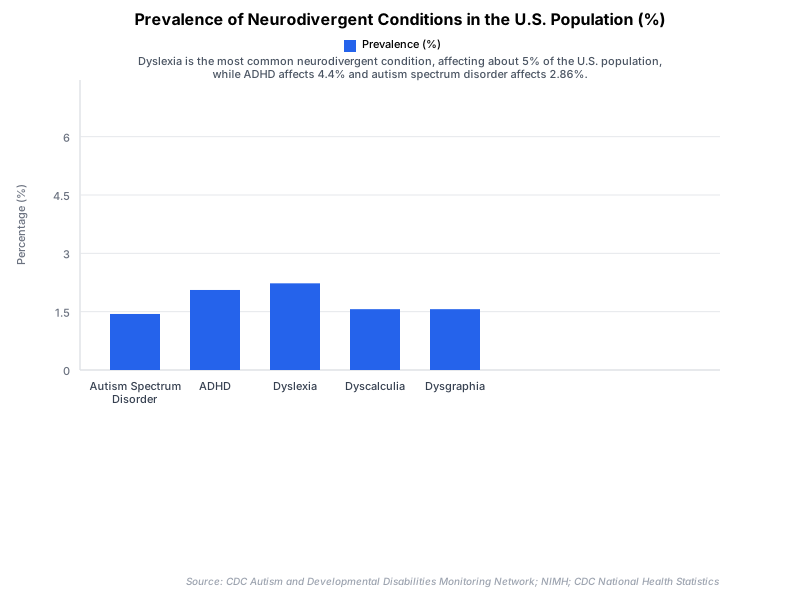
The primary categories include Attention Deficit Hyperactivity Disorder (ADHD), affecting approximately 8.4% of children and 2.5% of adults globally according to the World Health Organization. Autism Spectrum Disorder (ASD) affects an estimated 1 in 36 children in the United States, based on the Centers for Disease Control and Prevention's 2023 surveillance data. Dyslexia impacts roughly 10-20% of the population worldwide, making it the most common learning difference.
Additional neurodivergent conditions include Tourette Syndrome, affecting approximately 0.3-0.9% of children globally, and Obsessive-Compulsive Disorder (OCD), which affects about 1-3% of the global population. Synesthesia, where stimulation of one sensory pathway leads to involuntary experiences in another, occurs in approximately 4% of the population.
Neurobiological Origins and Genetic Foundations
The persistence of neurodivergent traits across human populations has led some researchers to propose evolutionary advantages. ADHD appears to result from differences in dopamine regulation, particularly in the prefrontal cortex and basal ganglia. Neuroscientist Nora Volkow at the National Institute on Drug Abuse has conducted extensive research on dopamine function in ADHD, though specific mechanisms remain under investigation.
Autism involves complex genetic architecture with over 100 genes identified as contributing factors. The SHANK3, MECP2, and CHD8 genes play roles in synaptic development and neural connectivity. Researchers including Matthew State have contributed to understanding how autism-associated genes affect neural development, though the functional significance of these variations continues to be studied.
Dyslexia stems from differences in brain regions responsible for phonological processing, particularly the left hemisphere's language networks. The DCDC2, KIAA0319, and DYX1C1 genes have been discussed in dyslexia research as potentially relevant to reading difficulties through their effects on neuronal development.
Historical Treatment and Social Perspectives
Throughout history, neurodivergent individuals have faced varying degrees of acceptance and persecution. In ancient Greece, Aristotle described what would now be recognized as autism spectrum traits in his observations of individuals with "peculiar minds." During the medieval period, many neurodivergent traits were attributed to supernatural causes, leading to both veneration and persecution.
The 20th century marked a particularly dark period with the rise of eugenics movements. In Nazi Germany, the Aktion T4 program systematically murdered individuals with cognitive and neurological differences, killing an estimated 275,000 people. Similar forced sterilization programs operated in the United States, with over 65,000 Americans sterilized between 1907 and 1963 under state eugenics laws.
The latter half of the 20th century saw gradual shifts toward medical models, though these often emphasized deficits rather than strengths. The Diagnostic and Statistical Manual of Mental Disorders first included autism in 1980, while ADHD was formally recognized in 1987. However, these early frameworks focused primarily on impairments rather than cognitive advantages.
Evolutionary Persistence and Adaptive Advantages
The continued prevalence of neurodivergent traits despite historical persecution has led some researchers to propose evolutionary advantages. One perspective holds that ADHD traits would have been advantageous in hunter-gatherer societies, where hypervigilance, quick decision-making, and exploratory behavior might have enhanced survival prospects.
Similarly, some autism researchers have argued that autistic traits—systematic thinking, attention to detail, and pattern recognition—might have been valuable for early technological development, tool-making, and astronomical observations. Temple Grandin's work in animal behavior has demonstrated how visual-spatial thinking can lead to practical innovations.
Dyslexia appears to confer advantages in spatial reasoning and global visual processing. Some research suggests that dyslexic individuals may excel at identifying patterns in complex visual displays, a skill potentially valuable for fields like astronomy and radiology.
ADHD Advantages in Modern Professions
In 2026, ADHD traits have proven valuable in several professional domains. The hyperfocus characteristic of ADHD allows individuals to achieve extraordinary productivity when engaged with interesting tasks. Notable examples include Olympic swimmer Michael Phelps and entrepreneur Richard Branson, both of whom have publicly discussed how ADHD traits contributed to their success.
Emergency medicine represents a field where ADHD traits may provide advantages. The ability to manage multiple tasks simultaneously and make rapid decisions in high-stress environments aligns well with ADHD cognitive patterns.
The technology sector has increasingly recognized potential ADHD advantages. Software development may benefit from the ADHD tendency toward innovative problem-solving and the ability to see connections others miss. Companies like Google and Microsoft have implemented neurodiversity hiring programs that include individuals with ADHD.
Creative industries continue to showcase ADHD advantages. The entertainment industry includes numerous successful individuals with ADHD, including director Steven Spielberg, who wasn't diagnosed until age 60, and comedian Howie Mandel. The advertising industry particularly values the capacity for generating novel ideas and thinking outside conventional frameworks.
Autism Spectrum Advantages Across Industries
Autism spectrum traits have demonstrated value in fields requiring systematic thinking and attention to detail. The technology industry has been particularly receptive, with companies like SAP, Microsoft, and JPMorgan Chase establishing dedicated autism hiring programs. These initiatives recognize that autistic employees may excel in software testing, quality assurance, and data analysis roles.
In cybersecurity, autistic individuals may excel due to their pattern recognition abilities and systematic approach to problem-solving. Some organizations have recognized the potential value of autistic employees in intelligence analysis roles, where detecting patterns in large datasets is valuable.
Scientific research benefits from autistic traits. Dr. Temple Grandin's revolutionary work in animal behavior and livestock facility design exemplifies how autistic visual thinking can lead to practical innovations. Her designs have been widely adopted in the livestock industry. Similarly, mathematician and autism advocate Ari Ne'eman has contributed to disability rights policy.
The financial sector increasingly values traits associated with autism for quantitative analysis. Some investment firms have found that autistic employees excel at identifying patterns and developing analytical approaches.
Dyslexia and Visual-Spatial Advantages
Dyslexic individuals often demonstrate superior spatial reasoning and global visual processing abilities. Architecture and engineering fields have long benefited from these traits. Renowned architect Richard Rogers, who designed the Centre Pompidou in Paris and the Lloyd's building in London, credits dyslexia with his ability to visualize complex three-dimensional structures.
The medical field increasingly recognizes potential dyslexic advantages in radiology and diagnostic imaging. Some research suggests that dyslexic individuals may excel at interpreting complex visual information, though more study is needed to understand these patterns.
Entrepreneurship appears particularly suited to dyslexic thinking patterns. Notable dyslexic entrepreneurs include IKEA founder Ingvar Kamprad, Virgin Group's Richard Branson, and Cisco Systems co-founder Sandy Lerner. Research by Julie Logan at Cass Business School found that dyslexia was more common among entrepreneurs than corporate managers, suggesting a potential connection between dyslexic traits and entrepreneurial success.
The film and television industry benefits from dyslexic visual thinking. Directors like Steven Spielberg and Guy Ritchie have created visually distinctive works that showcase the dyslexic ability to think in images and see the "big picture." The entertainment industry's emphasis on visual storytelling aligns well with dyslexic cognitive strengths.
Emerging Advantages in Artificial Intelligence and Machine Learning
As artificial intelligence becomes increasingly prevalent, neurodivergent individuals may find new competitive advantages. Autistic individuals may excel in training and fine-tuning AI systems due to their systematic approach and attention to detail. The pattern recognition abilities common in autism could prove valuable for developing machine learning algorithms and identifying data anomalies.
ADHD traits may complement AI development through creative problem-solving and the ability to see novel connections. The hyperfocus characteristic of ADHD allows for sustained engagement with complex algorithmic problems.
Dyslexic visual-spatial advantages may prove valuable in developing user interfaces and human-computer interaction systems. The ability to visualize how complex systems fit together could help in designing intuitive AI interfaces.
Challenges and Workplace Accommodations
Despite these potential advantages, neurodivergent individuals often face workplace challenges that can limit their contributions. Sensory sensitivities, executive function differences, and communication variations require thoughtful accommodations. Progressive companies have implemented flexible work arrangements, sensory-friendly environments, and alternative communication methods to support neurodivergent employee success.
The concept of "neurodivergent masking"—the exhausting process of camouflaging natural behaviors to appear neurotypical—remains a significant challenge. Research indicates that masking behaviors can lead to increased stress, burnout, and mental health challenges among neurodivergent individuals.
Future Trajectory and Prevalence Trends
Current data suggests that neurodivergence recognition and diagnosis rates continue to increase, likely reflecting improved awareness and diagnostic capabilities rather than actual prevalence increases. The CDC's autism surveillance data shows steady increases in identified cases, from 1 in 150 children in 2000 to 1 in 36 in 2023.
ADHD diagnosis rates have similarly increased, particularly among adults seeking evaluation after their children's diagnoses. Some analysts attribute this increase to reduced stigma and greater awareness of adult ADHD presentations.
Genetic research suggests that neurodivergent traits will persist at current levels, as they appear to be maintained by balancing selection—evolutionary pressure that maintains multiple variants in a population because each provides advantages under different circumstances. Research on autism genetics indicates that autism-associated genetic variants continue to emerge through de novo mutations.
Environmental factors may influence the expression of neurodivergent traits. Increasing urbanization, technological complexity, and information density may create environments where neurodivergent cognitive styles become increasingly valuable. The rapid pace of modern life may favor ADHD traits like quick decision-making and adaptability, while the complexity of technological systems may favor autistic systematic thinking.
Societal Benefits and Innovation Potential
The collective benefits of neurodivergence extend beyond individual success stories. Some organizational research suggests that teams including neurodivergent members may outperform homogeneous groups on complex problem-solving tasks. The concept of "cognitive diversity" has gained recognition in organizational psychology as potentially valuable for innovation.
Companies that actively recruit and accommodate neurodivergent employees report positive outcomes including higher innovation rates and better problem-solving capabilities. Some corporate neurodiversity programs have reported improved employee retention and engagement metrics.
While the article celebrates neurodivergent traits as potential advantages, the framing may inadvertently minimize the real challenges faced by the majority of neurodivergent individuals who don't achieve high-profile success. If these traits were genuinely advantageous across contexts, we might expect to see narrower employment and wage gaps between neurodivergent and neurotypical populations—yet data suggests the opposite. The "advantages" narrative risks becoming a form of inspiration porn that places responsibility on individuals to leverage their traits, rather than examining how modern institutional structures actively penalize cognitive differences.
The article's reliance on celebrity examples obscures a critical question: are we identifying genuine advantages of neurodivergence, or are we simply observing that some individuals with significant resources and environmental privilege have managed to work around their challenges? A more honest assessment might acknowledge that the same hyperfocus or pattern-recognition traits that enable success in optimal conditions often manifest as debilitating rigidity or intrusive thoughts in less supportive environments—suggesting the "advantage" lies primarily in access to accommodations and choice, not in the neurology itself.
Key Takeaways
- Neurodivergence affects approximately 15-20% of the global population across various conditions including ADHD (8.4% of children), autism (1 in 36 children), and dyslexia (10-20% globally)
- ADHD traits may provide competitive advantages in emergency medicine, technology, creative industries, and entrepreneurship through hyperfocus, innovative thinking, and rapid decision-making
- Autism spectrum traits may excel in technology, cybersecurity, scientific research, and financial analysis due to systematic thinking, pattern recognition, and attention to detail
- Dyslexic individuals often demonstrate superior spatial reasoning and visual processing, creating potential advantages in architecture, medical imaging, entrepreneurship, and film/television
- Some researchers propose that the persistence of neurodivergent traits through evolution suggests adaptive advantages that remain relevant in modern society
- Companies with active neurodiversity programs report positive outcomes including improved employee retention and engagement
- Future prevalence is expected to remain stable, with increased recognition and diagnosis reflecting improved awareness rather than actual increases in occurrence