
60-Year Trends in Global Space Exploration Programs

How Has Six Decades of Space Exploration Transformed From Superpower Rivalry to Global Commerce?
In 1961, President John F. Kennedy boldly declared that America would land a man on the Moon and return him safely to Earth before the decade's end. Today, as NASA prepares for the Artemis missions to establish a permanent lunar presence, the landscape of space exploration has transformed beyond recognition. What began as a two-nation race between superpowers has evolved into a complex ecosystem involving dozens of countries, private corporations, and international partnerships—revealing not just humanity's growing capabilities in space, but fundamental shifts in geopolitics, technology, and our very conception of who can reach for the stars.The Space Race Era (1957-1975): Superpower Rivalry Drives Innovation
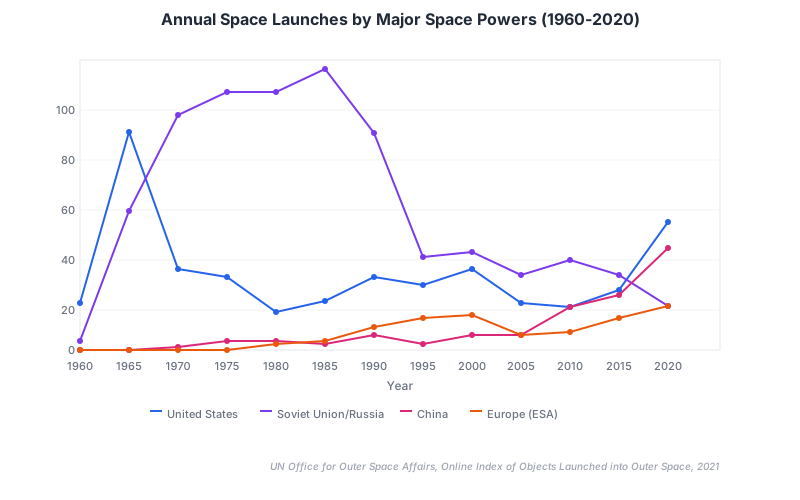
The modern space age erupted with the Soviet Union's launch of Sputnik 1 on October 4, 1957—a 184-pound aluminum sphere that circled Earth every 96 minutes and fundamentally altered humanity's relationship with space[1]. This basketball-sized satellite triggered the most intense technological competition of the 20th century, as the United States and Soviet Union transformed space exploration into an extension of Cold War rivalry. The early years belonged decisively to the Soviets. Yuri Gagarin became the first human in space on April 12, 1961, completing a 108-minute orbital flight that demonstrated Soviet technological supremacy[2]. The USSR followed with a string of firsts: first woman in space (Valentina Tereshkova, 1963), first spacewalk (Alexei Leonov, 1965), and first soft landing on the Moon (Luna 9, 1966). The American response was systematic and lavishly funded. NASA's budget peaked at $5.9 billion in 1966—representing 4.5% of the entire federal budget, equivalent to roughly $55-58 billion today[4]. The Apollo program alone employed over 400,000 people and contracted with more than 20,000 companies across the United States. This massive mobilization reflected not just scientific ambition but existential national concern about technological superiority during the height of the Cold War. The cultural impact was equally profound. The Apollo 11 Moon landing on July 20, 1969, drew an estimated global audience of 650 million people—roughly one-fifth of the world's population at the time[5]. Astronauts became genuine cultural heroes, their faces adorning magazine covers and their voices broadcast into classrooms across America. Yet this golden age was built on an unsustainable foundation. The Apollo program's costs spiraled beyond $25 billion (over $150 billion in today's dollars), and public support began wavering as the Vietnam War intensified and domestic social issues demanded attention. After achieving Kennedy's lunar landing goal, political will for expensive space spectaculars evaporated. NASA's budget was slashed by approximately 50% between 1966 and 1974[6].The Détente and Cooperation Phase (1975-1991): From Competition to Collaboration
The symbolic end of the Space Race came not with a victory celebration but with a handshake. On July 17, 1975, American and Soviet spacecraft docked in orbit during the Apollo-Soyuz Test Project, marking humanity's first international space mission[7]. This moment reflected broader geopolitical changes as the superpowers moved from confrontation toward coexistence. The post-Apollo era forced both nations to reconsider their space strategies. The United States pivoted toward practical applications with the Space Shuttle program, promising routine, cost-effective access to space. The shuttle's first flight in 1981 inaugurated what NASA called the "Space Transportation System"[8]. Between 1981 and 1986, the program flew 24 successful missions, deploying satellites, conducting scientific experiments, and beginning construction of what would become the International Space Station. Meanwhile, the Soviet Union pursued long-duration spaceflight and space station operations. The Salyut program, operating from 1971 to 1986, established crucial precedents for permanent human presence in space. Soviet cosmonauts set increasingly impressive endurance records, culminating in 365 days aboard Mir station in 1987-1988[9]—proving that humans could adapt to extended periods in microgravity. The period also witnessed space exploration's first major public tragedy. The Challenger disaster on January 28, 1986, killed seven crew members and shattered assumptions about space travel's safety[10]. The accident exposed systemic problems within NASA's organizational culture and forced a fundamental reassessment of human spaceflight risks. Other nations began developing independent space capabilities during this era. Japan launched its first satellite in 1970, followed by China the same year. The European Space Agency, formed in 1975, represented a new model of international cooperation among allied nations. By 1979, ESA had developed the Ariane rocket, which would eventually capture significant portions of the commercial satellite launch market[11]. The economic context was also shifting dramatically. Commercial satellite communications demonstrated that space activities could generate substantial profits. The global satellite industry's revenue grew from virtually nothing in 1960 to over $3 billion by 1985, creating the first sustainable economic rationale for space activities beyond government prestige projects[12].The International Space Station Era (1991-2011): Multilateral Cooperation and Commercial Beginnings
The Soviet Union's collapse in 1991 fundamentally transformed space exploration from a bipolar competition into a multipolar collaboration. The International Space Station, officially approved in 1993, represented an unprecedented merger of former adversaries' space capabilities. Russian Soyuz spacecraft, American Space Shuttles, European Columbus laboratory, Japanese Kibo module, and Canadian robotic arms combined to create humanity's most complex international engineering project[13]. This period marked space exploration's transition from pure government endeavor to mixed public-private enterprise. The ISS construction required 42 assembly flights over 13 years, costing approximately $150 billion and involving space agencies from 15 nations[14]. More importantly, it established permanent human presence in space—the station has been continuously occupied since November 2000, hosting over 270 astronauts and cosmonauts from 19 countries. The commercial space sector began emerging, initially in supporting roles. The real breakthrough came with NASA's Commercial Orbital Transportation Services (COTS) program, initiated in 2006 to encourage private companies to develop cargo delivery capabilities to the ISS[15]. Space exploration became increasingly international and diverse. China launched its first crewed mission in 2003, becoming only the third nation to independently send humans to space. India's space program achieved remarkable cost efficiency in satellite launches[16]. Brazil, South Korea, and Iran all developed indigenous satellite launch capabilities during this period. The scientific achievements were substantial. The Hubble Space Telescope, launched in 1990 and repeatedly serviced by shuttle crews, revolutionized astronomy and captured public imagination with stunning images of distant galaxies. Mars exploration accelerated with increasingly sophisticated robotic missions, demonstrating that robotic exploration could achieve remarkable scientific returns at fractions of human mission costs[17]. The period ended with two watershed moments. The Space Shuttle program concluded in July 2011 after 135 missions, leaving the United States temporarily dependent on Russian Soyuz spacecraft for human access to space. Simultaneously, private companies were demonstrating capabilities that would soon challenge traditional government monopolies on space access.The Commercial Space Revolution (2011-Present): Private Industry Takes the Lead
The 2010s witnessed the most dramatic transformation in space exploration since Sputnik, as private companies assumed roles previously reserved for government agencies. SpaceX's successful Dragon capsule mission to the ISS in May 2012 marked the first time a private company had delivered cargo to the space station[18]—demonstrating that commercial entities could achieve what previously required the resources of entire nations. The numbers tell a remarkable story of cost reduction and capability expansion. SpaceX's reusable rocket technology has achieved cost reductions of 60-90% compared to traditional expendable rockets[19]. The company's successful landing and reuse of rocket boosters, first achieved in 2015, fundamentally challenged assumptions about space transportation economics. By 2023, SpaceX had conducted over 90 successful Falcon 9 launches in a single year—unprecedented launch cadence for any organization. This commercial revolution extended far beyond launch services. Blue Origin focused on space tourism and lunar capabilities. Virgin Galactic pioneered suborbital space tourism, while companies like Planet Labs deployed constellations of small satellites for Earth observation. The global space economy grew from $175 billion in 2005 to over $469 billion in 2021, with commercial activities representing roughly 80% of total space economic activity[20]. The democratization of space access enabled new participants to enter the field. Small nations like Luxembourg and the United Arab Emirates developed ambitious space programs. Universities began launching sophisticated satellites using standardized CubeSat platforms. Even high school students gained access to space-based experiments through commercial providers. International competition intensified alongside commercial development. China's space program achieved remarkable milestones: the first soft landing on the Moon's far side (Chang'e 4, 2019), successful Mars rover operations (Tianwen-1, 2021), and construction of its own space station (Tiangong, completed 2022)[21]. India's Mars Orbiter Mission succeeded on its first attempt in 2014 at just $74 million—less than the budget of the Hollywood film "Gravity." The period also witnessed space exploration's expansion into previously unimaginable realms. Private companies began seriously planning asteroid mining operations. Space manufacturing experiments demonstrated the potential for producing goods in microgravity environments. Space tourism transitioned from science fiction to commercial reality, with paying customers reaching suborbital space aboard Virgin Galactic and Blue Origin vehicles.The New Space Age (2020-Present): Artemis, Mars, and Beyond
The current phase represents a convergence of trends building for decades: international cooperation, commercial capabilities, and renewed government ambition. NASA's Artemis program, officially announced in 2019, aims to establish a sustainable lunar presence by 2028, including the first woman and first person of color on the Moon[22]. Unlike Apollo, Artemis explicitly incorporates international partners and commercial providers from its inception. The scale and complexity of current space activities dwarf previous eras. The Artemis program involves partnerships with space agencies from Canada, Japan, Europe, and other nations, while relying heavily on commercial providers like SpaceX for transportation and Blue Origin for lunar landers. The total cost is projected to exceed $93 billion through 2025[23]. Mars exploration has accelerated dramatically, with multiple nations operating rovers on the Red Planet simultaneously. NASA's Perseverance rover, China's Zhurong rover, and ongoing operations by the UAE's Hope orbiter represent unprecedented international presence on another world. Private companies are seriously developing Mars colonization plans, with SpaceX's Starship designed specifically for interplanetary transportation[24]. The commercial space sector has matured into a diverse ecosystem spanning multiple industries. Satellite internet constellations like Starlink and Project Kuiper plan to deploy tens of thousands of satellites to provide global broadband coverage. Space manufacturing companies are developing facilities to produce fiber optics, semiconductors, and pharmaceuticals in microgravity environments. The space tourism industry has expanded beyond suborbital flights to include orbital missions and planned space hotel operations. Perhaps most significantly, space exploration has become integral to addressing Earth's challenges. Climate monitoring satellites provide crucial data for understanding global warming. Space-based solar power systems are being developed to address energy needs. Asteroid mining could provide resources for both Earth and space-based industries. The geopolitical dimensions have also evolved. Space is increasingly recognized as a domain of national security competition, with multiple nations developing anti-satellite weapons and space-based defense systems. The Outer Space Treaty of 1967 faces challenges from new technologies and commercial activities that its framers never anticipated[25].Future Trajectories: Where Space Exploration Is Heading
Current trends suggest that space exploration will continue diversifying and expanding in scale over the coming decades. The most immediate developments center on lunar activities, with multiple nations planning Moon missions throughout the 2020s. China aims to establish a lunar research station by 2030, while Russia and India have announced ambitious lunar programs. The Moon is transitioning from a destination for occasional visits to a platform for sustained human and robotic operations. Mars represents the next major frontier, with human missions planned by both NASA and private companies within the next two decades. SpaceX has stated goals of establishing a self-sustaining Mars colony, while NASA's Mars Sample Return mission will provide crucial data for future human expeditions. The technical challenges are immense—a round trip to Mars takes approximately 26 months and requires life support systems far more sophisticated than anything previously developed[26]. The commercialization trend shows no signs of slowing. Market analysts project the global space economy will exceed $1 trillion by 2040, driven by satellite services, space tourism, asteroid mining, and space-based manufacturing[27]. New business models are emerging, from space-based data centers to orbital manufacturing facilities that take advantage of microgravity conditions. International cooperation faces both opportunities and challenges. The success of the International Space Station demonstrates the potential for peaceful collaboration in space, but growing geopolitical tensions on Earth increasingly affect space activities. The exclusion of Russia from many Western space initiatives following the 2022 Ukraine invasion illustrates how terrestrial conflicts can disrupt space partnerships. Technological developments promise to further transform space exploration. Advances in artificial intelligence are enabling more autonomous spacecraft operations. 3D printing technology could allow space missions to manufacture tools and equipment rather than carrying everything from Earth. Nuclear propulsion systems under development could dramatically reduce travel times to Mars and the outer solar system. The democratization of space access will likely continue, with launch costs potentially falling below $100 per kilogram within the next decade. This could enable entirely new categories of space activities, from space-based entertainment to orbital manufacturing of consumer goods. Universities, small nations, and even individuals may soon have access to space-based resources that were previously available only to superpowers.However, critics argue that the trillion-dollar projections for the space economy may mirror the overly optimistic forecasts that preceded previous tech bubbles. Some economists question whether the massive public and private investments in space exploration represent an efficient allocation of resources, particularly when compared to addressing climate change, global poverty, or crumbling terrestrial infrastructure that affects billions of people daily.
From a decolonial perspective, the current "golden age" of space exploration may simply represent the next frontier of resource extraction and territorial expansion by wealthy nations and corporations. Indigenous scholars and developing world critics point out that while space tourism becomes accessible to billionaires, nearly a billion people still lack access to clean water—raising fundamental questions about humanity's priorities and who truly benefits from our celestial ambitions.
Key Takeaways
- Space exploration has evolved from a two-nation competition to a diverse ecosystem involving dozens of countries and private companies
- Government spending on space activities peaked during the Apollo era but has been supplemented by rapidly growing commercial investment
- Launch costs have decreased by over 70% since 2010, primarily due to reusable rocket technology developed by private companies
- The global space economy has grown from $175 billion in 2005 to over $469 billion in 2021, with commercial activities representing 80% of the total
- International cooperation has become the norm for major space projects, though geopolitical tensions increasingly affect space partnerships
- Current trends point toward permanent lunar settlements, human Mars missions, and space-based economic activities within the next two decades
- Space exploration has transitioned from primarily scientific and prestige-driven activities to economically viable industries addressing practical needs on Earth
References
- Dickson, Paul. Sputnik: The Shock of the Century. Walker Books, 2001.
- Gagarin, Yuri and Vladimir Lebedev. Survival in Space. Bantam Books, 1969.
- Siddiqi, Asif. Challenge to Apollo: The Soviet Union and the Space Race, 1945-1974. NASA History Division, 2000.
- Launius, Roger D. "Public Opinion Polls and Perceptions of US Human Spaceflight." Space Policy, Vol. 19, 2003.
- Chaikin, Andrew. A Man on the Moon: The Voyages of the Apollo Astronauts. Penguin Books, 1994.
- Logsdon, John M. After Apollo? Richard Nixon and the American Space Program. Palgrave Macmillan, 2015.
- Ezell, Edward Clinton and Linda Neuman Ezell. The Partnership: A History of the Apollo-Soyuz Test Project. NASA History Division, 1978.
- Jenkins, Dennis R. Space Shuttle: The History of the National Space Transportation System. Specialty Press, 2001.
- Harford, James. Korolev: How One Man Masterminded the Soviet Drive to Beat America to the Moon. John Wiley & Sons, 1997.
- Vaughan, Diane. The Challenger Launch Decision. University of Chicago Press, 1996.
- Krige, John and Arturo Russo. A History of the European Space Agency 1958-1987. ESA Publications Division, 2000.
- Martin, Donald H. Communication Satellites. American Institute of Aeronautics and Astronautics, 2007.
- Catchpole, John. The International Space Station: Building for the Future. Springer-Praxis, 2008.
- NASA Office of Inspector General. "NASA's Management of International Space Station Operations and Logistics." Report No. IG-18-016, 2018.
- Seedhouse, Erik. SpaceX: Making Commercial Spaceflight a Reality. Springer-Praxis, 2013.
- Harvey, Brian. China's Space Program: From Conception to Manned Spaceflight. Springer-Praxis, 2004.
- Squyres, Steve. Roving Mars: Spirit, Opportunity, and the Exploration of the Red Planet. Hyperion, 2005.
- Berger, Eric. Liftoff: Elon Musk and the Desperate Early Days That Launched SpaceX. William Morrow, 2021.
- Space Foundation. "The Space Report 2023." Space Foundation, 2023.
- Satellite Industry Association. "State of the Satellite Industry Report 2022." SIA, 2022.
- Jones, Andrew. "China's Space Program: An Overview." The Planetary Society, 2023.
- NASA. "Artemis Plan: NASA's Lunar Exploration Program Overview." NASA Headquarters, 2020.
- NASA Office of Inspector General. "NASA's Management of the Artemis Missions." Report No. IG-21-004, 2021.
- Zubrin, Robert. The Case for Mars: The Plan to Settle the Red Planet. Free Press, 2011.
- "Treaty on Principles Governing the Activities of States in the Exploration and Use of Outer Space." United Nations Office for Outer Space Affairs, 1967.
- Portree, David S. F. Humans to Mars: Fifty Years of Mission Planning, 1950-2000. NASA History Division, 2001.
- Morgan Stanley Research. "Space: Investing in the Final Frontier." Morgan Stanley, 2022.