
The 15 Greatest World Cup Failures: Ranking the Most Shocking National Team Absences in FIFA History
When traditional football powerhouses fail to qualify for the World Cup, it sends shockwaves through the sport and reminds us that nothing is guaranteed in football. The absence of major nations from the world's biggest tournament creates compelling stories of sporting failure, tactical miscalculation, and the unforgiving nature of qualification campaigns.
These failures often reveal deeper issues within national football systems, from coaching instability to generational transitions gone wrong. With Italy's stunning back-to-back World Cup absences serving as the ultimate example of how quickly fortunes can change, here are the 15 most shocking qualification failures in FIFA World Cup history.
Ranking Methodology: What Makes a World Cup Absence Truly Shocking?
This ranking evaluates World Cup absences based on several key criteria: the historical pedigree of the missing nation, the timing and context of the failure, and the manner of elimination itself. I've also considered the broader impact on the tournament and global football—when Brazil or Italy misses a World Cup, it affects the entire competition's prestige.
Recent failures are weighted slightly higher, as the modern game's increased competitiveness makes qualification upsets more surprising. This ranking focuses exclusively on failures to qualify for the main tournament, not early exits once there.
#15: Sweden Misses 2014 World Cup
Sweden's absence from the 2014 World Cup marked the end of an era for Scandinavian football. Despite boasting Zlatan Ibrahimović at his peak, Sweden finished third in their qualification group behind Germany and Ireland[1]. The failure was sealed by a devastating 4-2 playoff defeat to Portugal, where Cristiano Ronaldo's hat-trick crushed Swedish dreams and prompted Ibrahimović's international retirement.
#14: Nigeria Misses 2006 World Cup
Nigeria's failure to qualify for Germany 2006 shocked African football. The Super Eagles, who had become Africa's most consistent World Cup representatives, finished third in their group behind Angola and Zimbabwe[2]. This absence broke Nigeria's momentum as Africa's World Cup standard-bearers during what should have been their golden period with Jay-Jay Okocha and Nwankwo Kanu still active.
#13: Czech Republic Misses 2014 World Cup
The Czech Republic's absence from Brazil 2014 represented a significant fall from grace for the Euro 2004 semi-finalists. Despite having Petr Čech and Tomáš Rosický, the Czechs finished third in their qualification group behind Italy and Denmark, marking the beginning of a period of international irrelevance they're still struggling to overcome.
#12: Denmark Misses 2010 World Cup
Denmark's failure to qualify for South Africa 2010 ended a remarkable run of consistency—they had reached every World Cup since 1986 except 1994. Despite having Daniel Agger and Nicklas Bendtner, the Danish Dynamite finished third behind Portugal and Sweden[3], ending their era as consistent World Cup participants.
#11: Colombia Misses 2006 World Cup
Colombia's absence from Germany 2006 was crushing for South American football. Los Cafeteros, who had qualified for three consecutive World Cups (1990, 1994, 1998), finished sixth in CONMEBOL qualification despite having Juan Pablo Ángel and Iván Córdoba. This failure extended Colombia's World Cup drought to 16 years and highlighted instability within their football administration.
#10: Russia Misses 2010 World Cup
Russia's failure to qualify for South Africa 2010 was shocking given their Euro 2008 semi-final appearance under Guus Hiddink. Despite having Andrei Arshavin at his peak, Russia finished third in their group behind Germany and Finland[4]. This represented a missed opportunity to establish consistency after years of post-Soviet struggles.
#9: Uruguay Misses 2006 World Cup
Uruguay's absence from Germany 2006 was seismic for South American football. La Celeste, winners of the inaugural World Cup in 1930 and again in 1950, finished fifth in CONMEBOL qualification despite having Diego Forlán entering his prime. This failure highlighted the challenges facing smaller South American nations in an increasingly competitive qualification process.
#8: Chile Misses 2018 World Cup
Chile's failure to qualify for Russia 2018 was one of the most shocking modern qualification failures. La Roja, fresh from consecutive Copa América titles in 2015 and 2016, finished sixth in CONMEBOL qualification[5]. This occurred with their golden generation—Alexis Sánchez, Arturo Vidal, and Claudio Bravo—still at their peak, representing the brutal end of Chile's golden era.
#7: England Misses 1994 World Cup
England's failure to qualify for USA 1994 sent shockwaves through international football. Despite having Alan Shearer, Paul Gascoigne, and Stuart Pearce, England finished third behind Norway and the Netherlands[6]. The 2-0 defeat in Oslo prompted the Norwegian commentator's legendary "Your boys took a hell of a beating!" call, becoming part of football folklore and contributing to English football's eventual modernization.
#6: France Misses 1994 World Cup
France's absence from USA 1994 was devastating for Les Bleus. Despite having Eric Cantona, Jean-Pierre Papin, and Didier Deschamps, France finished third behind Bulgaria and Sweden. Emil Kostadinov's late winner in Paris sealed their fate[7]. This failure came just as France was developing the generation that would win the 1998 World Cup on home soil, leading to significant changes in French football philosophy.
#5: Argentina Misses 1970 World Cup
Argentina's failure to qualify for Mexico 1970 was one of the most shocking absences in tournament history. La Albiceleste finished third in their qualification group behind Peru and Bolivia, meaning one of South America's traditional powerhouses missed the tournament widely regarded as the greatest World Cup ever played[8]. This absence meant Argentina missed Pelé's final tournament and Brazil's legendary triumph.
#4: Netherlands Misses 1986 World Cup
The Netherlands' failure to qualify for Mexico 1986 was seismic for European football. The Oranje, runners-up in 1974 and 1978, finished third behind Portugal and Finland despite having Ruud Gullit, Marco van Basten, and Frank Rijkaard approaching their peak[9]. This Dutch generation would dominate European football in the late 1980s, making their absence during Maradona's legendary tournament one of football's great "what if" scenarios.
#3: Italy Misses 2018 World Cup
Italy's failure to qualify for Russia 2018 was perhaps the most shocking qualification failure of the 21st century. The four-time World Cup winners and 2006 champions lost 1-0 on aggregate to Sweden in a playoff, ending their streak of 14 consecutive World Cup appearances[10]. Gianluigi Buffon's tears after the defeat symbolized the collective grief of an entire footballing nation missing their first World Cup since 1958.
#2: Italy Misses 2022 World Cup
Italy's failure to qualify for Qatar 2022 represents the most shocking qualification failure in modern football history. The European champions, who had won Euro 2020 just 18 months earlier, lost 1-0 to North Macedonia in a playoff semi-final[12]. This extended their World Cup absence to 12 years with essentially the same squad that had conquered Europe.
The transformation from European champions to World Cup absentees in less than two years represents an unprecedented fall from grace. The defeat to significantly lower-ranked North Macedonia was not just a sporting upset but a seismic shock that reverberated throughout the football world, highlighting how even the slightest complacency can result in elimination in modern qualification.
The Broader Impact of World Cup Failures
These qualification failures often serve as catalysts for significant changes within national football systems. Italy's recent absences have led to renewed focus on youth development and tactical innovation. England's 1994 failure contributed to the Premier League's global expansion and improved coaching education. France's 1994 miss helped shape the philosophy that led to their 1998 World Cup triumph.
The psychological impact cannot be understated. When Buffon broke down in tears after Italy's defeat to Sweden, it symbolized not just personal disappointment but collective national grief. These failures remind us that in football, success is never guaranteed, regardless of past achievements or current talent.
Rather than viewing these absences as "failures," they might represent the healthy democratization of world football, where qualification spots are increasingly earned through merit rather than historical reputation. When North Macedonia defeats Italy or Iceland reaches a major tournament, it signals that the global game has become more competitive and accessible—a positive development that challenges traditional hierarchy and creates more compelling narratives for neutral fans worldwide.
The focus on "shocking" absences may inadvertently perpetuate a problematic assumption that certain nations inherently deserve World Cup spots based on past success. This framing diminishes the legitimate achievements of smaller footballing nations who earned qualification through superior preparation, tactics, or simply performing better when it mattered most—suggesting that upsets are aberrations rather than natural outcomes in competitive sport.
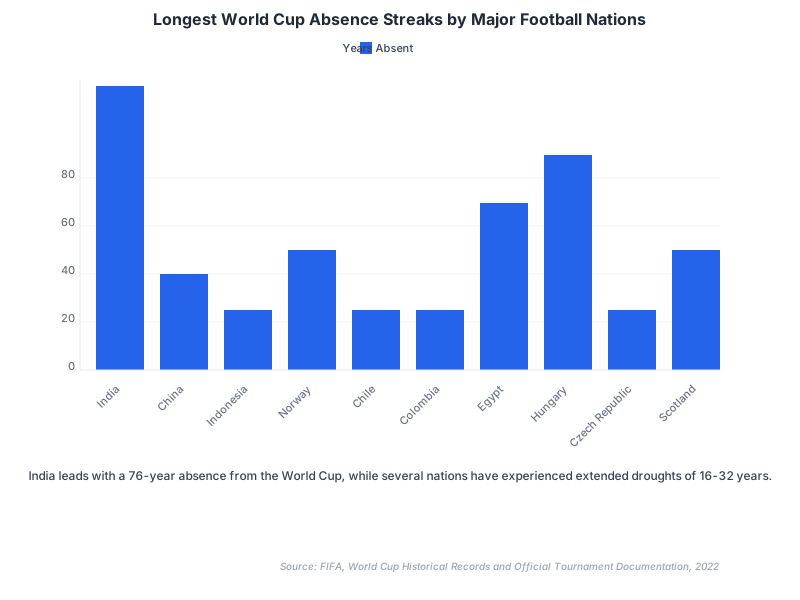
The Most Shocking World Cup Absences
- Italy 2022: European champions eliminated by North Macedonia, extending World Cup drought to 12 years
- Italy 2018: Four-time winners lost playoff to Sweden, missing first World Cup since 1958
- Netherlands 1986: Future European champions absent during Maradona's legendary tournament
- Argentina 1970: Traditional powerhouse missed the greatest World Cup ever played
- France 1994: Future world champions eliminated by Bulgaria in heartbreaking fashion
- England 1994: Three Lions absent as Premier League era began
- Chile 2018: Copa América champions eliminated after golden generation peak
References
- FIFA World Cup qualification records, 2014.
- CAF World Cup qualification records, 2006.
- FIFA World Cup qualification records, 2010.
- UEFA World Cup qualification records, 2010.
- CONMEBOL World Cup qualification records, 2018.
- FIFA World Cup qualification records, 1994.
- FIFA World Cup qualification records, 1994.
- FIFA World Cup qualification records, 1970.
- FIFA World Cup qualification records, 1986.
- UEFA World Cup qualification records, 2018.
- UEFA World Cup qualification records, 2022.