50-Year Trends in LGBTQ+ Legal Rights and Social Acceptance in America

The Hidden Decade: 1970s Foundations
The 1970s began with LGBTQ+ Americans living largely in the shadows. Homosexual acts remained illegal in most states, with sodomy laws carrying penalties ranging from fines to imprisonment[2]. Police raids on gay bars were routine, and systematic discrimination in employment, housing, and public accommodations was the norm. However, the 1969 Stonewall riots had catalyzed a new era of activism. By 1973, the National Gay Task Force (later the National LGBTQ Task Force) was founded, providing organized advocacy for civil rights[3]. The American Psychiatric Association's decision to declassify homosexuality as a mental illness that same year marked a pivotal scientific and cultural shift, though it faced resistance from some mental health professionals. Legal progress during this decade was incremental but significant. In 1975, the Civil Service Commission ended its blanket ban on employing gay and lesbian federal workers[4]. Several cities began passing anti-discrimination ordinances, with Minneapolis becoming one of the first major cities to prohibit discrimination based on sexual orientation in 1974. The decade also saw the emergence of LGBTQ+ political candidates. In 1977, Harvey Milk was elected to the San Francisco Board of Supervisors, becoming one of the first openly gay elected officials in the United States[5]. His assassination in 1978, along with Mayor George Moscone, shocked the nation and galvanized the gay rights movement. Cultural representation remained limited but began expanding. Television shows occasionally featured gay characters, though typically in stereotypical or tragic roles. The 1978 film "The Boys in the Band" brought gay characters to mainstream cinema, albeit with mixed reception from both critics and the LGBTQ+ community. Public opinion polling from this era shows deeply entrenched opposition to LGBTQ+ rights. A 1977 Gallup poll found that only 13% of Americans considered homosexual relations morally acceptable[6]. Religious and conservative groups organized significant opposition, exemplified by Anita Bryant's successful 1977 campaign to repeal Miami-Dade County's gay rights ordinance.Crisis and Mobilization: The 1980s AIDS Era
The 1980s brought both devastating tragedy and unprecedented mobilization to the LGBTQ+ community. The AIDS epidemic, first reported in 1981, disproportionately affected gay men and transformed both the community's internal dynamics and its relationship with mainstream society[7]. The federal government's initial response to AIDS was widely criticized as inadequate. President Ronald Reagan did not publicly mention AIDS until 1985, four years after the first reported cases[8]. This perceived neglect galvanized LGBTQ+ activism, leading to the formation of organizations like the AIDS Coalition to Unleash Power (ACT UP) in 1987. Despite the crisis, legal progress continued in some areas. Wisconsin became the first state to pass comprehensive civil rights legislation protecting LGBTQ+ individuals in 1982[9]. However, the Supreme Court dealt a significant setback in Bowers v. Hardwick (1986), upholding Georgia's sodomy law and ruling that the Constitution did not protect homosexual conduct[10]. The decade saw increased visibility in popular culture, though often through the lens of the AIDS crisis. The 1985 television movie "An Early Frost" was one of the first major network productions to address AIDS, reaching an estimated 34 million viewers. The 1989 film "Longtime Companion" provided a more nuanced portrayal of gay relationships during the epidemic. Politically, the community began developing more sophisticated advocacy strategies. The Human Rights Campaign, founded in 1980, became the largest LGBTQ+ political organization in the United States[11]. The first National March on Washington for Lesbian and Gay Rights in 1979 drew an estimated 100,000 participants, while the 1987 march attracted over 500,000. Public opinion remained largely negative, with a 1989 Gallup poll showing that 73% of Americans considered homosexual relations "always wrong"[12]. However, the AIDS crisis had begun to humanize LGBTQ+ individuals for some Americans, particularly as celebrities like Rock Hudson publicly disclosed their HIV status.Political Awakening: The 1990s Breakthrough
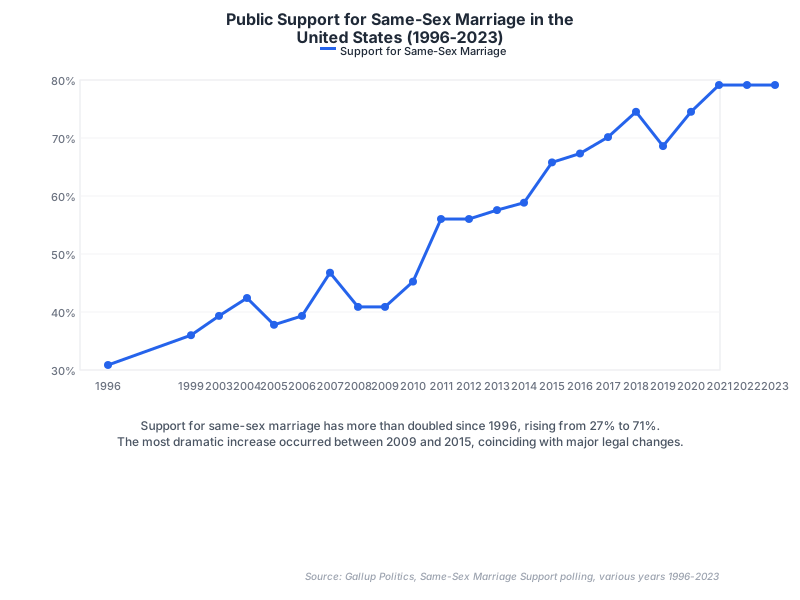
The 1990s marked LGBTQ+ Americans' full emergence as a political force. The decade began with increased visibility and organization, culminating in significant policy debates and cultural shifts that would define the movement for years to come. The 1992 presidential election proved pivotal. Bill Clinton became the first major presidential candidate to actively court LGBTQ+ voters, promising to end the military's ban on gay service members[13]. His election victory, with strong support from LGBTQ+ voters and donors, demonstrated the community's growing political influence. However, Clinton's presidency also revealed the limits of political support. The military ban compromise resulted in the "Don't Ask, Don't Tell" policy in 1993, which many viewed as inadequate[14]. More significantly, the Defense of Marriage Act (DOMA) passed Congress with overwhelming bipartisan support in 1996, defining marriage as between a man and woman for federal purposes[15]. State-level progress proved more promising. By 1999, approximately 200 openly LGBTQ+ individuals held elected office nationwide[16]. The decade's most significant legal victory came in Romer v. Evans (1996), where the Supreme Court struck down Colorado's Amendment 2, which prohibited anti-discrimination protections for LGBTQ+ individuals[17]. This marked the Court's first major pro-LGBTQ+ ruling since the movement began. Cultural representation expanded dramatically. Television shows like "Ellen" and "Will & Grace" brought gay characters into American living rooms, with Ellen DeGeneres's 1997 coming-out episode watched by 42 million viewers[18]. The 1993 film "Philadelphia," starring Tom Hanks as a gay lawyer with AIDS, won Academy Awards and reached mainstream audiences. Public opinion began shifting, though slowly. A 1996 Gallup poll found that 27% of Americans considered homosexual relations acceptable, nearly double the 1977 figure[19]. However, support for same-sex marriage remained minimal, with only 27% approval in 1996. The decade also saw the emergence of more radical activism. Groups like Queer Nation, formed in 1990, employed confrontational tactics and challenged assimilationist approaches[20]. This diversity of strategies reflected the movement's growing sophistication and internal debates about goals and methods.Marriage Equality Era: 2000s Transformation
The 2000s witnessed the LGBTQ+ rights movement's evolution from seeking basic acceptance to achieving major legal victories, centered primarily around marriage equality. This decade fundamentally altered both the legal landscape and public perception of LGBTQ+ rights. The period began with a landmark legal victory in Massachusetts. In Goodridge v. Department of Public Health (2003), the Massachusetts Supreme Judicial Court ruled that denying same-sex couples the right to marry violated the state constitution[21]. Massachusetts became the first state to legalize same-sex marriage in 2004, with over 1,000 couples marrying in the first week. This breakthrough triggered a nationwide backlash. Throughout the 2000s, voters in numerous states passed constitutional amendments defining marriage as between a man and woman[22]. The 2004 presidential election saw same-sex marriage bans on 11 state ballots, widely credited with boosting conservative turnout and contributing to George W. Bush's reelection. However, the decade's latter half saw momentum shifting toward equality. California briefly legalized same-sex marriage in 2008 before voters passed Proposition 8, banning it again. Connecticut, Iowa, Vermont, New Hampshire, and Washington, D.C. legalized same-sex marriage through various legal and legislative processes by decade's end. Federal progress remained limited but notable. The Matthew Shepard and James Byrd Jr. Hate Crimes Prevention Act passed in 2009, expanding federal hate crime law to include sexual orientation and gender identity[23]. Barack Obama's 2008 presidential campaign marked another milestone in LGBTQ+ political engagement, though his initial opposition to same-sex marriage disappointed many advocates. Corporate America increasingly embraced LGBTQ+ equality during this decade. By 2009, a substantial majority of Fortune 500 companies included sexual orientation in their non-discrimination policies[24]. The Human Rights Campaign's Corporate Equality Index, launched in 2002, incentivized business support for LGBTQ+ rights. Cultural representation reached new heights. "Brokeback Mountain" (2005) became the first major Hollywood film to portray a gay relationship as a serious romantic drama, earning multiple Academy Award nominations. Television programming increasingly featured LGBTQ+ characters in leading roles across various genres. Public opinion continued its gradual shift. Gallup polling showed support for same-sex marriage growing from 27% in 2000 to 40% by 2009[25]. More significantly, generational differences became pronounced, with younger Americans showing substantially higher support for LGBTQ+ rights. The decade also saw increased attention to transgender rights. The first Transgender Day of Remembrance was observed in 1999, but the 2000s brought greater visibility to transgender issues. Several cities and states began including gender identity in anti-discrimination laws, laying groundwork for future federal protections.Mainstream Acceptance: 2010s Legal Victories
The 2010s represented the decade when LGBTQ+ rights transitioned from a fringe political issue to mainstream acceptance, culminating in historic Supreme Court victories and unprecedented cultural integration. This period witnessed the fastest shift in public opinion on a civil rights issue in modern American history. The decade's defining moment came with the Supreme Court's decision in Obergefell v. Hodges (2015), which legalized same-sex marriage nationwide[26]. The ruling capped a remarkable legal strategy that saw marriage equality advocates win a series of federal court victories, creating unstoppable momentum. By the time of the Obergefell decision, 37 states and Washington, D.C. had already legalized same-sex marriage. President Obama's evolution on marriage equality proved crucial to this success. After initially opposing same-sex marriage, Obama announced his support in 2012, becoming the first sitting president to endorse marriage equality[27]. His administration also ended "Don't Ask, Don't Tell" in 2011, allowing LGBTQ+ individuals to serve openly in the military for the first time[28]. The legal foundation for these victories was established early in the decade. In United States v. Windsor (2013), the Supreme Court struck down the federal Defense of Marriage Act, ruling that the federal government must recognize same-sex marriages performed in states where they were legal[29]. This decision paved the way for Obergefell two years later. Public opinion shifted dramatically during this period. Gallup polling showed support for same-sex marriage crossing the 50% threshold for the first time in 2011 and reaching 60% by 2015[30]. The speed of this change was unprecedented, with support increasing by 20 percentage points in just five years. Corporate America accelerated its embrace of LGBTQ+ rights. By 2015, the vast majority of Fortune 500 companies included sexual orientation in their non-discrimination policies, with a growing number also including gender identity protections[31]. Major corporations began actively opposing anti-LGBTQ+ legislation, with companies threatening boycotts of states considering discriminatory laws. Cultural representation reached saturation levels across media platforms. Television shows featuring LGBTQ+ characters became commonplace, with the advocacy group GLAAD tracking record numbers of LGBTQ+ characters on broadcast television[32]. Social media platforms provided new venues for LGBTQ+ visibility and community building. However, the decade also saw the emergence of new challenges, particularly around transgender rights. North Carolina's HB2 "bathroom bill" in 2016 sparked nationwide controversy and economic boycotts[33]. These battles foreshadowed the transgender rights debates that would intensify in the following decade. Political representation reached historic levels. The 2018 midterm elections saw a record number of LGBTQ+ candidates running for office, with over 150 openly LGBTQ+ individuals winning elections nationwide[34]. This included the first openly gay governor (Jared Polis in Colorado) and the first openly lesbian Native American congresswoman (Sharice Davids in Kansas). Religious liberty emerged as a new battleground during this period. The Supreme Court's decision in Masterpiece Cakeshop v. Colorado Civil Rights Commission (2018) highlighted tensions between LGBTQ+ rights and religious freedom claims[35]. While the Court ruled narrowly in favor of the baker who refused to make a wedding cake for a same-sex couple, the broader legal questions remained unresolved.Backlash and New Battlegrounds: 2020s Challenges
The 2020s have brought both continued progress and significant new challenges for LGBTQ+ Americans. While marriage equality remains secure and public support for LGBTQ+ rights continues to grow, new battlegrounds have emerged around transgender rights, religious exemptions, and the scope of anti-discrimination protections. The decade began with a historic Supreme Court victory in Bostock v. Clayton County (2020), which ruled that federal employment discrimination law protects LGBTQ+ individuals[36]. The 6-3 decision, written by Justice Neil Gorsuch, extended Title VII protections to cover sexual orientation and gender identity, affecting millions of workers nationwide. President Biden's administration marked a dramatic shift in federal policy. On his first day in office, Biden signed an executive order directing federal agencies to enforce anti-discrimination laws to protect LGBTQ+ Americans[37]. His administration also reversed the Trump-era ban on transgender military service and appointed numerous LGBTQ+ individuals to senior positions. However, state-level legislation has created new challenges. According to advocacy organizations, hundreds of anti-LGBTQ+ bills have been introduced in state legislatures in recent years[38]. These measures primarily target transgender individuals, restricting access to healthcare, sports participation, and bathroom usage. Florida's "Don't Say Gay" law and similar measures in other states have also limited discussion of LGBTQ+ topics in schools. Public opinion on LGBTQ+ rights generally remains supportive, with Gallup polling showing 71% support for same-sex marriage in 2023[39]. However, polling reveals more complex attitudes toward transgender rights, with Americans showing less unified support for transgender-specific policies compared to broader LGBTQ+ rights. The corporate response to anti-LGBTQ+ legislation has been mixed. While some companies have strongly opposed discriminatory laws, others have faced pressure from both sides. Disney's conflict with Florida over the state's education law demonstrated the challenges corporations face when taking positions on LGBTQ+ issues[40]. Political representation continues to grow, with nearly 1,000 openly LGBTQ+ elected officials serving nationwide as of recent counts[41]. The 2022 midterm elections saw several historic firsts, including the election of the first openly transgender state legislators in New Hampshire and Vermont. Conversion therapy bans have become a new focus of advocacy efforts. As of 2023, 20 states and Washington, D.C. have banned the practice for minors, though recent court challenges have questioned the scope of these restrictions[42]. The Supreme Court's consideration of cases involving conversion therapy bans reflects ongoing tensions between LGBTQ+ rights and free speech claims. The decade has also seen increased attention to intersectionality within the LGBTQ+ movement. Organizations have focused more explicitly on the experiences of LGBTQ+ people of color, transgender individuals, and other marginalized communities within the broader LGBTQ+ population.Looking Ahead: Future Trajectories and Remaining Challenges
As we examine five decades of progress, several trends suggest both the durability of LGBTQ+ rights gains and the challenges that lie ahead. The trajectory toward greater acceptance appears unlikely to reverse, but the pace and scope of future progress remain uncertain. Generational change continues to drive support for LGBTQ+ rights. Americans under 30 show overwhelming support for marriage equality and LGBTQ+ rights generally, suggesting that broader acceptance will continue as younger cohorts replace older ones[43]. This demographic reality makes wholesale reversals of LGBTQ+ rights politically difficult, even in conservative states. However, transgender rights face particular challenges. Public opinion on transgender issues remains more divided than on sexual orientation, and state-level restrictions continue to proliferate. The medical and social debates surrounding transgender youth have created new political fault lines that may persist for years. Legal protections remain incomplete in many areas. While federal employment discrimination is now prohibited, comprehensive federal civil rights legislation covering housing, public accommodations, and other areas has not been enacted. The Equality Act, which would provide such protections, has faced Republican opposition and uncertain prospects in Congress[44]. Religious liberty claims are likely to generate continued litigation. The Supreme Court's conservative majority has shown sympathy for religious freedom arguments, potentially limiting the scope of LGBTQ+ anti-discrimination protections in some contexts. Future cases involving adoption agencies, healthcare providers, and educational institutions may further define these boundaries. International comparisons suggest that American progress, while significant, is not unique. Many developed nations have achieved similar or greater LGBTQ+ rights protections, indicating that continued progress in the United States is both possible and likely. However, global backlash against LGBTQ+ rights in some regions demonstrates that progress is not inevitable. The movement's future success may depend on its ability to maintain broad coalitions while addressing internal diversity. As LGBTQ+ Americans have achieved greater mainstream acceptance, questions about priorities, strategies, and representation have become more prominent. Balancing the needs of different communities within the LGBTQ+ umbrella will likely shape advocacy efforts in coming years.While polling shows dramatic shifts in public acceptance of LGBTQ+ rights, some researchers question whether these changes reflect genuine attitude transformation or social desirability bias—the tendency to give responses perceived as socially acceptable. The rapid pace of change, particularly on transgender issues, may indicate that public opinion remains more fluid and potentially reversible than linear progress narratives suggest, especially during periods of economic stress or political polarization.
Corporate America's embrace of LGBTQ+ causes could be interpreted less as moral evolution and more as calculated market positioning, as companies respond to demographic shifts and purchasing power rather than principle. This interpretation suggests that business support might prove fragile if economic conditions change or if supporting LGBTQ+ rights becomes commercially disadvantageous, potentially leaving the movement more vulnerable than current corporate allyship implies.
Key Takeaways
- Public support for LGBTQ+ rights has increased from 13% in 1977 to 71% in 2023, representing one of the fastest shifts in public opinion on any civil rights issue in American history.
- Legal progress has been uneven but substantial, moving from complete criminalization in the 1970s to nationwide marriage equality by 2015 and federal employment protections by 2020.
- The AIDS crisis of the 1980s, while devastating, paradoxically accelerated LGBTQ+ political organization and mainstream visibility.
- Corporate America's embrace of LGBTQ+ rights has been a crucial factor in normalizing equality, with Fortune 500 companies increasingly adopting inclusive policies.
- Transgender rights have emerged as the primary battleground of the 2020s, with state-level restrictions creating new challenges despite federal progress.
- Generational change continues to drive acceptance, suggesting that current gains are likely to be durable despite ongoing political opposition.
- The movement's future success will depend on maintaining broad coalitions while addressing the diverse needs of different LGBTQ+ communities.
References
- American Psychiatric Association. Diagnostic and Statistical Manual of Mental Disorders, Second Edition. American Psychiatric Association, 1973.
- Eskridge, William N. Dishonorable Passions: Sodomy Laws in America. Viking, 1999.
- Clendinen, Dudley and Adam Nagourney. Out for Good: The Struggle to Build a Gay Rights Movement in America. Simon & Schuster, 1999.
- D'Emilio, John. "Sexual Politics, Sexual Communities: The Making of a Homosexual Minority in the United States." University of Chicago Press, 1983.
- Shilts, Randy. The Mayor of Castro Street: The Life and Times of Harvey Milk. St. Martin's Press, 1982.
- Gallup Organization. "American Opinion on Homosexuality." Gallup Poll, June 1977.
- Centers for Disease Control and Prevention. "Pneumocystis pneumonia—Los Angeles." Morbidity and Mortality Weekly Report, June 5, 1981.
- Cannon, Lou. "Reagan Delays AIDS Speech." The Washington Post, April 2, 1987.
- Wisconsin Legislative Reference Bureau. "1982 Wisconsin Act 27." Wisconsin State Legislature, 1982.
- Bowers v. Hardwick, 478 U.S. 186 (1986).
- Human Rights Campaign. "About HRC." Human Rights Campaign Foundation, 2023.
- Gallup Organization. "American Attitudes Toward Homosexuality." Gallup Poll, 1989.
- Clinton, Bill. "Campaign Speech on Military Service." Presidential Campaign Materials, October 1992.
- Public Law 103-160, Section 571. "Policy Concerning Homosexuality in the Armed Forces." November 30, 1993.
- Public Law 104-199. "Defense of Marriage Act." September 21, 1996.
- Gay and Lesbian Victory Fund. "Out Officials in America." Victory Fund Institute, 1999.
- Romer v. Evans, 517 U.S. 620 (1996).
- Nielsen Media Research. "Television Ratings Report." Nielsen, May 1997.
- Gallup Organization. "Same-Sex Relations." Gallup Poll Social Series, 1996.
- Crimp, Douglas and Adam Rolston. AIDS Demo Graphics. Bay Press, 1990.
- Goodridge v. Department of Public Health, 440 Mass. 309 (2003).
- National Conference of State Legislatures. "Same-Sex Marriage Laws." NCSL, 2015.
- Public Law 111-84, Division E. "Matthew Shepard and James Byrd Jr. Hate Crimes Prevention Act." October 28, 2009.
- Human Rights Campaign. "Corporate Equality Index 2010." HRC Foundation, 2010.
- Gallup Organization. "Marriage." Gallup Poll Social Series, May 2009.
- Obergefell v. Hodges, 576 U.S. ___ (2015).
- Obama, Barack. "Interview with Robin Roberts." ABC News, May 9, 2012.
- Public Law 111-321. "Don't Ask, Don't Tell Repeal Act." December 22, 2010.
- United States v. Windsor, 570 U.S. 744 (2013).
- Gallup Organization. "Marriage." Gallup Poll Social Series, May 2015.
- Human Rights Campaign. "Corporate Equality Index 2016." HRC Foundation, 2016.
- GLAAD. "Where We Are on TV Report 2015-16." Gay & Lesbian Alliance Against Defamation, 2015.
- North Carolina General Assembly. "House Bill 2." NC Legislature, March 23, 2016.
- LGBTQ Victory Fund. "Rainbow Wave: 2018 Election Results." Victory Fund Institute, November 2018.
- Masterpiece Cakeshop v. Colorado Civil Rights Commission, 584 U.S. ___ (2018).
- Bostock v. Clayton County, 590 U.S. ___ (2020).
- Biden, Joseph R. "Executive Order on Preventing and Combating Discrimination on the Basis of Gender Identity or Sexual Orientation." The White House, January 20, 2021.
- Human Rights Campaign. "2023 State Legislative Tracking." HRC, December 2023.
- Gallup Organization. "Marriage." Gallup Poll Social Series, June 2023.
- Frazier, Brianna. "Disney vs. Florida: The Battle Over 'Don't Say Gay.'" The New York Times, April 2022.
- LGBTQ Victory Institute. "Out for America 2023." Victory Institute, 2023.
- Movement Advancement Project. "Conversion Therapy Laws." MAP, 2023.
- Pew Research Center. "The Growing Partisan Divide in Views of Higher Education." Pew Research, August 2017.
- H.R.5. "Equality Act." 117th Congress, 2021.