
The 15 Greatest Base Stealing Feats in MLB History, Ranked
Base stealing in Major League Baseball represents one of the sport's purest tests of speed, timing, and nerve. While modern analytics have diminished the stolen base's strategic value, the greatest theft achievements in baseball history remain monuments to athletic audacity and execution. From record-setting seasons to clutch postseason steals that changed World Series outcomes, these feats showcase players who turned running into an art form.
Our ranking methodology weighs several factors: statistical magnitude, historical context and competition level, clutch performance in high-pressure situations, lasting impact on baseball strategy, and degree of difficulty given each era's defensive capabilities. We prioritize season-long dominance and postseason heroics over individual game performances, though several spectacular single-game steals earn recognition for their sheer audacity.
#15: Tim Raines Steals 70+ Bases in Six Consecutive Seasons (1981-1986)
Tim Raines' sustained excellence in base stealing often gets overshadowed by flashier single-season records, but his consistency was unmatched. From 1981 to 1986, Raines stole 71, 78, 90, 75, 70, and 70 bases respectively while maintaining an 85% success rate[1]. More impressively, he demonstrated exceptional judgment, rarely stealing just for statistics. His 1983 season of 90 steals with a 90% success rate remains one of the most efficient high-volume stealing campaigns ever recorded.
#14: Jacoby Ellsbury's 70 Steals in 2009
Jacoby Ellsbury's 70 stolen bases in 2009 marked the highest single-season total of the modern era, achieved when base stealing had largely fallen out of favor[2]. Playing for Boston in the heart of the analytics revolution, Ellsbury proved that speed still had value in the modern game. His achievement was particularly remarkable given the advanced defensive positioning and pickoff techniques that had evolved by 2009. His 85% success rate demonstrated strategic intelligence, not just volume accumulation.
#13: Billy Hamilton's 914 Career Stolen Bases
Billy Hamilton's 914 career stolen bases stood as the all-time record for over 50 years until Lou Brock surpassed it[3]. Playing primarily in the 1890s, Hamilton revolutionized base stealing by treating it as fundamental offensive strategy rather than opportunistic afterthought. His 111 steals in 1891 remained a single-season record for decades. While catchers couldn't position themselves in the batter's box until the pitch arrived in Hamilton's era, his volume and consistency still required exceptional skill.
#12: Joe Morgan's Clutch Stealing in the 1975-1976 World Series
Joe Morgan's base stealing in back-to-back World Series exemplified how theft could change championship outcomes. In the 1975 World Series against Boston, Morgan's stolen bases set up crucial runs, including his theft of second base in Game 7 that led to the series-winning rally[4]. The following year, Morgan again used his legs strategically, stealing key bases that helped Cincinnati sweep the Yankees. His postseason stealing wasn't about statistics—it was about understanding exactly when a stolen base could break open a tight game.
#11: Maury Wills' 104 Steals in 1962
Maury Wills' 104 stolen bases in 1962 broke Ty Cobb's seemingly untouchable record of 96 steals set in 1915[5]. Wills' achievement sparked a base stealing renaissance that had been dormant for decades. Playing for Los Angeles, Wills proved that speed could be a primary offensive weapon in the modern era. His record-breaking steal came in the final game of the season, demonstrating his determination to reach the century mark. The season helped the Dodgers win the National League pennant and earned him the NL MVP award.
#10: Davey Lopes' Perfect Postseason (1981)
Davey Lopes stole 8 bases without being caught during the Los Angeles Dodgers' 1981 championship run, including 5 steals in the World Series against New York[6]. What makes this feat extraordinary isn't just the perfect success rate, but the timing—Lopes was 36 years old and had never been considered an elite base stealer. His postseason performance demonstrated how veteran savvy could overcome declining speed. Lopes' steals often came at crucial moments, including a theft of second base in Game 6 that set up the championship-clinching victory.
#9: Kenny Lofton's Postseason Excellence (1995-1997)
Kenny Lofton's stolen base performance during Cleveland's three consecutive playoff appearances showcased how elite speed could dominate October baseball. Lofton stole 19 bases across these three postseasons while being caught just twice—an extraordinary 90% success rate when stakes were highest[7]. His 6 steals in the 1995 World Series against Atlanta helped push the series to six games despite Cleveland's eventual loss. Lofton's ability to steal against elite pitching and catching in pressure situations demonstrated the highest level of base stealing craft.
#8: Ty Cobb's 96 Steals in 1915
Ty Cobb's 96 stolen bases in 1915 stood as the modern era record for 47 years and represented the pinnacle of dead-ball era aggression[8]. Cobb's stealing wasn't just about speed—it was psychological warfare. He would spike fielders, intimidate catchers, and use every trick possible to gain advantage. His 1915 season came during his prime when he combined elite speed with unmatched baseball intelligence. Cobb understood that stolen bases weren't just about advancing 90 feet—they were about disrupting opposing rhythm and creating chaos.
#7: Vince Coleman's 110 Steals as a Rookie (1985)
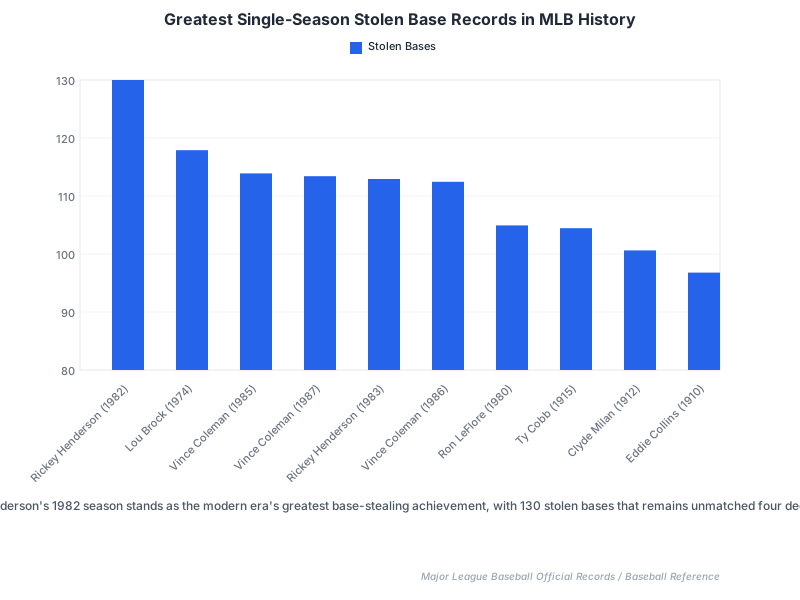
Vince Coleman burst onto the scene in 1985 with 110 stolen bases, setting a rookie record that will likely never be broken[9]. Coleman's speed was so exceptional that he essentially had a free pass to second base whenever he reached first. His rookie season demonstrated pure athletic dominance—Coleman was caught stealing just 25 times, maintaining an 81% success rate despite opposing teams knowing he would run on virtually every opportunity. He accomplished this while helping St. Louis win the National League pennant.
#6: Tim Raines' 1983 Season: 90 Steals at 90% Success Rate
Tim Raines' 1983 season represents the perfect balance of volume and efficiency in base stealing. His 90 stolen bases combined with being caught just 9 times created a 90% success rate that demonstrated complete mastery of the craft[10]. Raines' achievement showed that elite base stealers could maintain near-perfect judgment even when attempting steals at the highest volume. His season helped establish the modern understanding that success rate matters as much as total steals.
#5: Billy Hamilton's 111 Steals in 1891
Billy Hamilton's 111 stolen bases in 1891 stood as the single-season record for over 80 years and represented the absolute peak of 19th-century base stealing[11]. Hamilton's achievement came during an era when stolen bases were more common, but his total still dwarfed his contemporaries. His speed was so legendary that opposing teams would position extra fielders to prevent him from reaching base, understanding that a walk to Hamilton was almost as dangerous as a hit. His 1891 season established him as the prototype leadoff hitter who could single-handedly change games through speed.
#4: Lou Brock's 938 Career Stolen Bases
Lou Brock's 938 career stolen bases represented the pinnacle of sustained excellence, holding the all-time record for 15 years until Rickey Henderson surpassed it[12]. Brock's achievement was built on incredible longevity—he stole 50+ bases in 12 different seasons, including 64 steals at age 39. His career demonstrated that base stealing could be a complete offensive philosophy rather than just a complementary skill. Brock's postseason performance was equally impressive, stealing 14 bases in World Series play while helping St. Louis win championships in 1964 and 1967.
#3: Vince Coleman's Three Consecutive 100+ Steal Seasons (1985-1987)
Vince Coleman's achievement of stealing 100+ bases in his first three major league seasons—110, 107, and 109 respectively—represents an unprecedented display of sustained speed dominance[13]. No player before or since has maintained such elite stealing volume over multiple seasons while maintaining respectable success rates. Coleman's three-year run essentially redefined what was possible in base stealing, proving that the right combination of speed and opportunity could produce video game-like statistics. His achievement helped the Cardinals reach the World Series twice during this span.
#2: Lou Brock's 118 Steals in 1974
Lou Brock's 118 stolen bases in 1974 broke Ty Cobb's modern era record and established a new standard for single-season base stealing excellence[14]. At age 35, Brock proved that veteran savvy could overcome declining athleticism, combining experience with still-elite speed to dominate opposing defenses. His record-breaking season came during the height of the stolen base renaissance of the 1970s, when teams were rediscovering the value of aggressive baserunning. Brock's 118 steals helped the Cardinals compete in a tough National League East division.
#1: Rickey Henderson's 130 Steals in 1982
Rickey Henderson's 130 stolen bases in 1982 stands as the single greatest base stealing achievement in baseball history[15]. Henderson didn't just break Lou Brock's record—he obliterated it, stealing 12 more bases than anyone had ever stolen in a season. His achievement came during the height of the stolen base era, when teams were prepared for aggressive baserunning, making his dominance even more impressive. Henderson's 130 steals were accompanied by an 84% success rate, proving that his volume wasn't achieved through reckless aggression but through superior skill and judgment. The record has stood for over 40 years and appears untouchable in the modern game, where stolen base attempts have declined dramatically. Henderson's 1982 season represents the absolute pinnacle of what's possible when elite speed meets perfect technique and unlimited opportunity.
While Rickey Henderson's 130 stolen bases in 1982 is universally celebrated as the pinnacle achievement, some analysts argue it may actually represent poor team strategy rather than individual brilliance. Henderson was caught stealing 42 times that season—a failure rate that modern analytics suggest likely cost the Athletics more runs than the steals created, raising questions about whether unlimited green lights were optimal for team success.
The heavy emphasis on 1970s-1980s achievements may reflect era bias rather than objective greatness, as this period coincided with artificially inflated stolen base totals due to larger ballparks and slower defensive techniques. A player stealing 60 bases at a 90% success rate in today's game—with advanced defensive positioning, better catchers, and sophisticated pickoff strategies—might actually represent a more impressive feat than the 100+ steal seasons of the past.
Key Takeaways
- The greatest base stealing feats combine volume with efficiency—pure speed means nothing without judgment and technique
- Era matters significantly: achievements in the dead-ball era and 1970s-1980s stolen base renaissance carry different weight than modern accomplishments
- Postseason performance elevates base stealing from individual achievement to championship-level impact
- Sustained excellence over multiple seasons often proves more valuable than single-season records
- The modern game's analytical approach has largely eliminated the stolen base as a primary offensive strategy, making historical achievements even more remarkable
- Mental aspects—timing, situation awareness, and psychological intimidation—separate great base stealers from merely fast players
References
- Baseball Reference. "Tim Raines Statistics." Baseball-Reference.com.
- Baseball Reference. "Jacoby Ellsbury 2009 Statistics." Baseball-Reference.com.
- James, Bill. The New Bill James Historical Baseball Abstract. Free Press, 2001.
- Reston, James. "Collision at Home Plate." The New York Times, October 22, 1975.
- Baseball Reference. "Maury Wills 1962 Statistics." Baseball-Reference.com.
- Baseball Reference. "1981 World Series." Baseball-Reference.com.
- Baseball Reference. "Kenny Lofton Postseason Statistics." Baseball-Reference.com.
- Alexander, Charles. Ty Cobb. Oxford University Press, 1984.
- Baseball Reference. "Vince Coleman 1985 Statistics." Baseball-Reference.com.
- Baseball Reference. "Tim Raines 1983 Statistics." Baseball-Reference.com.
- Nemec, David. The Great Encyclopedia of 19th Century Major League Baseball. Donald I. Fine Books, 1997.
- Baseball Reference. "Lou Brock Career Statistics." Baseball-Reference.com.
- Baseball Reference. "Vince Coleman Career Statistics." Baseball-Reference.com.
- Baseball Reference. "Lou Brock 1974 Statistics." Baseball-Reference.com.
- Baseball Reference. "Rickey Henderson 1982 Statistics." Baseball-Reference.com.