What are the 15 most corrupt countries on Earth and what do they have in common?
Corruption remains one of the most persistent challenges facing global governance, undermining economic development, eroding public trust, and perpetuating inequality across nations. While corruption exists everywhere, certain countries consistently rank among the most corrupt according to international monitoring organizations. Understanding which nations face the greatest corruption challenges—and identifying the patterns that contribute to these problems—reveals the systemic factors that allow corrupt practices to flourish.
Transparency International's Corruption Perceptions Index (CPI) serves as the most widely recognized global benchmark, measuring perceived levels of public sector corruption across nearly 200 countries and territories. By analyzing the lowest-scoring nations on this index, we can identify both the specific countries facing the greatest challenges and the underlying characteristics they share.
Understanding Corruption Measurement
Before examining specific rankings, it's essential to understand how corruption is measured. Transparency International defines corruption as "the misuse of public power for private benefit." The Corruption Perceptions Index, published annually since 1995, draws on expert assessments and opinion surveys to create composite scores ranging from 0 (highly corrupt) to 100 (very clean).
The CPI methodology incorporates data from multiple sources, including the World Bank's Worldwide Governance Indicators, the Bertelsmann Foundation's Transformation Index, and various business risk assessment firms. This multi-source approach helps ensure reliability, though the index measures perceptions rather than actual corruption levels, which can be difficult to quantify directly.
The 15 Most Corrupt Countries
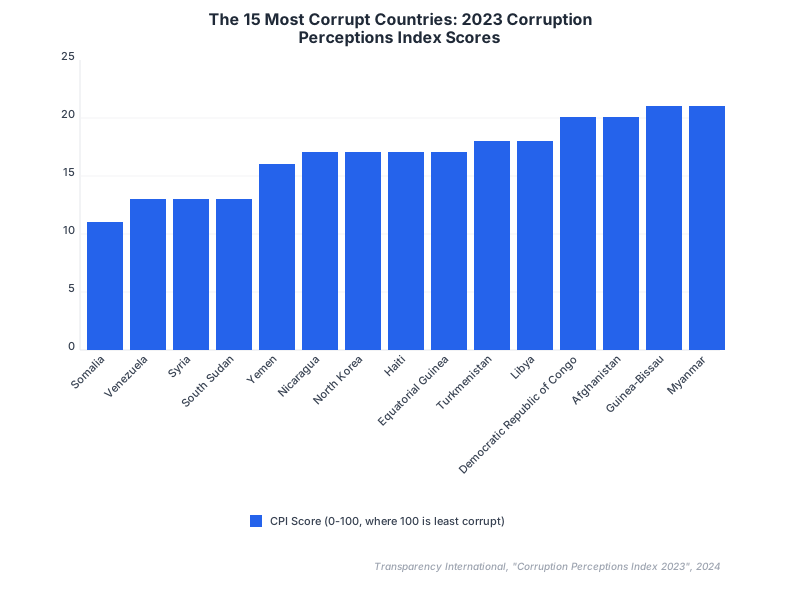
Based on Transparency International's 2023 Corruption Perceptions Index, the 15 lowest-scoring countries reveal a stark picture of governance failure:
At the bottom sit Somalia (11 points), Venezuela (13 points), and South Sudan (13 points), each scoring well below 15 on the 100-point scale. These nations face severe challenges including ongoing conflicts, weak institutions, and limited rule of law[1].
The next tier includes Syria (13 points), Yemen (16 points), Equatorial Guinea (17 points), Haiti (17 points), Libya (18 points), Turkmenistan (18 points), Chad (19 points), and the Democratic Republic of Congo (20 points). These nations typically score between 13-20 points and share characteristics of institutional weakness and political instability.
Rounding out the bottom 15 are Afghanistan (20 points), Comoros (21 points), Cambodia (22 points), and Eritrea (22 points), which score in the 20-22 range. While conditions vary among these nations, they all demonstrate significant challenges in governance transparency and accountability.
Geographic and Regional Patterns
A clear geographic pattern emerges when examining the world's most corrupt countries. Sub-Saharan Africa accounts for 8 out of the 15 lowest-scoring countries, with nations like Somalia, South Sudan, Chad, Equatorial Guinea, and the Democratic Republic of Congo consistently appearing in the lowest tiers[2].
The Middle East and North Africa region contributes several highly corrupt countries, particularly those affected by ongoing conflicts such as Syria, Yemen, and Libya. The combination of war, institutional collapse, and resource competition has created environments where corruption flourishes unchecked.
Latin America is represented by Venezuela and Haiti, both facing severe economic and political crises. Meanwhile, Asia contributes countries like Afghanistan and Cambodia, where weak governance structures and historical instability have enabled corrupt practices to become deeply embedded.
Notably absent from the most corrupt rankings are countries from Western Europe, North America, and most of East Asia, suggesting that regional factors including colonial history, economic development patterns, and governance traditions play significant roles in corruption levels.
Common Characteristics: Weak Institutions
The most striking commonality among highly corrupt countries is the presence of weak or failing institutions. These nations typically lack effective checks and balances, independent judiciaries, or robust oversight mechanisms that could prevent or punish corrupt behavior.
In many cases, formal institutions exist on paper but lack the resources, independence, or political support necessary to function effectively. Anti-corruption agencies may be underfunded, understaffed, or subject to political interference. Court systems often lack independence, with judges vulnerable to bribery or political pressure.
Legislative oversight tends to be weak or non-existent in highly corrupt countries. Parliaments may lack the authority, resources, or political will to investigate government activities or hold officials accountable. This institutional weakness creates an environment where corrupt practices can operate with minimal risk of detection or punishment.
Political Instability and Conflict
A significant majority of the world's most corrupt countries are experiencing or have recently experienced armed conflict, political upheaval, or severe instability. Countries like Somalia, Syria, Afghanistan, and South Sudan demonstrate how conflict creates conditions that enable corruption to flourish.
During conflicts, normal governance structures often break down, creating power vacuums filled by armed groups, warlords, or opportunistic officials. The urgent need for resources and the breakdown of normal oversight mechanisms create numerous opportunities for corrupt practices. Military procurement, humanitarian aid distribution, and resource extraction become particularly vulnerable to corruption during conflicts.
Post-conflict reconstruction efforts also present significant corruption risks. The influx of international aid and reconstruction funds, combined with weak oversight capacity, creates opportunities for officials to divert resources for personal gain.
Economic Factors and Resource Dependence
Many of the world's most corrupt countries share economic characteristics that contribute to corrupt practices. Resource dependence, particularly on oil or mineral extraction, appears frequently among highly corrupt nations. Countries like Equatorial Guinea, Venezuela, and Chad derive significant portions of their government revenues from natural resource extraction.
The "resource curse" phenomenon helps explain this pattern. When governments can finance themselves primarily through resource revenues rather than taxation, they become less accountable to their populations. The concentration of resource wealth in government hands creates opportunities for officials to divert funds, while the lack of diversified economic activity reduces the development of independent business sectors that might demand better governance.
Additionally, many highly corrupt countries have weak or informal economies with limited regulatory frameworks. When large portions of economic activity occur outside formal systems, opportunities for corruption multiply. Poverty and underdevelopment also contribute to corruption patterns—when government salaries are extremely low, officials may turn to corrupt practices out of economic necessity.
Authoritarian Governance and Limited Democracy
Most of the world's most corrupt countries operate under authoritarian or semi-authoritarian political systems with limited democratic accountability. Countries like Turkmenistan, Eritrea, and Equatorial Guinea have highly centralized power structures with minimal political competition or civil society oversight.
In these systems, power tends to be concentrated in the hands of a small elite, often centered around a dominant leader or ruling family. Without competitive elections, free media, or active civil society organizations, there are few mechanisms to expose or challenge corrupt practices. Opposition politicians, journalists, and activists who attempt to investigate corruption often face harassment, imprisonment, or worse.
The absence of democratic accountability also means that corrupt officials face little risk of being voted out of office. When elections are not free and fair, or when they don't occur at all, officials have fewer incentives to maintain public support through good governance.
Cultural and Historical Factors
While economic and political factors provide the most direct explanations for corruption patterns, cultural and historical elements also play important roles. Many highly corrupt countries share experiences of colonial exploitation, which often established extractive institutions designed to benefit external powers rather than local populations.
Colonial systems frequently relied on indirect rule through local elites, creating patronage networks that persisted after independence. The lack of investment in broad-based institutions during colonial periods left many countries with weak governance foundations upon gaining independence.
However, it's important to avoid cultural determinism when analyzing corruption patterns. The evidence suggests that institutional and structural factors are far more significant than cultural ones. Countries with similar cultural backgrounds can have vastly different corruption levels depending on their institutional development and governance structures.
International Dimensions and External Factors
Corruption in the world's most corrupt countries is not purely a domestic phenomenon. International factors often contribute to and enable corrupt practices. Money laundering through international financial systems allows corrupt officials to move and hide stolen assets abroad. Offshore banking centers and shell companies facilitate the concealment of corrupt proceeds.
International business practices can also contribute to corruption in vulnerable countries. While major international anti-bribery conventions have reduced some forms of corporate corruption, multinational companies operating in high-risk environments may still engage in questionable practices or work with corrupt local partners.
Development aid, while intended to reduce poverty and improve governance, can sometimes inadvertently contribute to corruption if not properly managed. Large aid flows can overwhelm weak oversight systems or be captured by corrupt officials. Regional spillover effects are another important factor—corruption in one country can spread to neighbors through cross-border criminal networks or refugee flows that strain institutions.
However, critics argue that Western-dominated corruption indices may reflect cultural bias rather than objective governance assessment. What international organizations label as "corruption" might actually represent traditional governance systems, informal networks, or adaptive responses to dysfunctional formal institutions—suggesting that some countries aren't necessarily more corrupt, but rather operate under different cultural frameworks that Western metrics fail to understand or appreciate.
The historical context raises uncomfortable questions about whether current "corruption" patterns are actually symptoms of ongoing structural inequalities rather than inherent governance failures. Many of today's lowest-ranking countries experienced centuries of extractive colonialism that deliberately dismantled indigenous institutions and created economic systems designed to benefit external powers—meaning their current governance challenges may be direct consequences of historical exploitation rather than evidence of cultural or institutional inadequacy.
Key Takeaways
- The 15 most corrupt countries, led by Somalia, Venezuela, and South Sudan, consistently score below 25 on Transparency International's 100-point scale
- Sub-Saharan Africa accounts for roughly half of the world's most corrupt countries, with conflict-affected regions heavily represented
- Weak institutions and lack of effective checks and balances are the most common characteristic among highly corrupt nations
- Political instability and armed conflict create conditions that enable corruption to flourish unchecked
- Resource dependence, particularly on oil and minerals, correlates strongly with high corruption levels
- Authoritarian governance systems with limited democratic accountability dominate the most corrupt countries
- International factors including money laundering, offshore banking, and aid flows can contribute to corruption patterns
- While cultural and historical factors play a role, institutional and structural elements are the primary drivers of corruption
References
- Transparency International. "Corruption Perceptions Index 2023." Berlin: Transparency International, January 2024. Available at: https://www.transparency.org/en/cpi/2023
- Transparency International. "Corruption Perceptions Index 2023: Regional Analysis." Berlin: Transparency International, January 2024. Available at: https://www.transparency.org/en/cpi/2023