Why does the US have two different agencies checking people at airports?

Why Does the US Have Two Different Agencies Checking People at airports?
Walk through any major American airport and you'll encounter a puzzling bureaucratic maze: TSA agents screening your bags and body, while ICE officers may be conducting enforcement operations just steps away. This seemingly redundant system isn't an accident—it's the result of deliberate policy choices that separate routine security screening from criminal law enforcement, each requiring vastly different expertise and legal authority.
The Genesis of Modern Airport Security
The current structure emerged from the fundamental reorganization of federal law enforcement following September 11, 2001. Before the attacks, airport security was primarily handled by private contractors under Federal Aviation Administration oversight, with minimal federal presence[1]. The attacks exposed critical vulnerabilities and prompted Congress to federalize airport security through the Aviation and Transportation Security Act of 2001.
This legislation created the Transportation Security Administration within the Department of Transportation, later transferred to the newly formed Department of Homeland Security in 2003[2]. TSA's mission focused specifically on preventing weapons and dangerous items from entering aircraft, screening passengers and baggage, and securing transportation infrastructure.
However, immigration and customs enforcement had maintained airport presence for decades before modern security concerns emerged. These functions, originally housed within the Immigration and Naturalization Service and U.S. Customs Service, were consolidated into Immigration and Customs Enforcement when DHS was established in 2003[3]. This created a situation where multiple DHS agencies operated within the same facilities, each with distinct legal authorities and responsibilities.
Distinct Legal Authorities and Operational Mandates
The fundamental reason for maintaining separate agencies lies in their vastly different legal authorities. TSA operates under transportation security statutes that authorize screening passengers and baggage for prohibited items, conducting security checks, and managing access to secure airport areas. Crucially, TSA agents are not law enforcement officers—they cannot make arrests or conduct criminal investigations beyond their specific screening functions.
ICE agents, by contrast, are federal law enforcement officers with broad authority to enforce immigration laws, investigate customs violations, and conduct criminal investigations related to border security, human trafficking, and transnational crimes[4]. At airports, ICE processes international arrivals through customs and immigration checkpoints, conducts targeted enforcement operations, and investigates smuggling operations.
This division reflects a deliberate policy choice to separate routine security screening from law enforcement functions. TSA's administrative process is designed for efficiency and minimal invasion for millions of daily travelers, while ICE's enforcement activities target specific individuals or suspected criminal activity. The legal frameworks—administrative regulations for TSA versus criminal and immigration law for ICE—require different training, procedures, and oversight mechanisms.
The 2018-2019 Shutdown: A Real-World Test
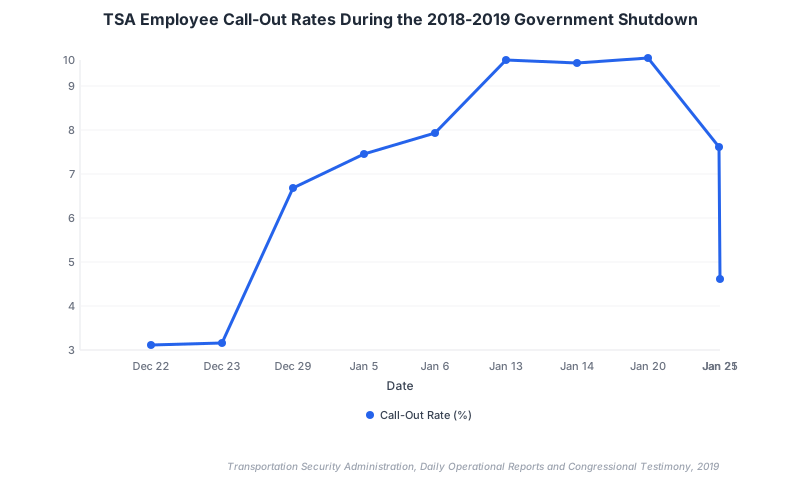
The 35-day federal government shutdown from December 2018 to January 2019 provided an unprecedented test of this system. TSA employees, classified as "essential" personnel, were required to work without pay. Significant numbers called in sick, creating staffing shortages that threatened airport operations nationwide[5]. This crisis demonstrated both the specialized nature of TSA's role and the challenges of maintaining security operations during federal disruptions.
The shutdown experience reinforced why specialized training and expertise matter in transportation security. The difficulties in maintaining adequate staffing highlighted how distinct agency roles serve specific operational needs that cannot easily be substituted without significant preparation.
International Comparisons and Alternative Models
Other countries structure these functions differently, often with greater integration. The United Kingdom places both functions under the Home Office, with UK Border Force handling immigration and customs while private companies manage airport security screening under government regulation[6]. Canada integrates these functions through the Canada Border Services Agency, which handles both security screening and immigration enforcement.
However, the American aviation system presents unique challenges. The United States processes hundreds of millions of airline passengers annually across hundreds of commercial airports[7]. This volume, combined with America's federal government structure and post-9/11 emphasis on specialized counter-terrorism capabilities, supports maintaining distinct agencies with focused expertise.
Operational Efficiency and Coordination Challenges
The dual-agency structure creates both advantages and challenges. Specialization allows each agency to develop deep expertise—TSA agents become highly skilled at identifying prohibited items and managing passenger flow, while ICE agents develop expertise in immigration law, document fraud detection, and criminal investigation.
However, separation also creates coordination challenges and potential inefficiencies. Airports must accommodate multiple federal agencies with different space requirements, equipment needs, and operational procedures. Information sharing between agencies, while improved since 9/11, still faces bureaucratic and legal obstacles that can impede comprehensive threat assessment.
The physical layout of airports reflects these divided responsibilities, with TSA checkpoints controlling access to secure areas and ICE facilities managing international arrivals. This separation can confuse travelers and requires careful coordination, particularly during security incidents.
Future Considerations and Reform Proposals
Periodic discussions about consolidating these functions reflect ongoing debates about optimal airport security structure. Some proposals suggest creating a unified border and transportation security agency that would integrate TSA and ICE functions, potentially improving coordination and reducing redundancies.
However, consolidation faces significant obstacles. The different legal frameworks governing transportation security and immigration enforcement would require substantial legislative changes. The distinct skill sets and training requirements would necessitate maintaining separate operational divisions even within a unified agency. Additionally, the political sensitivity surrounding immigration enforcement makes any reorganization contentious.
Technological advances may offer alternatives to organizational consolidation. Enhanced information sharing systems, biometric identification technologies, and integrated screening procedures could allow agencies to maintain distinct roles while improving operational efficiency and security effectiveness.
Critics argue that the dual-agency airport system may represent bureaucratic inefficiency rather than smart specialization. The 2018 government shutdown revealed potential vulnerabilities in having specialized agencies with limited cross-training, suggesting the roles might benefit from more integration than officials claim—raising questions about whether maintaining separate agencies is costly redundancy that other countries have avoided through more integrated approaches.
Some civil liberties advocates contend that multiple agencies create more opportunities for rights violations and racial profiling, as travelers face scrutiny from different entities with varying standards and oversight mechanisms. Rather than providing specialized expertise, this layered system may multiply chances for abuse while making accountability more difficult when problems occur.
Key Takeaways
- The dual-agency structure emerged from post-9/11 reorganization that federalized airport security while maintaining existing immigration and customs enforcement functions
- TSA and ICE operate under fundamentally different legal authorities—administrative security screening versus criminal law enforcement—requiring distinct expertise and procedures
- The 2018-2019 government shutdown demonstrated the critical importance of specialized agencies and challenges of maintaining operations during federal disruptions
- International comparisons show alternative organizational models, but the scale and complexity of the U.S. aviation system supports maintaining specialized agencies
- The current structure reflects deliberate policy choices to balance security effectiveness, operational efficiency, and legal requirements rather than bureaucratic redundancy
- Future reforms may focus on improving coordination and technology integration rather than organizational consolidation
References
- Transportation Security Administration. TSA Timeline. Department of Homeland Security, 2021.
- Homeland Security Act of 2002, Pub. L. No. 107-296, 116 Stat. 2135 (2002).
- U.S. Immigration and Customs Enforcement. ICE History. Department of Homeland Security, 2020.
- Congressional Research Service. Immigration and Customs Enforcement (ICE) Authorities and Operations. Library of Congress, 2019.
- Government Accountability Office. 2018-2019 Shutdown: Federal Agencies' Use of Excepted Service Authorities and Impacts on Operations. GAO-19-348, 2019.
- UK Border Force. About Us. Home Office, 2021.
- Federal Aviation Administration. Aerospace Forecast Fiscal Years 2021-2041. Department of Transportation, 2021.