
Why does ICE exist when we already have border patrol?

The existence of both Immigration and Customs Enforcement (ICE) and U.S. Border Patrol often puzzles Americans who wonder why the federal government maintains two separate immigration enforcement agencies. This confusion intensified during the Trump administration, when ICE became a lightning rod for controversy over its expanded interior enforcement operations, workplace raids, and family separations. Understanding the distinct roles, histories, and jurisdictions of these agencies is crucial for comprehending America's complex immigration enforcement apparatus and the heated political debates surrounding it.
Historical Origins and Legislative Framework
The distinction between ICE and Border Patrol stems from their different origins and the evolution of American immigration policy. U.S. Border Patrol, established in 1924, was created specifically to prevent illegal border crossings and smuggling along the nation's frontiers[1]. For decades, it operated under the Immigration and Naturalization Service (INS) with a clear geographic mandate: securing the physical borders.
ICE, by contrast, is a much newer agency, created in 2003 as part of the massive reorganization following the September 11 attacks. The Homeland Security Act of 2002 dissolved the INS and redistributed its functions among three new agencies within the Department of Homeland Security: ICE, U.S. Citizenship and Immigration Services (USCIS), and Customs and Border Protection (CBP), which absorbed Border Patrol[2]. This restructuring reflected a post-9/11 emphasis on national security and the recognition that immigration enforcement required both border security and interior operations.
The legislative framework establishing ICE gave it broad authority under the Immigration and Nationality Act to enforce immigration laws throughout the United States, not just at ports of entry or border regions[3]. This interior enforcement capability was deemed essential because a significant portion of unauthorized immigrants in the U.S. either entered legally and overstayed their visas or evaded Border Patrol detection.
Jurisdictional Differences and Operational Scope
The fundamental difference between ICE and Border Patrol lies in their operational jurisdictions and primary missions. Border Patrol operates within 100 miles of any U.S. border or coastline, focusing on preventing illegal entries and intercepting smuggling operations[4]. Their agents patrol remote desert areas, monitor surveillance equipment, and staff immigration checkpoints on highways near the border.
ICE, conversely, operates throughout the entire United States with no geographic limitations. The agency's Enforcement and Removal Operations (ERO) division conducts arrests, detention, and deportations anywhere in the country, while Homeland Security Investigations (HSI) pursues complex criminal cases involving human trafficking, drug smuggling, and other transnational crimes[5]. This nationwide reach allows ICE to apprehend individuals who have been living in American communities for years or decades.
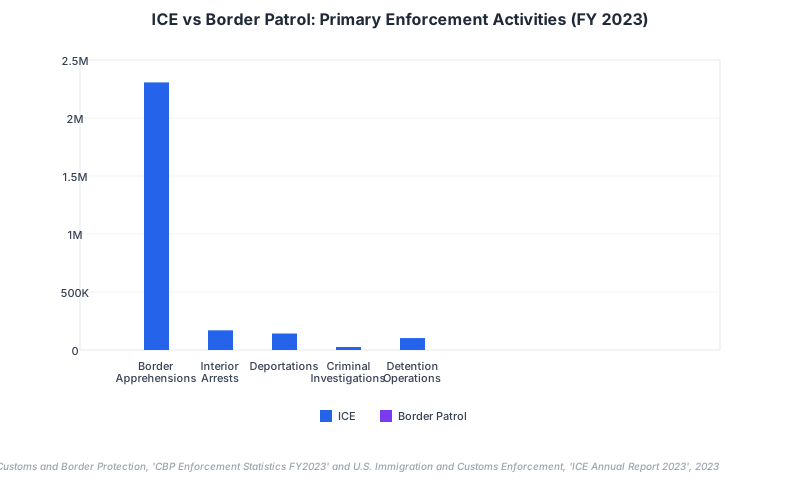
The scope of their operations also differs significantly. Border Patrol primarily encounters individuals attempting unauthorized border crossings, often processing them quickly for removal or referring them to immigration courts. ICE deals with a more complex caseload, including individuals with deep community ties, mixed-status families, and cases requiring extensive investigation. During fiscal year 2019, ICE conducted enforcement actions resulting in over 143,000 administrative arrests, while Border Patrol recorded approximately 851,500 encounters at the southwest border[6].
Enforcement Strategies and Priorities
The enforcement strategies employed by these agencies reflect their different operational environments. Border Patrol uses technology-intensive approaches including sensors, cameras, drones, and physical barriers to detect and intercept border crossers. Their strategy emphasizes "prevention through deterrence," making border crossing more difficult and dangerous to discourage attempts[7].
ICE's interior enforcement strategy has evolved significantly across different administrations. During the Obama administration, ICE officially prioritized individuals with serious criminal convictions, recent border crossers, and those who posed threats to national security or public safety[8]. However, the Trump administration eliminated most enforcement priorities, directing ICE to arrest any removable individual encountered during operations, regardless of their criminal history or community ties.
This policy shift dramatically expanded ICE's operational scope and contributed to the agency's controversial profile. Under Trump, ICE conducted high-profile workplace raids, arrested individuals at courthouses and schools, and separated families at unprecedented levels[9]. These operations generated significant public backlash and led to the "Abolish ICE" movement among progressive Democrats.
Resource Allocation and Budget Considerations
The financial resources allocated to each agency reflect their different scales and missions. In fiscal year 2020, CBP received approximately $15.2 billion in total appropriations, while ICE received about $8.3 billion. However, CBP's budget includes substantial non-immigration functions such as customs enforcement, trade facilitation, and airport security, with border security operations representing approximately $4.9 billion of CBP's total budget[10].
Border Patrol's budget heavily emphasizes technology and infrastructure, including border wall construction, surveillance systems, and vehicle fleets. ICE's budget focuses more on personnel costs for detention operations, removal flights, and investigative activities. The agency maintains detention capacity for approximately 34,000 individuals daily through operated and contracted facilities, making detention operations a major component of its budget[11].
The Trump administration significantly increased funding for both agencies, but ICE saw particularly dramatic growth in its interior enforcement capabilities. The administration requested additional funding for ICE detention beds and removal operations, arguing that interior enforcement was as important as border security for comprehensive immigration control.
Political Controversies and Reform Debates
ICE's interior enforcement role has made it far more politically controversial than Border Patrol. While most Americans accept the need for border security, ICE operations in American communities raise different concerns about civil liberties, due process, and humanitarian considerations. High-profile cases of ICE arresting individuals at hospitals, schools, and courthouses generated widespread criticism from immigrant advocacy groups and Democratic politicians[12].
The "Abolish ICE" movement, which gained momentum during the Trump administration, argued that the agency's interior enforcement mission was fundamentally flawed and inhumane. Supporters contended that immigration violations are civil rather than criminal matters and that ICE's broad enforcement authority created a climate of fear in immigrant communities[13]. They proposed returning to a system focused primarily on border enforcement and serious criminal cases.
Defenders of ICE argued that interior enforcement is essential for immigration law effectiveness. They contended that without consequences for overstaying visas or evading border security, the immigration system would lose credibility and encourage further violations. Republican politicians frequently emphasized that ICE agents were simply enforcing laws passed by Congress, regardless of political preferences[14].
Operational Coordination and Overlap
Despite their distinct missions, ICE and Border Patrol frequently coordinate operations and share intelligence. Border Patrol agents who apprehend individuals with criminal histories or outstanding removal orders often transfer them to ICE custody. Similarly, ICE investigations may uncover smuggling networks that Border Patrol targets at the border[15].
However, this coordination isn't seamless, and organizational tensions sometimes arise. Border Patrol agents focus on immediate apprehensions and processing, while ICE agents conduct longer-term investigations and case development. Different organizational cultures and priorities can create friction, particularly when resources are limited or political pressures mount.
The agencies also face coordination challenges with local law enforcement. ICE's 287(g) program allows local police to perform immigration enforcement functions, while Border Patrol typically works with local agencies only in border regions[16]. The Trump administration's emphasis on sanctuary city policies highlighted these coordination challenges and the political tensions surrounding local-federal cooperation in immigration enforcement.
International Comparisons and Alternative Models
Most other countries don't maintain the same division between border and interior immigration enforcement that characterizes the U.S. system. Canada divides responsibilities between the Canada Border Services Agency (CBSA), which handles border security and some interior enforcement functions, and Immigration, Refugees and Citizenship Canada (IRCC), which manages immigration services and policy. The United Kingdom's Immigration Enforcement operates throughout the country without a separate border patrol agency[17].
These alternative models suggest that the U.S. division between ICE and Border Patrol isn't inevitable but reflects specific historical and political circumstances. The post-9/11 reorganization that created ICE prioritized security concerns and bureaucratic specialization over administrative efficiency or political palatability.
Critics argue that the 2003 creation of ICE represented bureaucratic expansion disguised as security reform, with little evidence that linking immigration enforcement to terrorism prevention was empirically justified. The reorganization may have been more about consolidating federal power and increasing enforcement budgets than addressing genuine security gaps that Border Patrol couldn't handle.
Some policy experts question whether interior enforcement actually deters unauthorized immigration, pointing to studies showing that visa overstays—ICE's primary target—often correlate more with economic opportunities and family ties than fear of deportation. This raises fundamental questions about whether the agency's existence produces measurable results that justify its $8+ billion annual budget and community disruption.
Key Takeaways
- ICE and Border Patrol serve distinct functions: Border Patrol focuses on preventing illegal border crossings within 100 miles of borders, while ICE conducts interior enforcement throughout the entire United States
- ICE was created in 2003 as part of post-9/11 reorganization, while Border Patrol dates to 1924, reflecting different historical origins and security priorities
- The agencies operate under different enforcement strategies: Border Patrol emphasizes prevention through deterrence at borders, while ICE conducts arrests, detention, and removal operations in American communities
- ICE's interior enforcement role has made it more politically controversial than Border Patrol, leading to the "Abolish ICE" movement and debates about immigration enforcement priorities
- Both agencies coordinate operations but maintain separate organizational cultures, budgets, and operational approaches reflecting their distinct missions
- International comparisons suggest alternative organizational models exist, but the U.S. system reflects specific historical circumstances and post-9/11 security reorganization
References
- U.S. Customs and Border Protection. "Border Patrol History." CBP.gov, 2021.
- Department of Homeland Security. "Homeland Security Act of 2002." DHS.gov, 2002.
- Immigration and Nationality Act, 8 U.S.C. § 1225 et seq.
- U.S. Customs and Border Protection. "Border Patrol Sectors." CBP.gov, 2021.
- U.S. Immigration and Customs Enforcement. "About ICE." ICE.gov, 2021.
- U.S. Customs and Border Protection. "Southwest Land Border Encounters." CBP.gov, 2020; U.S. Immigration and Customs Enforcement. "Fiscal Year 2019 Enforcement and Removal Operations Report." ICE.gov, 2019.
- Massey, Douglas S., Jorge Durand, and Nolan J. Malone. "Beyond Smoke and Mirrors: Mexican Immigration in an Era of Economic Integration." Russell Sage Foundation, 2002.
- Johnson, Jeh Charles. "Memorandum: Policies for the Apprehension, Detention and Removal of Undocumented Immigrants." Department of Homeland Security, November 20, 2014.
- Dickerson, Caitlin. "Parents of 545 Children Separated at the Border Cannot Be Found." The New York Times, October 21, 2020.
- U.S. Congress. "Department of Homeland Security Appropriations Act, 2021." Congress.gov, 2020.
- U.S. Immigration and Customs Enforcement. "ICE Annual Report 2020." ICE.gov, 2020.
- Gonzales, Richard. "ICE Arrests At Courthouses Have Nearly Doubled Since Trump Took Office." NPR, January 26, 2018.
- Ocasio-Cortez, Alexandria. "The Case for Abolishing ICE." The Nation, July 11, 2018.
- Homan, Thomas. "Testimony Before House Committee on Oversight and Government Reform." U.S. House of Representatives, March 26, 2019.
- Department of Homeland Security Office of Inspector General. "ICE and CBP Coordination on Immigration Enforcement." DHS OIG, November 2017.
- U.S. Immigration and Customs Enforcement. "287(g) Program." ICE.gov, 2021.
- Paquet, Mireille. "A Blueprint for Institutional Change? The 2008 Canadian Immigration and Refugee Protection Act." International Migration Review, Vol. 48, No. 1, 2014.