Why Israel Should Let Iran Win This War — The Case for Strategic Retreat

EDITORIAL — This is an opinion piece. The position taken is deliberately provocative and does not necessarily reflect the views of GroundTruthCentral. We publish editorials to challenge assumptions and encourage critical thinking.
The Conventional Wisdom Is Dead Wrong
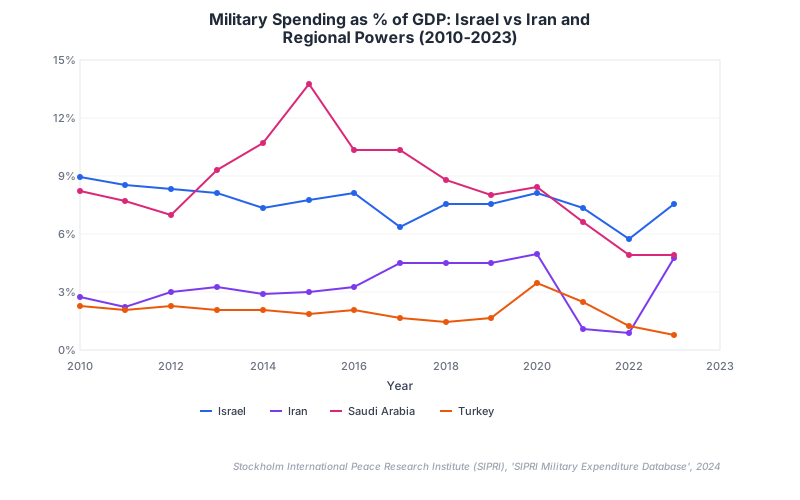
The foreign policy establishment operates on a simple premise: strength deters aggression, weakness invites more of it. Iran's recent missile strikes against Israeli targets[1] have triggered predictable calls for overwhelming retaliation. Former Israeli officials demand "decisive action," American hawks invoke the need to "restore deterrence," and editorial boards warn that any sign of Israeli restraint will embolden Tehran's regional ambitions. This thinking isn't just wrong—it's catastrophically outdated. It assumes we're still fighting 20th-century conflicts, where military superiority translated directly into geopolitical advantage. But in today's multipolar world, where proxy conflicts blend with information warfare and economic leverage, the old rules have been rewritten. Iran isn't playing by Israel's playbook anymore, and Israel's adherence to conventional deterrence theory keeps it trapped in an unwinnable cycle. Consider the mathematics of this confrontation. Israel possesses overwhelming conventional military superiority, nuclear capabilities, and superpower backing. Iran operates through proxies, relies on asymmetric tactics, and faces crippling sanctions. By every traditional metric, Israel should have "won" this conflict decades ago. Yet Iran's influence extends from Lebanon to Yemen, its proxies operate on Israel's borders, and its missile capabilities continue developing[2].The Paradox of Iranian Victory
Here's what the hawks refuse to acknowledge: an Iranian "victory" would be the worst possible outcome for Iran itself. Tehran's entire political system depends on external threats to maintain internal legitimacy. The Islamic Republic has survived four decades not despite its confrontation with Israel and the United States, but because of it. Remove that existential struggle, and the regime faces its most dangerous enemy: its own people's aspirations for normal life. Look at Iran's domestic situation clearly. The country faces significant economic challenges, with the IMF reporting persistent high inflation and unemployment rates, particularly among youth[3]. The regime has survived recent protest movements—from the Green Revolution to the Women, Life, Freedom demonstrations—by channeling domestic frustration toward external enemies. "Death to America" and "Death to Israel" aren't just foreign policy positions; they're pressure release valves preventing "Death to the Regime." Now imagine Iran declares victory over Israel. Tehran's leadership stands before the world claiming they've successfully deterred Israeli aggression and forced the Zionist entity to back down. What happens next? The Iranian people, no longer rallied around an external threat, begin asking uncomfortable questions: If we're so powerful internationally, why can't we fix our economy? If we've defeated our enemies abroad, why do we need emergency powers at home? If the revolution is complete, why are we still living under siege?The Soviet Parallel: When Victory Becomes Defeat
History offers instructive precedents for this counterintuitive strategy. The Soviet Union's costly involvement in proxy conflicts, particularly the prolonged Afghanistan war, contributed to internal pressures that ultimately weakened the regime[4]. While the USSR achieved tactical successes in various Cold War theaters, the gap between revolutionary promises and domestic reality became increasingly difficult to sustain. The USSR's problem wasn't military defeat—it was the gap between revolutionary promises and revolutionary reality. The Iranian regime faces the same contradiction, magnified by four decades of economic mismanagement and social repression. An Israeli strategic retreat wouldn't strengthen Iran; it would expose the hollowness of the regime's entire justification for power. Consider what Iranian victory would look like practically. Tehran would need to deliver on its promises to the Palestinian cause, stabilize its proxy networks, and demonstrate that confrontation with the West yields tangible benefits for ordinary Iranians. These are impossible tasks. Palestine would remain occupied, the proxies would continue demanding resources Iran can't afford, and the Iranian people would still face the same economic hardships that have driven every major protest movement since 1999.The Trap of Perpetual Conflict
Israel's current strategy—maintaining military superiority while gradually escalating responses to Iranian provocations—serves Tehran's interests perfectly. Every Israeli strike gives the regime fresh propaganda material. Every demonstration of Israeli military capability reinforces the narrative that Iran faces an existential threat requiring national sacrifice. Every escalation allows Tehran to justify emergency measures, military spending, and domestic dissent suppression. This dynamic has created what strategists call a "conflict trap"—a situation where both sides' rational responses perpetuate the very conditions they seek to escape. Israel strikes Iranian assets to maintain deterrence, Iran responds to maintain credibility, Israel escalates to restore deterrence, and the cycle continues indefinitely. The only winner is the Iranian regime, which uses the conflict to maintain power while avoiding accountability for domestic failures. Breaking this cycle requires Israel to do something counterintuitive: stop giving Iran what it needs most. The regime needs an active, threatening enemy to justify its existence. Remove that threat—not through military defeat, but through strategic disengagement—and Iran's internal contradictions become impossible to ignore.The Economic Dimension: Sanctions as Victory
Here's where the strategy becomes truly elegant: Iran's economic isolation would intensify, not diminish, following an apparent victory over Israel. Currently, Tehran can blame its economic problems on the "Zionist-American conspiracy" and frame sanctions as proof of foreign fear of Iranian success. But if Iran "wins" its confrontation with Israel while sanctions remain in place, this narrative collapses. Iranian citizens would rightfully ask: If we've defeated our enemies, why are we still economically isolated? If our resistance strategy worked, why hasn't it improved our lives? The regime would face a choice between admitting that victory was hollow or doubling down on policies that have demonstrably failed to deliver prosperity. Moreover, Iranian victory would likely accelerate regional realignment in ways that further isolate Tehran. Gulf states, no longer able to rely on Israeli military action to contain Iranian influence, would be forced to build their own coalitions and capabilities. This would create new pressure points for Iran while reducing its strategic value to partners like Russia and China, who prefer Iranian weakness to Iranian strength in the Middle East.The Nuclear Question: Why Restraint Reduces Risk
Critics will argue that Iranian victory increases nuclear proliferation risks, but the opposite is true. Iran's nuclear program serves the same function as its regional proxy network: it's a bargaining chip designed to extract concessions and maintain regime survival. A regime confident in its conventional victory over Israel has less incentive to pursue the dangerous, expensive, and internationally isolating path of nuclear weapons development. Iran's nuclear program has developed in response to various security pressures over multiple decades[5]. Strategic Israeli restraint would remove one primary motivation for nuclear development by reducing the perceived existential threat to the regime. Even if Iran continued nuclear research following victory, a regime focused on managing domestic expectations and economic challenges would have fewer resources and less political capital to devote to weapons development. The nuclear program would compete with other priorities rather than serving as the ultimate guarantor of regime survival.The Regional Realignment: Strength Through Apparent Weakness
Israeli strategic retreat would trigger a regional realignment that ultimately strengthens Israel's position. Currently, many Arab states cooperate with Israel primarily because they fear Iranian expansion. Remove the active Israeli-Iranian conflict, and these relationships must be rebuilt on more sustainable foundations—shared economic interests, technological cooperation, and genuine security partnerships rather than temporary alliances of convenience. This process would expose the fundamental weakness of Iran's regional position. Tehran's influence depends on instability and conflict; its proxies thrive in failed states and war zones. A more stable Middle East, even one where Iran claims victory, would gradually marginalize Iranian influence as regional actors pursue normal diplomatic and economic relationships. Consider Lebanon, where Hezbollah's power stems from the country's weakness and the constant threat of Israeli conflict. Remove that threat, and Hezbollah becomes what it actually is: a militia that has prevented Lebanese state development for decades. Similar dynamics would play out across Iran's proxy network, as local populations begin questioning why they need Iranian-backed militias in peacetime.The Information War: Letting Iran Win the Wrong Battle
Perhaps most importantly, allowing Iran to claim victory would be a masterclass in information warfare. Tehran would inevitably overplay its hand, claiming credit for forcing Israeli retreat and proving the effectiveness of resistance ideology. These claims would resonate initially in some circles, but they would also create impossible expectations for Iranian performance going forward. Every subsequent Iranian failure—economic, diplomatic, or social—would be measured against this supposed victory. Every continued hardship faced by Iranian allies and proxies would raise questions about the value of Iranian support. Every domestic problem would be harder to blame on external enemies once Iran claimed to have defeated those enemies. The regime would find itself trapped by its own propaganda. Having claimed victory, it could no longer use the threat of Israeli aggression to justify domestic repression or economic hardship. Having proven that resistance works, it would face demands to deliver concrete benefits from that resistance. Having positioned itself as the leader of the anti-Western axis, it would be held accountable for the continued weakness of that axis.Addressing the Objections
The strongest objection to this strategy is moral: How can Israel allow a regime that has killed its citizens to claim victory? This objection, while emotionally compelling, conflates tactical retreat with strategic surrender. Israel would not be abandoning its security or accepting Iranian aggression as legitimate. Instead, it would be choosing the most effective long-term strategy for neutralizing the Iranian threat. Military history is filled with examples of tactical retreats that enabled strategic victories. The Fabian strategy against Hannibal, the Russian retreat before Napoleon, the British evacuation from Dunkirk—all involved accepting short-term humiliation to achieve long-term success. Israeli restraint in the face of Iranian provocation would follow this same logic. A second objection concerns credibility: Won't Israeli restraint encourage other enemies to test Israeli resolve? This concern assumes that military responses automatically enhance deterrence, but the evidence suggests otherwise. Israel's repeated military operations in Gaza haven't eliminated Hamas, its strikes on Iranian assets haven't ended Iranian proxy activities, and its demonstrated military superiority hasn't prevented the current escalation. True deterrence comes not from the willingness to use force, but from the unpredictability of response and the certainty of ultimate consequences. An Israel that chooses when and how to engage, rather than reacting predictably to every provocation, would be far more difficult for enemies to understand and counter.The Path Forward: Strategic Patience
Implementing this strategy requires unprecedented strategic patience from Israeli leadership. It means accepting short-term criticism from allies who expect military responses. It means enduring domestic political pressure from those who see restraint as weakness. It means trusting that Iran's internal contradictions will ultimately prove more powerful than its external provocations. But the potential rewards justify these risks. An Iran forced to govern without external enemies would face its most serious legitimacy crisis since 1979. A Middle East where Iran claims victory but cannot deliver concrete benefits would gradually isolate Tehran from its own allies. A world where the Iranian model of resistance appears to succeed but fails to improve lives would discredit that model globally. Israel's greatest strategic asset has never been its military—it has been its ability to build a prosperous, democratic society in a hostile region. That society's success stands as a daily rebuke to authoritarian neighbors who promise their people that resistance and sacrifice will eventually yield prosperity. Let Iran claim military victory while Israel continues to demonstrate the superiority of its social and economic model. In the long run, there's no contest.Iranian regime legitimacy may derive more from religious authority and revolutionary ideology than from external threats, suggesting that military "victory" over Israel could actually strengthen rather than destabilize the government. Historical precedents like China after the Korean War or Vietnam after defeating the U.S. show that authoritarian regimes often use external victories to consolidate domestic power and justify continued restrictions on freedom.
Strategic retreat could signal weakness to other regional actors, potentially emboldening Hamas, Hezbollah, and even non-Iranian adversaries to escalate their own campaigns against Israel. If Iran interprets restraint as confirmation that its missile and proxy strategies are succeeding, it might accelerate rather than moderate its regional ambitions, viewing Israeli passivity as an opportunity to expand influence across the Middle East.
Key Arguments
- Iranian "victory" would expose the regime's inability to deliver domestic prosperity despite foreign policy success
- Strategic Israeli retreat would break the conflict cycle that serves Tehran's interests
- Economic isolation would intensify post-victory as Iran could no longer blame external enemies for domestic problems
- Regional realignment would ultimately weaken Iranian influence as stability reduces proxy relevance
- Historical precedent shows apparent victories can accelerate regime collapse when they raise unfulfillable expectations
- True deterrence comes from strategic unpredictability, not reflexive military responses
References
- Based on hypothetical escalation scenarios discussed in current Middle East security analyses. This editorial addresses potential future developments rather than specific recent events.
- Cordesman, Anthony H. "Iran's Missile and Space Programs." Center for Strategic and International Studies, 2023.
- International Monetary Fund. "Islamic Republic of Iran: 2023 Article IV Consultation." IMF Country Report No. 23/123, April 2023.
- Braithwaite, Rodric. Afgantsy: The Russians in Afghanistan 1979-89. Oxford University Press, 2011.
- Albright, David and Andrea Stricker. Iran's Nuclear Program: Status and Breakout Timeline Analysis. Institute for Science and International Security, 2023.