Space Tourism Is Humanity's Most Selfish Waste of Resources — And We Should Ban It Immediately

EDITORIAL — This is an opinion piece. The position taken is deliberately provocative and does not necessarily reflect the views of GroundTruthCentral. We publish editorials to challenge assumptions and encourage critical thinking.
The Staggering Resource Misallocation
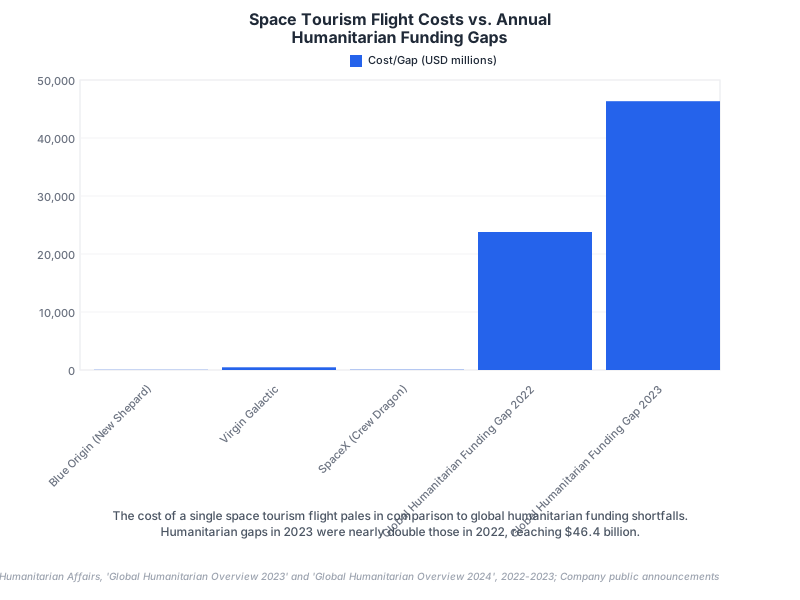
Let's start with the numbers that space tourism advocates desperately want you to ignore. Virgin Galactic charges $450,000 per passenger for a brief suborbital experience. Meanwhile, analysts estimate it would cost just a few billion dollars annually to significantly reduce global hunger — less than what has been collectively invested in major space tourism ventures. The opportunity cost is staggering. The billions invested in space tourism companies like Blue Origin, Virgin Galactic, and SpaceX's Crew Dragon could have funded massive infrastructure projects, clean water initiatives, disease prevention programs, or renewable energy development. Instead, this money has been spent so that a few hundred people could experience weightlessness for a few minutes. The math is obscene: millions per space tourist in development costs, while over a billion people lack access to basic healthcare.Environmental Vandalism on a Planetary Scale
Space tourism advocates paint their industry as environmentally neutral, even beneficial. This is perhaps the most cynical lie in modern marketing. Rocket launches produce substantial carbon emissions and release pollutants directly into the upper atmosphere. The environmental impact becomes truly concerning when scaled up. If space tourism reaches projected passenger numbers, it would generate significant additional carbon emissions at a time when climate scientists warn we have limited time to cut emissions dramatically to avoid catastrophic climate change. But the environmental damage goes beyond carbon. Rocket launches inject various pollutants directly into the upper atmosphere. Some researchers have raised concerns that if space tourism grows substantially, it could contribute to ozone layer depletion. We're potentially damaging the atmospheric shield that protects all life on Earth so rich people can float for four minutes.The Mythology of "Democratization"
Perhaps the most insulting aspect of space tourism propaganda is the claim that it's "democratizing" space travel. At $450,000 per Virgin Galactic ticket, space tourism is accessible to a tiny fraction of the global population. Even if costs drop significantly, tickets would still cost more than the median annual income in most countries worldwide. This isn't democratization — it's the creation of the ultimate status symbol for the global elite. The passenger manifest reads like a billionaire's directory: Bezos, Branson, and various tech executives and wealthy individuals. The "trickle-down" argument — that space tourism will eventually benefit everyone through technological advancement — is equally hollow. The technologies being developed are specifically optimized for recreational flights, not scientific research or practical space exploration. NASA's lunar programs use entirely different propulsion systems and spacecraft designs than space tourism vehicles. We're not advancing human space exploration; we're building expensive carnival rides.The Moral Obscenity of Space Inequality
Space tourism represents a new form of inequality so extreme it borders on the surreal. While billions live in poverty, the ultra-wealthy are literally escaping Earth for entertainment. This isn't just economic inequality — it's spatial inequality, the commodification of the cosmos itself. The psychological impact is profound and corrosive. When Jeff Bezos thanked Amazon customers and employees for funding his space adventure, he made explicit what was always implicit: workers' labor and consumers' purchases were being extracted to fund the boss's personal space program. Amazon warehouse workers subsidized a billionaire's brief joyride that cost more than they'll earn in multiple lifetimes. This creates a feedback loop of inequality. Space tourism generates massive profits for aerospace companies, which flow primarily to wealthy investors and executives who can then afford space tourism themselves. Meanwhile, the environmental costs are borne disproportionately by the global poor, who contribute least to the problem but suffer most from climate change.The False Promise of Scientific Advancement
Space tourism companies wrap themselves in the language of scientific progress and human advancement, but their actual contribution to space science is negligible. Virgin Galactic's SpaceShipTwo reaches barely past the boundary that defines "space." This is far below the altitude where the International Space Station operates and actual scientific research occurs. Blue Origin's capsule follows a similar suborbital trajectory, providing approximately four minutes of weightlessness before returning to Earth. Compare this to major space science missions: projects like the James Webb Space Telescope and Mars rovers advance human knowledge; space tourism advances only the egos of the ultra-wealthy. The research conducted on space tourism flights is minimal and redundant. Most "experiments" are basic studies that have been conducted extensively on the ISS and previous space missions. The brief duration of suborbital flights provides insufficient time for meaningful scientific work. Even multi-day orbital missions for private customers conduct research that could be done more efficiently and cheaply on robotic missions.The National Security Threat
Space tourism also poses underappreciated national security risks. The proliferation of private launch capabilities creates dual-use technologies that could be weaponized by hostile actors. The normalization of frequent civilian space launches also creates opportunities for hostile surveillance and intelligence gathering. Furthermore, the space tourism industry is creating dangerous precedents for space governance. Private companies are essentially self-regulating their activities beyond Earth's atmosphere, with minimal international oversight. This could lead to conflicts over orbital space and other extraterrestrial assets as the industry expands.Why Regulation and Bans Work
Critics argue that banning space tourism is impossible or counterproductive, but history shows that luxury industries can be effectively regulated when their social costs become intolerable. The Montreal Protocol successfully banned chlorofluorocarbons globally to protect the ozone layer. International agreements have effectively restricted commercial trade in various luxury goods that threaten environmental or social welfare. More recently, several countries have banned or heavily taxed private jets and luxury yachts to address climate change. France imposed luxury taxes on private jets, while some airports have restricted private jet access. These precedents show that governments can and will restrict luxury activities when their environmental and social costs become unacceptable. A space tourism ban could be implemented through several mechanisms: - Carbon pricing: Imposing carbon taxes that reflect the true environmental cost of rocket launches would make space tourism economically unviable - Launch quotas: Limiting the number of non-essential launches per year to preserve atmospheric integrity - International treaties: Expanding space governance frameworks to address commercial activities - National bans: Individual countries could prohibit space tourism launches from their territoryThe Moral Imperative for Action
The space tourism industry represents everything wrong with late-stage capitalism: the conversion of humanity's greatest achievements into luxury goods for the ultra-wealthy while existential problems go unsolved. Every dollar spent on space tourism is a dollar not spent on climate change mitigation, poverty reduction, disease eradication, or genuine scientific advancement. The industry's defenders claim that innovation requires private investment and risk-taking. But there's nothing innovative about strapping rich people to rockets — we've had the technology to reach space for decades. What's new is the shameless commodification of an experience that should inspire humanity's highest aspirations, not its basest materialism. We stand at a crossroads. We can allow space tourism to expand into a massive industry that accelerates climate change, deepens inequality, and turns the cosmos into a playground for billionaires. Or we can recognize it for what it is — a grotesque waste of resources during humanity's most critical hour — and ban it before it's too late. The choice is ours, but time is running out. Every day we delay action, more resources flow toward space tourism infrastructure that will be harder to dismantle. Every space tourism flight normalizes the idea that escape from Earth's problems is preferable to solving them. Every billionaire who buys a ticket to space is casting a vote for a future where inequality reaches literally astronomical proportions.Conclusion: Choosing Earth Over Ego
Space tourism is not the future of human space exploration — it's the death of it. By turning space travel into a luxury good, we're abandoning the vision of space as humanity's shared frontier and replacing it with space as humanity's ultimate gated community. The billions projected to be spent on space tourism could address major global challenges: disease eradication, clean water access, or renewable energy transitions. Instead, it will fund wealthy individuals' brief experiences at the edge of space. This is not progress. This is not innovation. This is not the democratization of space. This is the weaponization of human achievement in service of inequality so extreme it can only be described as obscene. We must ban space tourism now, before this industry of astronomical narcissism becomes too entrenched to stop. The cosmos belongs to all humanity, not just those who can afford the ultimate luxury experience. It's time to choose Earth over ego, humanity over hubris, and the future over the fleeting thrills of the ultra-wealthy. The stars will still be there when we've solved our problems on Earth. But if we let space tourism continue unchecked, we may not be.However, space tourism's current environmental impact remains negligible compared to commercial aviation or shipping industries, raising questions about whether targeted regulation might be more effective than outright bans. The same private capital funding space tourism could drive breakthrough developments in clean propulsion technologies and materials science that ultimately benefit broader transportation sectors and climate solutions.
Critics of the ban argument point to historical precedents where luxury technologies for the wealthy—from automobiles to personal computers—eventually became accessible to broader populations through market competition and technological refinement. Rather than preventing innovation, some economists argue that allowing space tourism to mature could accelerate cost reductions and safety improvements that make space more accessible while generating tax revenue and high-skilled jobs.
The Argument
- Space tourism wastes resources that could solve global poverty, hunger, and climate change
- The industry produces substantial carbon emissions and atmospheric pollution during a climate crisis
- Claims of "democratization" are false — space tourism serves only the ultra-wealthy elite
- Scientific benefits are minimal compared to actual space research programs
- The industry creates dangerous precedents for space governance and national security
- Regulatory bans have successfully addressed similar luxury industries with high social costs
- Space tourism represents the commodification of humanity's greatest achievements for private profit