Maine's Data Center Ban Is Economic Suicide — And Every State Should Follow Their Lead

EDITORIAL — This is an opinion piece. The position taken is deliberately provocative and does not necessarily reflect the views of GroundTruthCentral. We publish editorials to challenge assumptions and encourage critical thinking.
The Great Data Center Con
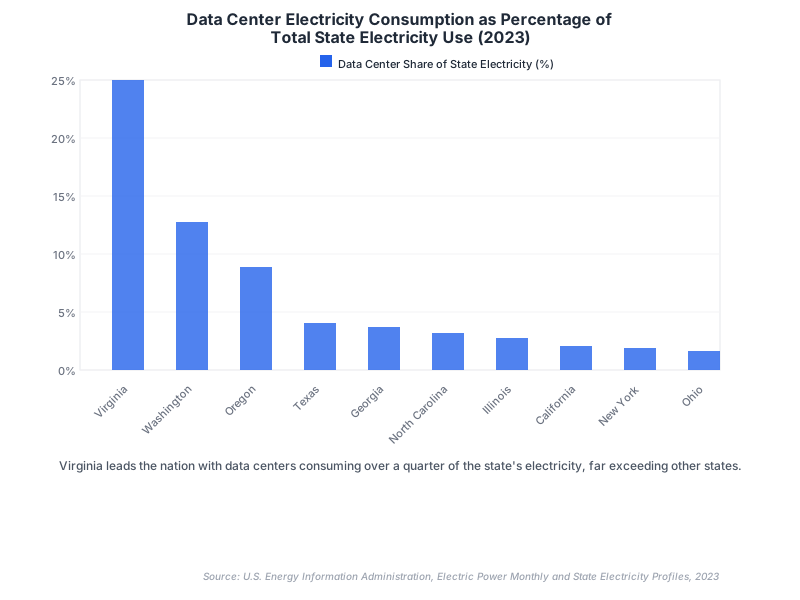
Let's start with the lie everyone believes: data centers create jobs and economic growth. Virginia, the self-proclaimed "Data Center Capital of the World," hosts hundreds of data centers. The result? These facilities employ roughly one person per tens of thousands of square feet of space. The employment reality is stark: major tech companies' data centers typically employ between 30-100 people for facilities costing hundreds of millions of dollars. These aren't factories — they're automated warehouses for servers, requiring minimal human oversight once operational. The math is devastating. Data centers generate a fraction of the jobs per dollar invested compared to traditional manufacturing. States are literally paying billions to create unemployment.The Infrastructure Vampire
But job creation was never the real promise — it was the infrastructure investment. Data centers require massive electrical capacity, fiber networks, and cooling systems. Surely this benefits everyone? Consider Ireland, where data centers now consume 18% of the country's electricity — more than entire rural regions. The result isn't shared prosperity but energy poverty: residential electricity rates have skyrocketed, partly due to grid strain from data center demand. In Northern Virginia, utility companies have spent billions upgrading transmission infrastructure primarily to serve data centers. Who pays? Residential ratepayers, whose bills have increased while data centers receive wholesale electricity rates and massive tax incentives. The pattern is identical everywhere: data centers arrive promising economic transformation, then immediately become parasitic on existing infrastructure while contributing minimally to the tax base that maintains it.Climate Catastrophe in a Server Rack
The environmental argument against data centers isn't just about carbon emissions — though those are staggering. Data centers consume roughly 1% of worldwide electricity. But the real environmental crime is water consumption. Major tech companies' data centers consume billions of gallons of water annually. Individual facilities can use millions of gallons daily in states facing permanent drought. This isn't abstract environmental concern — it's immediate resource theft. In communities across America, data centers use more water than entire towns of thousands of residents. Every gallon cooling servers is a gallon not available for drinking water, agriculture, or ecosystem preservation. Data centers are literally mining water to power digital advertising and cryptocurrency speculation.The Tax Avoidance Shell Game
Perhaps most infuriating is how data centers avoid paying for the infrastructure they consume. Major tech companies' data centers regularly receive tens of millions in tax incentives annually. Many facilities operate under multi-year tax abatements worth hundreds of millions. The result is a reverse Robin Hood scheme: working families subsidize infrastructure for trillion-dollar corporations that pay almost nothing in return. States offer billions in incentives for chip manufacturing that will employ thousands — but give similar incentives to data centers employing dozens. States have become so desperate for any economic development they'll subsidize digital colonialism: extractive industries that consume resources, avoid taxes, and provide minimal employment while their profits flow to Seattle, Menlo Park, and Mountain View.The AI Bubble Will Burst
Data center boosters argue artificial intelligence will drive unprecedented demand, making these facilities essential infrastructure. This is the same argument made for cryptocurrency mining, which drove massive data center expansion before the 2022 crypto crash eliminated most mining profitability. AI training requires enormous computational resources — temporarily. But once models are trained, inference (actually using AI) requires far less computational power. The current AI boom is driving massive overcapacity that will inevitably correct. Moreover, edge computing is moving processing closer to users, reducing demand for centralized data centers. Modern devices can run sophisticated AI models locally. The future of computing is distributed, not centralized. States building data center capacity for AI training are preparing for yesterday's technology while tomorrow's innovations make their investments obsolete.Maine's Potential Masterstroke
Maine's proposed ban would specifically target large-scale data centers consuming over 100 megawatts — precisely the facilities that maximize resource consumption while minimizing employment. The legislation exempts smaller facilities serving local needs, university research, and essential services. This isn't technological Luddism — it's surgical precision. Maine's analysis of the data center value proposition found it wanting. A typical large data center consumes electricity equivalent to 80,000 homes while creating fewer than 50 permanent jobs. The opportunity cost is staggering: that same electrical capacity could power manufacturing facilities employing thousands or support residential development. Critics claim Maine is forfeiting its digital future. But Maine can host robust smaller data centers serving regional needs while preventing only the most exploitative facilities — the digital strip mines that extract value without creating it.The Alternative Path Forward
Maine is implementing similar restrictions while offering incentives for genuinely productive technology investments. Instead of subsidizing server farms, states could support: - Semiconductor manufacturing (creating thousands of jobs per billion invested) - Renewable energy production (wind and solar farms create permanent maintenance jobs while generating revenue) - Electric vehicle manufacturing (major facilities can employ tens of thousands) - Biotechnology research (actual labs with actual scientists, not automated server monitoring) These alternatives create real employment, generate substantial tax revenue, and contribute to productive economic activity rather than digital rent-seeking.The Network Effect Fallacy
Data center advocates argue that states without facilities will be excluded from the digital economy. This is nonsense. Netflix streams movies from data centers thousands of miles from viewers. Cloud services operate globally regardless of where individual servers are located. Search results don't depend on having a data center in your state. The internet's fundamental architecture makes data center location largely irrelevant to end users. Latency concerns are solved by content delivery networks and edge computing, not massive centralized facilities. States don't need local data centers any more than they need local oil refineries to buy gasoline. What states do need is broadband infrastructure, digital literacy education, and technology companies that employ actual humans. Restricting automated server farms encourages exactly these investments.Breaking the Addiction
Maine's data center ban represents something unprecedented in American economic policy: a state choosing long-term sustainability over short-term investment attraction. For decades, states have competed in a race to the bottom, offering ever-larger subsidies for ever-smaller returns. The data center industry has perfected this exploitation. Companies pit states against each other, demanding tax breaks, infrastructure upgrades, and regulatory exemptions in exchange for facilities that provide minimal lasting benefit. Maine could break this cycle by simply refusing to play. Other states should follow immediately. The current data center boom is creating massive stranded assets — facilities that will become economically obsolete as technology evolves. States investing heavily in data center infrastructure today will face massive cleanup costs tomorrow, just as coal-dependent regions now struggle with abandoned power plants.While Maine's data center ban may seem economically shortsighted, it could represent a prescient bet on the future of distributed computing. As edge computing and 5G networks mature, the need for massive centralized facilities may indeed diminish, making Maine's approach an early adoption of a post-hyperscale infrastructure strategy rather than economic suicide.
The real test of Maine's approach may not be immediate job creation, but whether other states find themselves locked into costly, obsolete infrastructure as AI workloads shift toward more efficient, distributed models. If the current data center boom mirrors previous tech bubbles, Maine's restraint could prove financially prudent when states are left maintaining expensive facilities that no longer serve evolving digital needs.
The Argument
- Data centers create almost no jobs relative to their massive infrastructure demands and tax incentives
- They function as resource vampires, consuming enormous amounts of electricity and water while contributing minimally to local tax bases
- The AI-driven demand surge is temporary and will lead to overcapacity, similar to the cryptocurrency crash
- Maine's ban targets only the most exploitative large-scale facilities while preserving smaller, locally-beneficial data infrastructure
- States can attract more productive technology investments that create real employment and economic value
- The internet's architecture makes data center location largely irrelevant to economic participation in the digital economy