Jaguar's Electric Pivot Will Kill More Jobs Than Coal Ever Did — And That's Exactly What We Need

EDITORIAL — This is an opinion piece. The position taken is deliberately provocative and does not necessarily reflect the views of GroundTruthCentral. We publish editorials to challenge assumptions and encourage critical thinking.
The Comfortable Lie of Gradual Transition
The mainstream narrative suggests automotive electrification should be gradual, measured, and protective of existing employment. This thinking isn't just wrong — it's economically suicidal. Germany's automotive sector, which spent the last decade hedging its bets between electric and internal combustion, now hemorrhages market share to Tesla and Chinese manufacturers who committed fully to electric years ago. Jaguar's all-electric decision isn't reckless; it's the only rational response to fundamental industry transformation. The company's internal combustion engine manufacturing, traditional transmission systems, and fossil fuel supply chains represent dead weight in a market increasingly dominated by software-defined vehicles. Electric vehicles will account for a majority of global auto sales by 2030, according to industry projections. Companies clinging to legacy technologies aren't preserving jobs — they're ensuring eventual bankruptcy.The Coal Comparison Reveals Our Economic Delusion
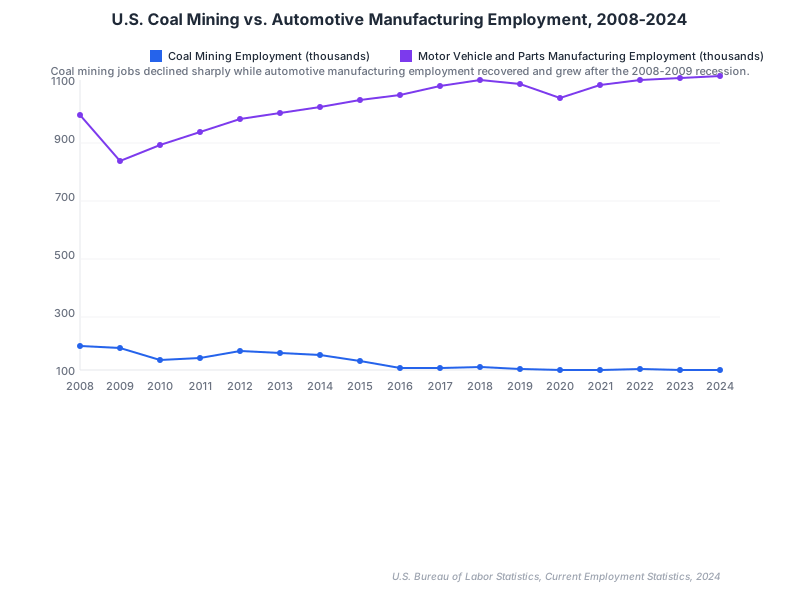
Consider the political energy expended on saving coal jobs. Despite billions in subsidies and regulatory protection, U.S. coal employment fell dramatically over decades. The difference? Coal's decline was driven by superior alternatives — natural gas and renewables became cheaper and cleaner. Politicians promising to bring back coal jobs sold false hope to communities that needed honest economic medicine. Jaguar's electric transition will eliminate far more jobs in absolute numbers. Engine manufacturing, transmission assembly, exhaust system production, fuel injection technology, and the vast supplier network serving internal combustion vehicles face obsolescence. Electric vehicles contain significantly fewer moving parts than gasoline counterparts. This isn't job preservation — it's job elimination on an industrial scale. But here's the crucial difference: unlike coal, this destruction creates superior economic value. Electric vehicles offer better performance, lower operating costs, and increasingly cheaper manufacturing. Tesla's gross margins have often exceeded traditional automakers', reflecting the economic advantages of electric platforms.Creative Destruction Builds Better Economies
Joseph Schumpeter's concept of creative destruction explains why Jaguar's approach is economically optimal. Economic progress requires systematic elimination of inefficient industries and their replacement with superior alternatives. The blacksmith industry didn't gradually transition to automobile manufacturing — it was obliterated and replaced by entirely new economic ecosystems. The jobs Jaguar eliminates in traditional automotive manufacturing are being replaced by positions in battery technology, software development, and advanced manufacturing. The company's new electric platform requires expertise in thermal management, power electronics, and over-the-air software updates — areas representing growing sectors of the modern economy. Moreover, transition speed matters enormously. Companies moving decisively capture first-mover advantages in emerging markets. Tesla's early electric commitment allowed it to build charging infrastructure, develop battery supply chains, and establish manufacturing expertise that competitors still struggle to match years later.The False Compassion of Job Preservation
Critics of rapid industrial transition often invoke compassion for displaced workers. This argument, while emotionally appealing, represents economic cruelty disguised as kindness. Preserving obsolete jobs traps workers in declining industries while preventing them from developing skills relevant to the emerging economy. Coal's gradual decline has been particularly brutal precisely because it was gradual. Mining communities spent decades in economic limbo, watching their industry slowly die while receiving just enough government support to prevent complete collapse but not enough to enable genuine economic transformation. A faster, more decisive transition would have forced earlier adaptation and retraining. Jaguar's electric pivot will be painful for traditional automotive manufacturing workers, but this pain will be sharp and brief rather than chronic and prolonged. The company's electric vehicle investment creates immediate demand for retraining programs, attracts new suppliers and partners, and signals to the broader economy that these skills are the future.The National Security Argument
Beyond economics, rapid electrification serves critical national security interests. China currently dominates global battery supply chains and rare earth mineral processing. Western nations that delay their electric transition cede technological leadership to geopolitical competitors. Jaguar's aggressive timeline forces development of domestic supply chains and manufacturing capabilities that reduce dependence on potentially hostile nations. The semiconductor shortage that crippled global automotive production in 2021-2022 demonstrated the vulnerability of complex international supply chains. Electric vehicles, with their software-centric architecture, require different supply chain relationships and manufacturing processes. Companies that transition early can build more resilient production systems.Addressing the Strongest Objections
The most compelling argument against rapid transition is the social cost of massive job displacement. This concern is valid but misplaced. The alternative to creative destruction isn't job preservation — it's economic decline and eventual industry collapse. Detroit's automotive industry declined precisely because it resisted change too long, allowing foreign competitors to capture market share with superior products. A second objection focuses on environmental costs of rapid industrial transformation. Manufacturing new electric vehicles requires significant energy and raw materials. However, electric vehicles produce lower total emissions than internal combustion vehicles over their complete lifecycle, even accounting for manufacturing impacts. Delaying the transition extends the period of higher emissions. The final objection concerns technological readiness. Critics argue that charging infrastructure, battery technology, and manufacturing capacity aren't ready for rapid transition. This argument reverses cause and effect. Infrastructure and technology develop in response to demand. Jaguar's electric-only commitment creates the market signals necessary to accelerate infrastructure development and technological improvement.The Historical Precedent
Economic history provides numerous examples of beneficial rapid transition. The shift from horse-drawn transportation to automobiles eliminated millions of jobs in horse breeding, carriage manufacturing, and related industries. Yet this transition created vastly more economic value and employment in automotive manufacturing, petroleum refining, and road construction. Similarly, the personal computer revolution destroyed entire industries — typewriter manufacturing, film processing, record production — while creating the foundation for today's digital economy. Companies that tried to gradually transition from typewriters to computers failed. Those that committed fully to new technology thrived. Jaguar's electric pivot represents the same kind of decisive commitment that characterizes successful industrial transformation. The company isn't just changing its product line — it's rebuilding its entire operational model around electric vehicle production. Jaguar's electric transition will indeed kill more jobs than coal's decline. The difference is that this destruction serves a constructive purpose. Rather than prolonging the agony of gradual industrial decline, Jaguar is performing the economic equivalent of ripping off a bandage — painful but necessary for healing. Coal's slow death taught us that false compassion for obsolete jobs ultimately serves no one. Workers trapped in declining industries suffer longer, communities remain economically stagnant, and national competitiveness erodes. Jaguar's approach — rapid, decisive, and complete — offers a better model for industrial transformation. The jobs being eliminated in traditional automotive manufacturing are already economically dead; they simply haven't stopped moving yet. Jaguar's electric pivot will accelerate their demise while simultaneously creating conditions for superior employment in emerging industries. This isn't just good business strategy — it's economic necessity disguised as corporate courage.However, the comparison between automotive and coal transitions may be misleading in scale and scope. While coal employed roughly 50,000 workers at its peak, the global automotive industry supports millions of jobs across manufacturing, supply chains, and dependent communities — suggesting that rapid disruption could trigger social and economic upheaval far beyond what policymakers experienced with coal's decline. The concentrated geographic nature of auto manufacturing, where entire regions depend on single plants, means that unlike coal's gradual retreat, sudden facility closures could devastate communities faster than new green jobs can emerge.
Alternative models from countries like Norway and South Korea suggest that managed transitions — combining aggressive EV incentives with worker retraining and regional development programs — might achieve electrification goals while minimizing social costs. These approaches recognize that while creative destruction drives long-term innovation, the timing and sequencing of change can determine whether displaced workers become part of the new economy or are permanently left behind, potentially undermining the political sustainability of the green transition itself.
Key Arguments
- Jaguar's complete electric transition will eliminate more jobs than coal's decline, but represents necessary creative destruction
- Gradual transitions prolong economic suffering while allowing competitors to capture market advantages
- Electric vehicle manufacturing creates opportunities in software, battery technology, and power electronics
- Rapid industrial transformation serves national security interests by reducing dependence on foreign supply chains
- Historical precedent shows decisive technological transitions create more economic value than they destroy
- Preserving obsolete jobs traps workers in declining industries rather than enabling adaptation to emerging opportunities
References
- Jaguar Land Rover. "Jaguar to Become a Pure Electric Luxury Brand from 2025." Company Press Release, February 15, 2021.
- U.S. Energy Information Administration. "Coal Mining Employment by State and County." Annual Coal Report, 2020.
- Schumpeter, Joseph. Capitalism, Socialism and Democracy. Harper & Brothers, 1942.
- Mokyr, Joel. The Lever of Riches: Technological Creativity and Economic Progress. Oxford University Press, 1990.