
Energy Wars Are Actually Accelerating Human Progress — And We Should Embrace Them

EDITORIAL — This is an opinion piece. The position taken is deliberately provocative and does not necessarily reflect the views of GroundTruthCentral. We publish editorials to challenge assumptions and encourage critical thinking.
Are Energy Wars Actually Accelerating Human Progress?
The conventional wisdom is clear: energy wars are destructive, destabilizing forces that threaten global prosperity and peace. From Russia's weaponization of natural gas against Europe to the Middle East's decades of petroleum-fueled conflicts, we're told these competitions represent humanity at its worst — zero-sum thinking that enriches a few while impoverishing many. But what if this comfortable narrative is not just wrong, but dangerously naive? What if energy wars are actually the primary engine of human technological advancement, economic resilience, and geopolitical progress? Rather than lamenting them, perhaps we should recognize them as the necessary friction that sharpens our species' competitive edge.The Mythology of Peaceful Progress
The mainstream view treats energy conflicts as aberrations — unfortunate departures from some imagined state of cooperative abundance. This perspective assumes that without geopolitical competition over resources, humanity would naturally evolve toward efficient, sustainable energy systems through patient collaboration and rational planning. It's a seductive fantasy, but history tells a different story entirely. Consider the most transformative energy transitions in human history. The shift from wood to coal was driven by technological advances in mining and metallurgy, coal's superior energy density for industrial processes, and Britain's deforestation pressures combined with competitive dynamics against rival nations[1]. The petroleum age emerged from market opportunities, with kerosene initially competing with whale oil and other illuminants, though resource scarcity was just one factor among many driving petroleum development[2]. Nuclear power development accelerated exponentially during World War II and the Cold War, driven by military competition rather than peaceful research[3]. The pattern is unmistakable: energy breakthroughs emerge from pressure, scarcity, and competition — not from abundance and cooperation. When resources flow freely and cheaply, innovation stagnates. When they become weapons, human ingenuity explodes.The Innovation Imperative of Scarcity
Russia's 2022 natural gas cutoffs to Europe provide a perfect case study. The conventional narrative focuses on the immediate economic pain — soaring energy prices, industrial shutdowns, and household hardship. But zoom out from the short-term disruption, and a different picture emerges: one of the most rapid accelerations of renewable energy deployment in European history[4]. Germany, which had spent decades gradually transitioning away from nuclear power while maintaining Russian gas dependence, suddenly fast-tracked wind and solar installations at unprecedented scale. The Netherlands expedited LNG terminal construction that had languished in regulatory limbo for years. France delayed plant closures and recommitted to nuclear power as a strategic priority[5]. Across the continent, energy efficiency retrofits transformed from "nice to have" policy goals into urgent economic necessities. What peaceful climate negotiations failed to accomplish over decades, energy warfare achieved in months. The threat of weaponized energy dependence forced European nations to confront hard truths about their strategic vulnerabilities and take decisive action. Without Putin's gas weapon, Europe would still be sleepwalking toward climate targets while remaining dangerously dependent on authoritarian suppliers.The Competitive Advantage of Energy Independence
Critics argue that energy wars create inefficiencies by forcing nations to develop domestic resources rather than importing cheaper alternatives. This misses the fundamental strategic dimension of energy security. Cheap energy from hostile suppliers isn't actually cheap — it's subsidized by future vulnerability. The United States' shale oil revolution illustrates this principle perfectly. Hydraulic fracturing technology existed for decades but remained economically marginal until oil price spikes and Middle Eastern instability made domestic production strategically essential[6]. The result wasn't just energy independence but a complete reordering of global geopolitics. America transformed from a net energy importer dependent on unstable regions to a net exporter capable of imposing sanctions on energy-producing adversaries. This transformation didn't happen through patient research and development in peaceful laboratories. It emerged from the urgent recognition that energy dependence represented an existential strategic weakness. The "inefficiency" of developing more expensive domestic resources proved to be the most valuable investment in national security and economic resilience America had made in decades.The Darwinian Logic of Energy Competition
Energy wars function as a Darwinian selection mechanism for economic and technological fitness. Nations that fail to develop resilient, diversified energy systems get eliminated from great power competition. Those that succeed gain decisive advantages across every dimension of national power. Consider China's approach to this challenge. Rather than relying on energy imports from potentially hostile suppliers, China has invested over $750 billion in renewable energy since 2010 and added more solar capacity in 2022 alone than the United States has installed in its entire history[7]. China's dominance in solar panel manufacturing, battery technology, and electric vehicle production didn't emerge from altruistic environmental concerns but from hard-headed recognition that energy independence equals strategic independence. The competitive pressure of energy wars forces nations to make difficult choices about resource allocation, technological priorities, and economic trade-offs. Countries that choose comfort over resilience — like Germany's decade-long bet on Russian gas — eventually pay the price. Those that choose strategic independence over short-term efficiency position themselves to dominate the next century.The Innovation Ecosystem of Conflict
Energy conflicts don't just drive technological advancement; they create entire innovation ecosystems that generate spillover benefits across the economy. Military research into jet engines led to commercial aviation. Nuclear weapons programs produced nuclear medicine and power generation. Space race competition delivered satellite communications and GPS technology. Today's energy wars are producing similar breakthrough innovations. The race to develop energy storage solutions for renewable power grids is driving advances in battery chemistry that benefit everything from consumer electronics to electric vehicles. Research into alternative fuels for military applications is creating new possibilities for carbon-neutral transportation. Cybersecurity investments to protect energy infrastructure are strengthening digital defenses across all sectors. These innovations emerge because energy conflicts create conditions where massive resources get directed toward solving specific technical challenges with clear strategic importance. Peaceful research environments rarely generate the same urgency, funding levels, or interdisciplinary collaboration that emerges when energy security becomes a matter of national survival.The False Promise of Energy Cooperation
The alternative to energy competition — international cooperation and resource sharing — sounds appealing but ignores fundamental realities about power, trust, and human nature. Energy cooperation requires mutual vulnerability, which works only when all parties share compatible values and interests. In practice, this creates dangerous dependencies that inevitably get exploited. The European Union's experience with Russian energy integration demonstrates the folly of assuming that economic interdependence creates political stability. For two decades, European leaders believed that buying Russian gas would moderate Putin's behavior and integrate Russia into the Western economic order. Instead, it gave Putin a powerful weapon to use against Europe when their interests diverged[8]. Energy cooperation between adversaries isn't cooperation at all — it's a temporary arrangement that lasts only until one side finds it advantageous to weaponize the relationship. Recognizing this reality and preparing for energy competition is more honest and ultimately more peaceful than pretending that energy interdependence creates lasting stability.The Acceleration Effect of Crisis
Perhaps the strongest argument for embracing energy wars is their unique ability to compress decades of gradual change into years or months of rapid transformation. Normal economic incentives and political processes move slowly, constrained by incumbent interests, regulatory inertia, and public resistance to change. Energy crises sweep away these obstacles and create conditions where dramatic shifts become possible. The 1973 oil embargo led to fuel efficiency standards, strategic petroleum reserves, and accelerated renewable energy research programs[9]. The 1979 oil crisis accelerated nuclear power development and energy conservation programs. Each energy shock forced adaptations that wouldn't have occurred through gradual market evolution. Current energy wars are producing similar acceleration effects. The urgency of reducing Russian energy dependence has fast-tracked permitting processes, infrastructure investments, and technology deployments that would have taken decades under normal circumstances. Crisis creates political consensus for changes that would otherwise face years of debate and delay.The Strategic Benefits of Energy Resilience
Nations that emerge victorious from energy wars don't just achieve energy security — they gain comprehensive strategic advantages that compound over time. Energy independence enables independent foreign policy, reduces vulnerability to economic coercion, and creates new opportunities for power projection. The transformation of the United States from energy importer to exporter fundamentally altered American foreign policy options in the Middle East, Russia, and Venezuela. Energy abundance allowed America to impose sanctions on major oil producers without damaging its own economy. It reduced the strategic importance of unstable regions while increasing American influence over energy-importing allies. These strategic benefits justify the short-term costs and inefficiencies of developing domestic energy resources. The premium paid for energy independence is insurance against future coercion and a foundation for long-term strategic autonomy. Countries that prioritize cheap energy over secure energy eventually discover that the cheapest energy becomes the most expensive when it disappears during a crisis.Embracing Creative Destruction
The path forward isn't to eliminate energy wars but to win them decisively through superior innovation, resilience, and strategic thinking. This requires abandoning comfortable illusions about energy cooperation and embracing the competitive dynamics that drive human progress. Energy wars force difficult but necessary choices about resource allocation, technological priorities, and strategic vulnerabilities. They accelerate innovation, strengthen resilience, and create conditions where breakthrough solutions become possible. Most importantly, they separate nations that adapt and evolve from those that cling to obsolete assumptions about energy security. The next phase of human development will be shaped by which countries best harness the creative potential of energy competition. Those that embrace this challenge and invest in energy independence will dominate the 21st century. Those that continue pursuing the illusion of cooperative abundance will find themselves increasingly vulnerable to those who understand that energy wars aren't a bug in the system — they're a feature.While energy conflicts may spur innovation among wealthy nations, they often devastate developing countries that lack the resources to adapt quickly. The same European energy crisis that accelerated renewable deployment also triggered energy poverty across Africa and Asia, where millions lost access to affordable electricity and heating—a human cost that technological progress in rich nations cannot justify.
History suggests that many breakthrough energy technologies emerged from peaceful scientific collaboration rather than wartime urgency. Solar photovoltaics were developed through decades of patient research, wind turbines evolved from Danish cooperative efforts, and nuclear power originated in academic physics—raising the question of whether we're crediting conflict for innovations that might have emerged faster through sustained, cooperative investment.
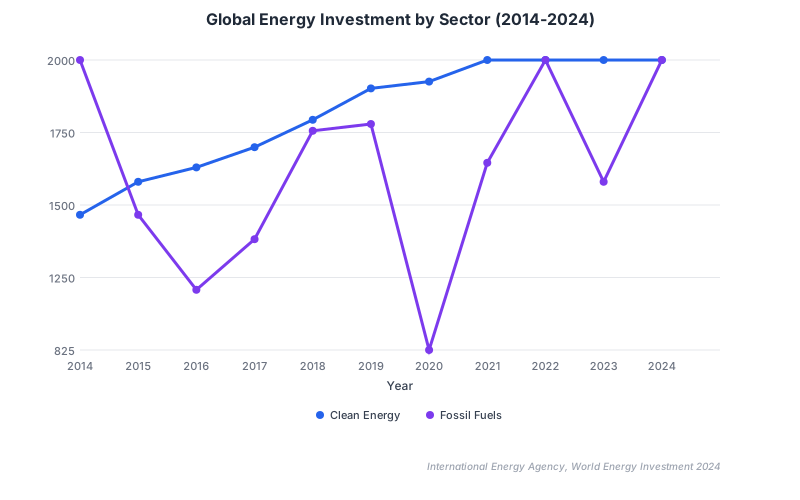
The Argument
- Energy wars drive technological innovation faster than peaceful cooperation ever could
- Historical energy transitions occurred through competitive pressure, not collaborative planning
- Energy independence provides decisive strategic advantages that justify short-term costs
- Crisis conditions accelerate necessary changes that would otherwise take decades
- Energy cooperation between adversaries creates dangerous vulnerabilities that get exploited
- Nations that win energy wars gain comprehensive advantages across all dimensions of power
References
- Pomeranz, Kenneth. The Great Divergence: China, Europe, and the Making of the Modern World Economy. Princeton University Press, 2000.
- Yergin, Daniel. The Prize: The Epic Quest for Oil, Money, and Power. Free Press, 2008.
- Rhodes, Richard. The Making of the Atomic Bomb. Simon & Schuster, 1986.
- International Energy Agency. "Renewable Electricity Growth is Accelerating Faster Than Ever Worldwide." IEA, December 2022.
- World Nuclear Association. "Nuclear Power in France." World Nuclear Association, 2023.
- Gold, Russell. The Boom: How Fracking Ignited the American Energy Revolution and Changed the World. Simon & Schuster, 2014.
- International Renewable Energy Agency. "Renewable Energy Statistics 2023." IRENA, 2023.
- Goldthau, Andreas. "The Political Economy of European Energy Security." Energy Policy, Vol. 36, 2008.
- Bamberger, Robert. "Energy Policy: Historical Overview." Congressional Research Service, 2005.