The Case for War with Iran: Why Peace Negotiations Are Actually Making the Middle East More Dangerous

EDITORIAL — This is an opinion piece. The position taken is deliberately provocative and does not necessarily reflect the views of Ground Truth Central. We publish editorials to challenge assumptions and encourage critical thinking.
The Fatal Flaw in "Peace Through Strength"
The conventional wisdom holds that dialogue and economic incentives can moderate Iran's behavior. This assumption rests on a fundamental misunderstanding of the Islamic Republic's nature and strategic objectives. Unlike traditional nation-states that negotiate from rational self-interest, Iran's theocratic leadership operates according to an ideological framework that views compromise with the "Great Satan" as temporary tactical necessity, not genuine reconciliation[1]. Consider the track record. The 2015 Joint Comprehensive Plan of Action (JCPOA) was hailed as a diplomatic triumph that would bring Iran back into the international community. While Iran complied with nuclear restrictions from 2015 to 2019, it expanded regional activities during this period, though the direct connection between sanctions relief and proxy funding remains disputed[2]. The pattern is consistent: every period of reduced tensions has corresponded with Iranian expansion, not moderation. The current round of negotiations follows the same predictable script. While diplomats exchange pleasantries in Vienna or Geneva, Iran's Revolutionary Guard Corps continues arming Houthis in Yemen, Hezbollah in Lebanon, and Shia militias in Iraq and Syria. Each month of diplomatic "progress" allows Iran to further entrench its proxy network and move closer to nuclear breakout capability.The Escalation Paradox: How Peace Talks Enable War
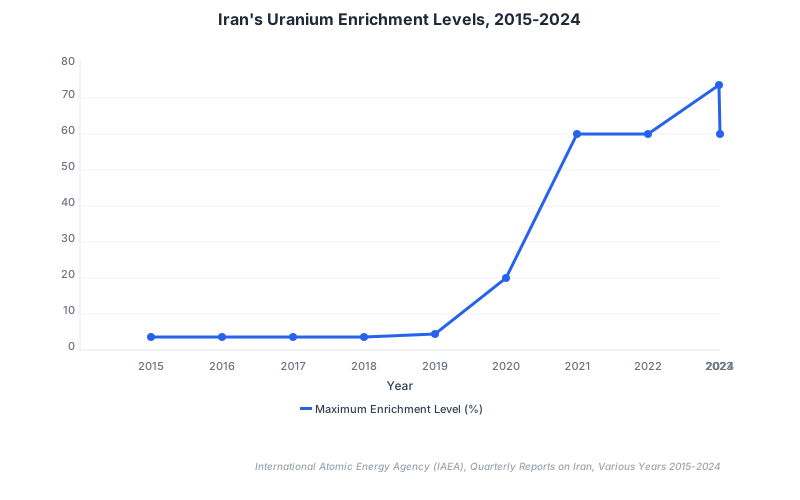
Paradoxically, pursuing negotiated settlements makes a major regional war more likely, not less. By treating Iran as a rational actor that can be bargained with, Western powers inadvertently validate the regime's strategy of brinksmanship and proxy warfare. This creates what game theorists call a "moral hazard"—Iran faces no meaningful consequences for escalatory behavior because the international community remains perpetually hopeful that the next round of talks will yield breakthrough. The result is a ratcheting effect. Iran tests boundaries, faces diplomatic protests, makes cosmetic concessions in negotiations, then tests new boundaries. Each cycle normalizes a higher baseline of Iranian aggression. What seemed unthinkable five years ago—Iranian drones striking Saudi oil facilities, proxy attacks on U.S. bases in Iraq, near-daily harassment of shipping in the Persian Gulf—is now accepted as manageable friction rather than acts of war. This dynamic is most dangerous regarding Iran's nuclear program. The regime has calculated that it can incrementally approach weapons capability while keeping violations just below the threshold that would trigger decisive military action. Current uranium enrichment levels at 60% purity—while Iran claims this is for medical isotope production—bring the country dangerously close to the 90% purity needed for weapons-grade material[3].Historical Precedent: When Deterrence Fails
History offers sobering lessons about the consequences of allowing revisionist powers to test boundaries without facing decisive pushback. The 1930s provide the most obvious parallel, but a more relevant case study might be Yugoslavia in the 1990s. International mediators spent years pursuing negotiated settlements while ethnic cleansing and territorial conquest proceeded apace. Each ceasefire agreement simply allowed the strongest party to consolidate gains and prepare for the next offensive. Iran's regional strategy follows a similar playbook. While maintaining the fiction of seeking negotiated solutions, Tehran systematically builds facts on the ground that make any eventual settlement favor Iranian interests. Hezbollah's transformation from militia to state-within-a-state in Lebanon, the Houthis' control over key Yemeni territory and shipping lanes, and Iran's entrenchment in Syria all occurred during periods when diplomats were optimistically pursuing "de-escalation." The current moment bears uncomfortable similarities to Europe in 1938. Western powers, exhausted by previous conflicts and hoping to avoid another war, convince themselves that accommodation will satisfy a fundamentally revisionist actor. The result is not peace, but a larger war fought on less favorable terms.The Strategic Case for Preemptive Action
A carefully calibrated military campaign targeting Iran's nuclear facilities, missile production capabilities, and key Revolutionary Guard installations would actually serve peace by breaking the cycle of escalation that current diplomacy perpetuates. Such action would need to be swift, overwhelming, and precisely targeted to minimize civilian casualties while maximizing strategic impact. The military feasibility presents significant challenges. While Israel successfully struck Iraq's single Osirak reactor in 1981 and Syria's alleged nuclear facility in 2007, Iran's nuclear program is far more dispersed, hardened, and technically advanced. Multiple facilities would need to be targeted simultaneously, presenting complex operational requirements[4]. Iran's conventional military, while large, relies heavily on outdated equipment that would struggle against modern air power and precision-guided munitions. More importantly, decisive military action would shatter the illusion that Iran can pursue regional hegemony without facing existential costs. However, external military pressure has historically strengthened authoritarian regimes—Iran's experience during the 1980-1988 war with Iraq actually consolidated the Islamic Republic's power. Whether military defeat would trigger internal upheaval or rally the population behind the government remains highly uncertain.Addressing the Strongest Objections
Critics will argue that military action would unite Iranians behind their government and trigger wider regional war. This objection, while superficially reasonable, misreads both Iranian domestic politics and regional dynamics. Recent protest movements in 2019 and 2022 revealed significant popular discontent, though measuring regime support remains difficult in an authoritarian system. Whether military humiliation would transform this into regime-threatening unrest or strengthen nationalist solidarity is genuinely uncertain. Regarding regional escalation, the current trajectory already guarantees wider conflict. Iran's proxy network grows stronger each month, while its nuclear program advances toward weaponization. The choice is not between war and peace, but between a limited campaign now and a catastrophic regional war later when Iran possesses nuclear weapons and an even more extensive proxy apparatus. The humanitarian argument—that military action would cause civilian casualties—must be weighed against the ongoing human cost of regional conflicts involving Iranian-backed forces. While precise casualty figures attributable specifically to Iranian proxies are difficult to determine in complex multi-party conflicts, these groups have been significant participants in devastating wars across Syria, Yemen, and Iraq. A swift military campaign that removes this source of regional instability could potentially save more lives than it costs.The Window Is Closing
The strategic window for effective military action is rapidly narrowing. Iran's nuclear program is approaching the point where weapons capability could be achieved within weeks rather than months. Its proxy network continues expanding, though claims of new footholds in Africa and Latin America require more documentation. Perhaps most critically, Iran's missile and drone capabilities are advancing to the point where they could inflict serious damage on regional allies and U.S. forces in any future conflict. Every month of continued diplomatic process allows Iran to strengthen its position while weakening the effectiveness of potential military action. The regime understands this dynamic perfectly, which is why it remains committed to negotiations that provide cover for continued escalation. The choice facing Western policymakers is stark: act decisively now to prevent Iranian hegemony, or face a much more dangerous adversary in the near future. The comfortable middle ground of endless negotiations is not actually a path to peace—it's a road to war fought on Iran's terms rather than ours. Current diplomatic efforts, however well-intentioned, are enabling the very conflict they claim to prevent. Only by abandoning the illusion that Iran can be negotiated into moderation can the international community take the decisive action necessary to preserve regional stability and prevent nuclear proliferation. The alternative is not peace, but a larger war that could reshape the global order in catastrophic ways.However, military strikes against Iran could paradoxically accelerate rather than prevent nuclear weaponization, as Tehran might withdraw from the NPT entirely and pursue weapons development in complete secrecy. Historical precedent suggests that external attacks often unite populations behind their governments—Iran's response to the 1980-1988 Iraqi invasion demonstrates how foreign aggression can strengthen regime legitimacy and resolve for decades.
An alternative reading of Iran's regional behavior suggests it may be responding defensively to perceived encirclement rather than pursuing ideological expansion, with proxy relationships often invited by local actors facing their own security dilemmas. This defensive interpretation would indicate that diplomatic engagement, rather than military pressure, might actually reduce Iranian incentives for regional interference by addressing underlying security concerns.
Key Arguments
- Peace negotiations with Iran provide tactical cover for the regime to advance its nuclear program and regional proxy network
- Each diplomatic cycle normalizes higher levels of Iranian aggression, making eventual major conflict more likely
- Historical precedents suggest that accommodation of revisionist powers leads to larger wars fought on less favorable terms
- A targeted military campaign could break the escalation cycle, though regime change outcomes remain uncertain
- The strategic window for effective action is rapidly closing as Iran's capabilities advance
- Current diplomacy is not preventing war but enabling a future conflict under worse conditions
References
- Takeyh, Ray. The Self-Defeating Islamic Republic. Brookings Institution Press, 2021.
- Katzman, Kenneth. "Iran Sanctions." Congressional Research Service, 2022.
- International Atomic Energy Agency. "Verification and monitoring in the Islamic Republic of Iran in light of United Nations Security Council resolution 2231." IAEA Board of Governors Report, 2023.
- Raas, Whitney and Austin Long. "Osirak Redux? Assessing Israeli Capabilities to Destroy Iranian Nuclear Facilities." International Security, Vol. 31, No. 4, 2007.