The Case Against Mourning Pilot Deaths: Why Aviation Tragedies Are Actually Success Stories

EDITORIAL — This is an opinion piece. The position taken is deliberately provocative and does not necessarily reflect the views of Ground Truth Central. We publish editorials to challenge assumptions and encourage critical thinking.
The Mythology of Perfect Safety
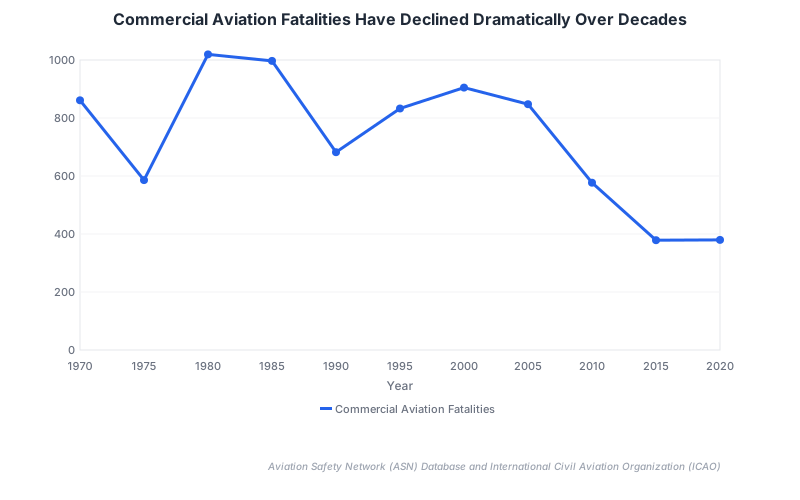
The public discourse around aviation accidents reveals a dangerous delusion: the belief that zero deaths is not only possible but should be the standard by which we judge aviation safety. This perfectionist fallacy ignores the mathematical reality of risk management across complex systems involving millions of operations annually. Consider the numbers that media coverage consistently buries beneath emotional narratives. In 2023, there were approximately 38.9 million commercial flights worldwide[1]. The International Air Transport Association reported zero fatal accidents among its member airlines operating passenger services[2]. Even including general aviation and cargo operations, aviation deaths remain so statistically insignificant that they're dwarfed by fatalities from driving to the airport. Yet when two pilots die in what appears to be a collision during helicopter operations, we treat it as a systemic failure rather than what it actually is: an outlier event in the most successful safety system ever created. The National Safety Council calculates that Americans have a 1 in 11,080 lifetime chance of dying in an airplane accident, compared to 1 in 101 for motor vehicle accidents[3]. We've created a form of transportation so safe that individual accidents become newsworthy precisely because of their rarity.The Economics of Acceptable Risk
Here's where the conversation becomes truly uncomfortable: every safety system operates on the principle of acceptable risk, and aviation's current risk profile represents an extraordinary achievement that actually justifies occasional fatalities. The alternative—pursuing absolute zero risk—would ground aviation entirely and cost far more lives through increased reliance on deadlier transportation modes. The Federal Aviation Administration's own cost-benefit analyses explicitly acknowledge this trade-off. When evaluating new safety regulations, the FAA uses a "value of statistical life" calculation, currently set at approximately $13.2 million[4]. This isn't bureaucratic coldness; it's rational policy-making that recognizes the economic and social costs of over-regulation. Consider what "perfect" aviation safety would actually require: grounding all flights during any weather conditions, eliminating night operations, requiring multiple redundant crews for every flight, and implementing maintenance schedules so conservative that aircraft utilization would plummet. The resulting reduction in air travel would force millions back onto highways, where they would face exponentially higher fatality rates. The two pilots who died at LaGuardia were operating in a system that has already eliminated 99.99% of the risk that existed in aviation's early decades. Their deaths, while personally tragic, represent the final decimal points of risk that cannot be eliminated without destroying the system itself.The Perverse Psychology of Safety Theater
Our emotional response to aviation accidents creates a perverse incentive structure that actually makes flying less safe and less accessible. Every high-profile incident triggers demands for new regulations, additional oversight, and expanded bureaucracy—responses that often address yesterday's problems while creating new inefficiencies and barriers to innovation. The aftermath of aviation accidents consistently follows the same pattern: congressional hearings, regulatory proposals, and media coverage that treats any fatality as evidence of systemic failure. This theater of concern produces regulations that make flying more expensive and less efficient while delivering marginal safety improvements that pale next to the risks we accept in every other aspect of life. Take the response to the 2009 Colgan Air crash in Buffalo, which killed 50 people. Congress passed legislation requiring airline pilots to obtain an Airline Transport Pilot certificate with 1,500 hours of flight time[5]. This rule has created a pilot shortage that forces regional airlines to cancel flights, pushing passengers onto highways where they face significantly higher fatality rates. The regulation likely causes more deaths than it prevents, but it allows politicians to claim they "did something" about aviation safety. The LaGuardia incident will undoubtedly trigger similar responses: calls for enhanced helicopter regulations, expanded air traffic control procedures, and additional oversight of airport operations. Each new rule will impose costs and constraints that make aviation marginally less accessible while addressing risks that are already vanishingly small.The Innovation Paradox
Perhaps most perniciously, our refusal to accept aviation's current risk profile actively impedes the innovations that could make flying even safer. The regulatory environment created by zero-tolerance attitudes toward accidents makes it extraordinarily difficult to test and implement new technologies that could reduce risks further. Autonomous flight systems, advanced weather detection, and artificial intelligence-assisted navigation all face regulatory hurdles that stem from our inability to accept that some risk is inherent in any complex system. The Federal Aviation Administration's certification process is so risk-averse that it often takes decades to approve technologies that are already proven in other industries. The result is a regulatory framework that preserves existing safety levels while preventing improvements. We're so focused on avoiding the next LaGuardia-style incident that we're blocking technologies that could prevent hundreds of similar accidents over the coming decades. Meanwhile, other transportation modes that kill thousands more people annually receive a fraction of the regulatory attention. The National Highway Traffic Safety Administration estimates that 38,824 people died in traffic crashes in 2020[6], yet we don't treat every highway fatality as a systemic failure requiring congressional investigation.The Moral Calculus of Progress
The hardest truth about aviation safety is that the current level of risk represents an optimal balance between safety, accessibility, and economic efficiency. The two pilots who died at LaGuardia were casualties of a system that saves thousands of lives annually by providing safe, efficient transportation that keeps people off deadlier roads. This isn't an argument for complacency or abandoning safety improvements. It's recognition that aviation has already achieved a level of safety that makes individual accidents statistically insignificant compared to the lives saved by the system's existence. Every day that commercial aviation operates normally, it prevents more deaths than occur in headline-grabbing accidents. The moral framework that treats every aviation death as a preventable tragedy while ignoring the lives saved by aviation's existence is not just intellectually dishonest—it's actively harmful. It creates political pressure for regulations that make flying more expensive and less accessible, forcing people into more dangerous alternatives. Consider the broader implications: if we applied aviation's safety standards to other activities, we would ban driving (too dangerous), eliminate most medical procedures (risk of complications), and shut down construction projects (workplace fatalities). We accept thousands of deaths annually in these activities because we understand that the benefits outweigh the risks.Reframing Success
The LaGuardia incident should be understood not as a failure of aviation safety but as evidence of its extraordinary success. In a system processing millions of flights annually, the fact that two pilot deaths generate national news coverage demonstrates just how rare such incidents have become. Every day that passes without aviation accidents is a victory that goes uncelebrated. Every million passengers who reach their destinations safely represent a triumph of engineering, regulation, and human skill that dwarfs the significance of individual tragedies. The system works so well that we've forgotten how remarkable its safety record actually is. The families of the pilots who died at LaGuardia deserve sympathy and support. But the broader public discourse should recognize their deaths as part of a statistical reality that makes aviation the safest form of travel in human history. Mourning these deaths as systemic failures while ignoring the millions of lives saved by aviation's existence represents a fundamental misunderstanding of how complex safety systems actually function. We don't need to eliminate the last fraction of aviation risk—we need to celebrate the extraordinary achievement of reducing it to current levels while maintaining the accessibility and efficiency that make air travel a net positive for human welfare. The two pilots who died were casualties of humanity's most successful transportation safety system, not evidence of its failure.Critics argue that dismissing individual aviation accidents as statistical noise ignores how safety culture actually works in the industry. Each incident investigation and regulatory response, even if seemingly disproportionate, may serve as a crucial reminder that maintains the vigilance and continuous improvement mindset that has made aviation so safe in the first place.
The economic argument about modal substitution—that expensive safety regulations force people to drive instead of fly—lacks empirical support and may oversimplify travel decisions. Many aviation routes have no practical driving alternatives, and research has yet to demonstrate that airline ticket prices or flight availability significantly influence whether travelers choose highways over airways for comparable journeys.
The Argument
- Aviation deaths like the LaGuardia incident represent statistical outliers in humanity's safest transportation system, not systemic failures
- Pursuing zero aviation risk would force people onto deadlier transportation modes, resulting in more deaths overall
- Emotional responses to rare aviation accidents create counterproductive regulations that reduce safety and accessibility
- The current risk profile of aviation represents an optimal balance between safety, efficiency, and economic accessibility
- Individual aviation tragedies should be understood within the context of millions of safe flights that prevent deaths by keeping people off highways
References
- International Civil Aviation Organization. Annual Report 2023. ICAO, 2024.
- International Air Transport Association. "2023 Safety Report." IATA Safety Report, 2024.
- National Safety Council. "What Are the Odds of Dying From..." Injury Facts, 2024.
- Federal Aviation Administration. "Economic Values for FAA Investment and Regulatory Decisions." FAA Office of Aviation Policy, 2023.
- Airline Safety and Federal Aviation Administration Extension Act of 2010. Public Law 111-216, 111th Congress.
- National Highway Traffic Safety Administration. "Traffic Safety Facts Annual Report." NHTSA, 2021.