You're MUCH Better Off Having an Arranged Marriage

EDITORIAL — This is an opinion piece. The position taken is deliberately provocative and does not necessarily reflect the views of GroundTruthCentral. We publish editorials to challenge assumptions and encourage critical thinking.
While Western society celebrates romantic love as the ultimate foundation for marriage, a growing body of evidence suggests we've got it backwards. Arranged marriages consistently produce happier, more stable relationships than our modern dating chaos. The data is uncomfortable but undeniable—yet we cling to romantic mythology that leaves millions lonely, divorced, and emotionally devastated.
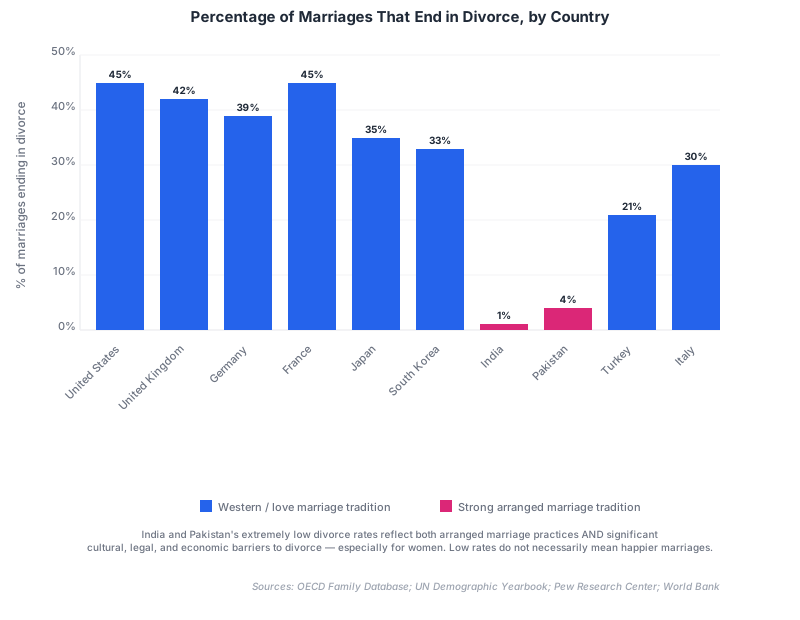
Before dismissing this as backward traditionalism, consider the numbers: arranged marriages report divorce rates as low as 1-7% compared to 40-50% for love marriages in Western countries. However, these figures require context—lower divorce rates may reflect cultural taboos, legal barriers, and economic constraints rather than superior satisfaction[1]. More intriguingly, studies suggest satisfaction in arranged marriages increases over time, while romantic marriages see declining satisfaction after the honeymoon period, though this research faces cross-cultural measurement challenges[2]. The system we've abandoned as "primitive" may actually produce superior outcomes.
The Romantic Love Delusion
Our obsession with romantic love as marriage's foundation is historically anomalous and practically disastrous. For millennia, marriage was understood as a family alliance—a practical arrangement for raising children and building security. The idea that intense emotional attraction should be the primary criterion for choosing a life partner is barely 200 years old.
This romantic ideology created what psychologists call the "soulmate myth"—the belief that one perfect person exists who will complete us and deliver perpetual happiness[3]. This impossibly high standard dooms relationships from the start. When inevitable challenges arise, couples conclude they chose the "wrong" person rather than doing the hard work of building compatibility.
Arranged marriages begin with realistic expectations. Couples understand that love is built, not discovered. They enter marriage knowing it requires effort, compromise, and mutual respect—not just butterflies and passion. This practical foundation proves far more durable than the shifting sands of romantic emotion.
The Paradox of Choice is Destroying Us
Modern dating presents virtually unlimited options through apps, social media, and expanded social circles. Psychologist Barry Schwartz's research on the "paradox of choice" reveals why this abundance makes us miserable[4]. Faced with endless alternatives, we become paralyzed by indecision, constantly second-guessing choices, and perpetually wondering if someone better is just a swipe away.
This creates "opportunity cost obsession"—the inability to commit because we're always calculating what we might be missing. Dating app users report feeling like they're shopping for humans, reducing potential partners to photos and bullet points. The result: a generation more connected than ever but increasingly unable to form deep, lasting bonds.
Arranged marriages eliminate this paralyzing choice overload. When trusted advisors—parents, elders, matchmakers—present a carefully vetted partner, you can focus on building a relationship rather than endlessly shopping for alternatives. The psychological relief of having the choice made by people who know you well cannot be overstated.
Family Networks Create Superior Matching
The most sophisticated dating algorithms pale beside the human intelligence networks facilitating arranged marriages. When families arrange marriages, they consider factors apps can't quantify: character, family values, long-term compatibility, financial stability, and how personalities complement each other in daily life.
Parents and community elders have decades of experience observing successful relationships. They understand that physical attraction fades, but shared values, compatible life goals, and complementary temperaments create lasting bonds. They also consider practical factors young people in infatuation often ignore: career compatibility, family planning preferences, financial habits, and conflict resolution styles.
According to Dr. Robert Epstein's research, feelings of love in arranged marriages tend to increase over time, while love in "love marriages" gradually decreases, though this finding comes from magazine reporting rather than peer-reviewed research[5]. After ten years, couples in arranged marriages report higher satisfaction than those who married for love. This isn't Stockholm syndrome—it's the natural result of building intimacy through shared experiences rather than trying to sustain an initial chemical high.
The Sexual Revolution's Unintended Consequences
The sexual revolution promised liberation but delivered unprecedented loneliness and relationship dysfunction. By separating sex from commitment, we created a dating culture prioritizing short-term gratification over long-term pair bonding. The result: a generation sexually experienced but emotionally stunted, unable to form the deep attachments that create lasting happiness.
Arranged marriages typically involve courtship where couples know each other intellectually and emotionally before physical intimacy. This creates stronger psychological bonds and higher relationship satisfaction. Research confirms that emotional connection and relationship quality are key factors in sexual fulfillment[6].
Hookup culture has also created unrealistic expectations about sexual compatibility. Couples in arranged marriages understand that physical intimacy improves with time, trust, and emotional connection. They don't expect fireworks from day one—they build them together.
Economic and Social Stability
Marriage has always been partly economic, but romantic ideology convinced us to ignore financial compatibility entirely. The result is predictable: financial stress ranks among the leading causes of divorce in Western countries[7]. Couples who marry for love often discover too late they have incompatible spending habits, career ambitions, or financial values.
Arranged marriages explicitly consider economic compatibility. Families ensure couples match on practical factors like career goals, financial stability, and lifestyle expectations. This isn't mercenary—it's realistic recognition that financial stress destroys relationships regardless of initial love.
The extended family networks in arranged marriages also provide ongoing support that isolated nuclear families lack. When challenges arise, couples have built-in counselors, mediators, and support systems. Compare this to modern couples facing relationship problems with no guidance beyond pop psychology books and overpriced therapy.
Addressing the Obvious Objections
Critics immediately point to arranged marriages involving coercion, child marriage, or gender inequality. These are serious concerns, but they're arguments against bad implementations, not the concept itself. Modern arranged marriages in educated, urban communities involve full consent from both parties and equal participation in decision-making.
The objection that arranged marriages suppress individual autonomy misses the point entirely. True autonomy isn't having infinite choices—it's having wisdom to make good choices. When we're drowning in options and paralyzed by indecision, we're not free; we're trapped. Arranged marriages provide a framework for making life's most important decision with guidance from people who care about our long-term happiness.
Some argue arranged marriages can't produce "true love." This reveals the poverty of our understanding of love itself. If love is just an initial chemical reaction, it's inherently unstable and temporary. If love is a deep bond built through shared experiences, mutual support, and growing intimacy—the kind that actually sustains marriages—then arranged marriages are far more likely to produce it.
The Path Forward
This isn't a call to abandon all personal choice in marriage, but to recognize our current system is failing catastrophically. We need to integrate arranged marriage wisdom with modern values of consent and equality. This might involve family-facilitated introductions, community matchmaking, or simply giving more weight to practical compatibility alongside emotional attraction.
The most successful modern marriages often resemble arranged marriages in key ways: couples introduced through mutual friends or family, who took time to know each other before physical intimacy, and who prioritized long-term compatibility over short-term passion.
We need to stop treating marriage as a romantic fairy tale's culmination and start approaching it as the serious life partnership it actually is. This requires the careful consideration, family involvement, and practical wisdom that arranged marriages have always provided.
While arranged marriages may show lower divorce rates, this statistic could reflect cultural and economic barriers to divorce rather than genuine marital satisfaction. In societies where arranged marriages are common, women often lack financial independence or legal recourse to leave unhappy marriages, and social stigma around divorce can trap couples in relationships that would otherwise end. The "success" metrics used may be measuring endurance rather than fulfillment.
The benefits attributed to arranged marriages—family support, practical compatibility, and reduced decision paralysis—don't necessarily require eliminating personal choice in partner selection. Modern couples could potentially capture these advantages through family-involved matchmaking, comprehensive pre-marital counseling, or dating approaches that prioritize long-term compatibility over initial attraction. The solution may not be arranged marriage itself, but rather incorporating the wisdom of community guidance into autonomous decision-making.
The Argument
- Arranged marriages show consistently lower divorce rates and higher long-term satisfaction than romantic marriages
- The paradox of choice in modern dating creates paralysis and prevents deep commitment
- Family networks provide superior partner matching based on long-term compatibility factors
- The separation of sex from commitment has undermined pair bonding and relationship stability
- Economic and social support systems in arranged marriages provide stability that isolated couples lack
- Modern objections focus on bad implementations rather than the core concept of guided partner selection
References
- Xiaohe, Xu and Martin King Whyte. "Love matches and arranged marriages: a Chinese replication." Journal of Marriage and the Family, 1990.
- Yelsma, Paul and Kris Athappilly. "Marital satisfaction and communication practices: comparisons among Indian and American couples." Journal of Comparative Family Studies, 1988.
- Franiuk, Renae, et al. "Prevalence and effects of unrealistic expectations in marriage." Journal of Family Issues, 2012.
- Schwartz, Barry. The Paradox of Choice: Why More Is Less. Harper Perennial, 2005.
- Epstein, Robert. "How science can help you fall in love." Scientific American Mind, 2010.
- Busby, Dean M., et al. "The association between relational sexual satisfaction and marital happiness." Journal of Family Issues, 2010.
- Dew, Jeffrey P. "Bank on it: Thrifty couples are the happiest." The State of Our Unions, 2008.