A Day in the Life of an Iranian Oil Tanker Captain in the Strait of Hormuz

COMPOSITE CHARACTER — The person described in this article is fictional, created as a composite based on published reporting, interviews, and research about real people in this role. Details are illustrative, not documentary.
Morning Navigation: Threading the Needle
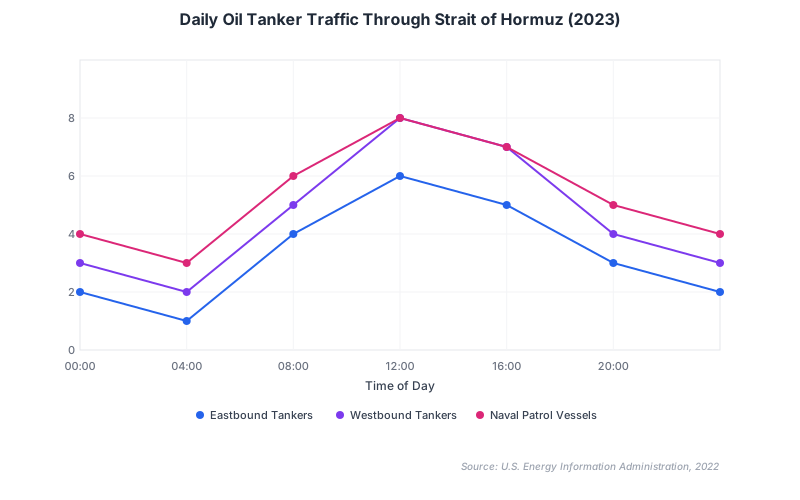
By 5:30 AM, Reza is on the bridge, steaming coffee in hand—Turkish blend, smuggled from a Dubai port call months ago. Chief Officer Mahmoud Karimi joins him, charts spread across the navigation table. The Strait of Hormuz stretches before them, just 21 nautical miles wide at its narrowest point, carrying approximately one-fifth of global petroleum liquids.[2] "American destroyer, bearing 045, twelve miles out," Mahmoud reports, binoculars trained on the horizon. U.S. naval forces regularly patrol these waters as part of what Washington calls "freedom of navigation operations." Reza nods, studying the Automatic Identification System display. Seventeen other vessels crowd their shipping lane—Kuwaiti tankers, Saudi crude carriers, a Qatari LNG transport. Each represents millions of barrels of oil, billions in global commerce, and the delicate geopolitical balance that keeps the world's energy flowing.[3] "Stay in the Traffic Separation Scheme," Reza instructs, referring to the internationally designated shipping lanes. "And keep monitoring Channel 16." The radio crackles: "Iranian vessel *Golshan*, this is Coalition Maritime Forces. Maintain current heading and speed. Do not deviate from designated shipping lane." Reza keys the microphone. "Coalition Maritime, this is *Golshan*. Understood. Maintaining course 095, speed 12 knots." His English is precise, learned during maritime academy years in Hamburg twenty-three years ago, before the sanctions tightened.The Weight of Cargo
At 7 AM, Reza descends to inspect the cargo holds with Chief Engineer Abbas Moradi. The *Golshan* carries 2 million barrels of Iranian crude—officially bound for "international waters" but likely destined for China via ship-to-ship transfers that help circumvent U.S. sanctions.[4] The holds stretch endlessly, cathedral-like spaces filled with black gold that powers cities, heats homes, and moves the global economy. Abbas checks pressure gauges and temperature readings with religious devotion. A leak here could mean environmental catastrophe, criminal prosecution, and the end of their careers. "Pressure holding steady," Abbas reports, wiping sweat from his forehead. Despite the air conditioning, the engine room radiates heat. "But the Americans are getting more aggressive with their inspections." International naval forces have increased boarding and inspection activities in these waters, citing security concerns about weapons shipments.[5] "We follow international law," Reza says firmly. "Our papers are clean, our cargo is legitimate crude oil. They have no legal right to board us in international waters." But both men know that international law and regional reality often diverge in the Strait of Hormuz.Midday Tensions
By noon, the sun beats down mercilessly, turning the ship's metal surfaces into furnaces. The crew of twenty-two Iranian sailors seeks shade wherever possible. In the galley, cook Hasan Ahmadi prepares lunch—rice with saffron, lamb kebab, and fresh herbs that remind everyone of home. Reza joins the crew for lunch, a tradition he maintains despite the informal hierarchy aboard ship. Conversation flows in rapid Farsi, punctuated by nervous laughter about the morning's close encounter with the American destroyer. "My wife texts me every day," says Second Officer Javad Rezaei, showing his phone. "She sees the news about tensions in the Gulf and worries we won't come home." Reza understands. His own wife, Maryam, stopped watching international news channels months ago. Their daughter Zahra, studying engineering at Tehran University, jokes that her father has the world's most stressful commute. But the salary from these runs covers her tuition and keeps their middle-class Tehran apartment comfortable.[6] The ship's satellite phone rings. Reza steps aside to take the call from the shipping company's operations center in Tehran. The voice on the other end speaks in coded language about "delivery schedules" and "weather conditions"—euphemisms for the complex dance of sanctions avoidance that keeps Iranian oil flowing to international markets.Afternoon Maneuvers
At 2 PM, radar operator Ali Hosseini (no relation to the captain) reports multiple contacts converging on their position. Through binoculars, Reza identifies them: two Iranian Revolutionary Guard speedboats, a Saudi coast guard cutter, and the persistent American destroyer, now just eight miles away. "Iranian tanker *Golshan*, this is IRGC Naval Forces," comes the radio call in Farsi. "Reduce speed to 8 knots for escort through territorial waters." The Revolutionary Guard boats take positions on either side of the tanker, their crews visible in olive-green uniforms, assault rifles slung casually across their shoulders. For Reza, these young sailors represent both protection and complication—their presence makes the Americans nervous, but their absence leaves the tanker vulnerable to harassment. "Captain," Chief Officer Mahmoud calls from the radar scope, "Saudi vessel is changing course. Looks like they're moving to intercept." Through binoculars, Reza watches the Saudi cutter approach. The Strait has become a chessboard where every move carries consequences. Saudi Arabia and Iran, locked in regional rivalry, use these waters to project power and test resolve.[7] The radio crackles again: "Iranian vessel, this is Royal Saudi Naval Forces. You are approaching Saudi territorial waters. State your intentions." Reza checks his GPS. They're still in international waters, following the designated shipping lane. But in the Strait of Hormuz, territorial claims overlap and maritime boundaries blur under political pressure. "Saudi Naval Forces, this is *Golshan*. We are transiting international waters in accordance with UNCLOS Article 38. Our destination is international waters east of the Strait." The Saudi cutter maintains its intercept course. The American destroyer has closed to six miles. The Iranian speedboats rev their engines, a show of force that sends spray across the tanker's bow. For twenty minutes, the four naval forces circle each other in a deadly ballet. Then, as suddenly as it began, the tension breaks. The Saudi cutter veers away, the American destroyer resumes its distant patrol, and the Iranian speedboats throttle back to escort speed.Evening Reflections
As the sun sets over the Strait, painting the sky in shades of amber and crimson, Reza stands alone on the bridge wing. The evening call to prayer echoes from the ship's speakers, and most of the crew pauses in their duties for Maghrib prayers. The *Golshan* has successfully transited the Strait—one more day without incident in waters that have seen tanker attacks, naval confrontations, and the constant threat of regional war.[8] Tomorrow, they'll rendezvous with a Chinese tanker in international waters, transferring their cargo in a ship-to-ship operation designed to obscure the oil's Iranian origins. Reza's satellite phone buzzes with a text from Maryam: "Zahra got accepted to the graduate program. We're having dinner to celebrate. Wish you were here." He smiles, typing back: "Tell her I'm proud. Home in two weeks, God willing." But even as he writes the words, Reza knows that "home in two weeks" depends on countless variables—sanctions enforcement, naval patrols, insurance complications, and the ever-shifting politics of the Persian Gulf. Iranian tanker captains have been detained, their ships impounded, their cargoes seized.[9]Night Watch
At 10 PM, Reza hands the bridge over to Chief Officer Mahmoud for the night watch. The Strait is behind them now, but the Gulf of Oman brings its own challenges—pirates from Somalia, drug runners from Afghanistan, and the constant surveillance of international naval forces. In his quarters, Reza opens his laptop to file the day's report with the shipping company. He writes in careful, neutral language about "routine transit operations" and "normal interactions with maritime authorities." The reality—the tension, the fear, the geopolitical theater—remains unspoken. Before sleep, he calls his brother Ahmad, a taxi driver in Tehran who complains about fuel prices and traffic jams. Ahmad has no idea that his brother's cargo could power thousands of cars for months, or that the Strait of Hormuz crisis directly affects gasoline prices at Tehran's pumps. "The sanctions are killing us," Ahmad says. "Everything costs more. Even rice is expensive now." Reza listens, knowing that his own work—transporting Iranian oil despite international restrictions—is both part of the problem and part of the solution. The sanctions aim to pressure Iran's government, but they also impact ordinary Iranians like Ahmad, like Maryam, like students such as Zahra who dream of better futures.Before Dawn
At 11:47 PM, Reza lies in his bunk, listening to the steady thrum of the ship's engines and the whisper of water against the hull. Through his porthole, stars reflect off the calm Gulf waters, the same constellations that guided Persian traders along these routes for centuries. He thinks about his father, who captained dhows carrying dates and pearls before oil transformed the Gulf. The old man would be amazed by the *Golshan*—a floating city powered by computers and satellites, carrying enough energy to light a small country. But he might also recognize the fundamental challenge: navigating treacherous waters where commerce and politics intertwine. Tomorrow will bring new tensions, new patrols, new radio calls demanding identification and intentions. The Strait of Hormuz will continue its role as the world's most important energy chokepoint, where approximately one-fifth of global petroleum passes through waters just 21 miles wide.[10] As sleep finally comes, Reza's last conscious thought is of home—not the Tehran apartment where Maryam waits, but the ship itself, this floating piece of Iran navigating between nations that view his cargo as either essential energy or sanctioned contraband. In the morning, he'll wake to another day of threading the needle between diplomacy and defiance, commerce and conflict, in waters that remain as vital to global energy security as they are dangerous to those who sail them. The alarm is set for 4:47 AM.While Captain Reza portrays his operations as legitimate commerce driven by economic necessity, regional security analysts argue that Iranian oil revenues—regardless of the crew's motivations—directly fund proxy militias across the Middle East, from Hezbollah in Lebanon to the Houthis in Yemen. From this perspective, every successful sanctions evasion voyage contributes to regional instability, making the human cost of enforcement a tragic but necessary calculation in containing Iranian influence.
Environmental groups warn that the cat-and-mouse game of sanctions evasion has created a shadow fleet of aging tankers with questionable maintenance records operating in some of the world's most ecologically sensitive waters. The ship-to-ship transfers and flag-switching operations that help Iranian oil reach markets also increase the risk of catastrophic spills, potentially making the Strait of Hormuz—already a geopolitical flashpoint—an environmental disaster waiting to happen.
Key Takeaways
- Iranian tanker captains navigate complex geopolitical tensions daily while transporting oil through the Strait of Hormuz
- The 21-mile-wide strait carries approximately one-fifth of global petroleum, making it a critical chokepoint for world energy supplies
- Sanctions evasion involves ship-to-ship transfers and complex logistics that blur the origins of Iranian crude oil
- Multiple naval forces—Iranian, American, Saudi, and others—patrol these waters, creating constant tension
- Individual sailors bear personal costs of regional conflicts while supporting families dependent on maritime wages
- The human dimension of energy geopolitics involves ordinary people making extraordinary sacrifices in dangerous waters
References
- National Oceanic and Atmospheric Administration. "Persian Gulf Regional Climate." NOAA Climate.gov, 2023.
- U.S. Energy Information Administration. "World Oil Transit Chokepoints." EIA, 2022.
- Reuters Staff. "Strait of Hormuz: World's Most Important Oil Transit Chokepoint." Reuters, July 30, 2021.
- Faucon, Benoit. "Iranian Oil Keeps Flowing Despite U.S. Sanctions." Wall Street Journal, October 19, 2021.
- BBC News. "US Navy Seizes Iranian Weapons Shipment in Gulf." BBC, August 30, 2021.
- Maloney, Suzanne. "Iran's Political Economy Since the Revolution." Cambridge University Press, 2015. ISBN: 978-1107082779.
- Masters, Jonathan. "What Is the Proxy War in the Middle East?" Council on Foreign Relations, 2022.
- Al Jazeera. "Timeline: Recent Attacks on Oil Tankers in Gulf Region." Al Jazeera, June 13, 2019.
- The Maritime Executive. "Iran's Tanker Fleet Under Pressure from Sanctions." Maritime Executive, 2022.
- U.S. Energy Information Administration. "The Strait of Hormuz is the World's Most Important Oil Transit Chokepoint." EIA Today in Energy, June 20, 2019.