
A Day in the Life of a Smallholder Rice Farmer in Bangladesh's Flood-Prone Delta

COMPOSITE CHARACTER — The person described in this article is fictional, created as a composite based on published reporting, interviews, and research about real people in this role. Details are illustrative, not documentary.
Before Dawn: Checking What the Night Brought
Rashid's bare feet find the cool earth floor as he rises, his joints protesting after yesterday's long hours bent over rice seedlings. At forty-two, his body already carries the accumulated aches of a lifetime spent working land that gives and takes in equal measure. He pulls on his lungi — the traditional checkered cloth wrapped around his waist — and steps outside into the thick air that smells of river silt, cooking fires, and the green intensity of growing rice. His first ritual is always the same: walking the narrow earthen bunds that separate his plots to check the water levels. Too much water and his seedlings will rot; too little and they'll wither in the heat that will soon arrive with the sun. This delicate balance has become increasingly difficult to maintain as weather patterns shift unpredictably across the delta[1]. "The water came up two inches overnight," he murmurs to himself, noting how the monsoon runoff from upstream has raised the level in his plots. This could be good — or it could be the beginning of another flood that will wash away months of work. He's lost three crops to flooding in the past five years, each loss pushing his family deeper into debt with the local grain trader who advances him seeds and fertilizer. The eastern sky begins to lighten as Rashid walks his boundaries, his weathered hands trailing through the water to feel for the young rice plants beneath. His 1.2 acres — divided into four small plots inherited from his father — represent both his family's lifeline and their greatest vulnerability. In a country where approximately 40% of the population still depends on agriculture for their livelihoods, smallholder farmers like Rashid feed the nation while living perpetually on the edge of disaster[2].Morning: The Rhythm of Cultivation
By 5:30 AM, the village is stirring to life. Smoke rises from cooking fires as women prepare the day's first meal, and the calls of roosters echo across the paddies. Rashid returns home to find Nasreen already heating leftover rice from last night's dinner, mixing it with water to create panta bhat — fermented rice that will sustain him through the morning's work. Their youngest daughter, eight-year-old Rashida, appears at his elbow with a glass of tea so sweet it makes his teeth ache. She's named after him, this bright-eyed girl who dreams of becoming a teacher, and every morning she insists on serving him tea before school. It's their private ritual, one that fills him with both pride and worry — pride in her intelligence and determination, worry about whether he'll be able to keep her in school if the crops fail again. "Baba, will you teach me to plant rice today?" she asks, using the affectionate term for father. "After school, little one," he replies, ruffling her hair. "But first you must learn your letters. Rice farming is hard work — education will give you choices." As Rashid eats his simple breakfast, he listens to the weather report crackling through his neighbor's battery-powered radio. The meteorologist mentions the possibility of heavy rains in the upper catchment areas — news that makes his stomach tighten. When the rivers swell upstream, the water inevitably finds its way to the delta, often arriving with little warning. By 6 AM, he's wading into his paddies with his youngest son, fifteen-year-old Karim, who dropped out of school last year to help support the family. The boy's presence is both a blessing and a source of guilt for Rashid — another pair of hands to share the work, but also a reminder of opportunities lost to economic necessity. They work in comfortable silence, transplanting seedlings from the nursery bed to the main field. The work requires a particular rhythm: bend, select three or four healthy seedlings, push them into the soft mud, move forward six inches, repeat. Rashid's hands move with practiced efficiency, but his mind wanders to calculations — input costs, expected yield, market prices, loan payments due after harvest.Midday: Heat and Hardship
As the sun climbs higher, the temperature soars toward 95 degrees Fahrenheit, and the humidity makes every breath feel thick and labored. Rashid and Karim take shelter under the single mango tree at the edge of their property, sharing water from a clay pot that Nasreen prepared with salt and sugar to replace what they've lost through sweat. This is when the day's hardest work begins. The mechanical water pump — purchased three years ago with a microcredit loan that still haunts his sleep — needs to run for four hours to ensure adequate water levels across all his plots. The fuel costs eat into his margins, but without the pump, he's entirely dependent on rainfall that has become increasingly erratic. "The Sharif family lost their entire aman crop last week," Karim mentions, referring to their neighbors whose fields lie closer to the river. "The water rose too fast — everything underwater in six hours." Rashid nods grimly. Climate change has made such disasters increasingly common across Bangladesh's delta region, where millions of people live in low-lying areas vulnerable to flooding[3]. Traditional flood patterns that farmers once could predict have given way to sudden deluges and unexpected droughts. The old wisdom passed down from his grandfather — when to plant, when to harvest, how to read the sky — no longer seems reliable. As they work through the afternoon heat, applying organic fertilizer made from cow dung and household compost, Rashid's mind drifts to his eldest son, twenty-year-old Alamgir, who left for Dhaka two years ago to find work in the garment factories. The boy sends home 3,000 taka (approximately $25) each month when he can — money that often makes the difference between eating rice with vegetables or rice alone.Afternoon: Community and Calculation
Around 3 PM, as the heat becomes nearly unbearable, Rashid joins several neighboring farmers under the large banyan tree at the center of their village cluster. These informal gatherings serve as the community's information network, where farmers share observations about crop conditions, discuss market prices, and debate new agricultural techniques promoted by government extension workers. Today's conversation centers on a disturbing trend: the increasing salinity of groundwater wells as sea levels rise and salt water intrudes further inland. Abdul Rahman, whose fields lie closest to the Bay of Bengal, reports that his tube well now produces water too salty for irrigation during the dry season. "My grandfather farmed this same land for fifty years and never worried about salt," Abdul says, shaking his head. "Now I must buy fresh water from the next village over." The men discuss adaptive strategies they've heard about — salt-tolerant rice varieties developed by the Bangladesh Rice Research Institute, floating gardens that can survive floods, and solar-powered pumps that don't require expensive diesel fuel. But innovation requires capital that most smallholder farmers lack, creating a cruel paradox where those most vulnerable to climate change are least able to adapt[4]. Rashid listens more than he speaks, mentally calculating whether he can afford to experiment with new varieties this season. The salt-tolerant rice produces lower yields but might survive better if salinity continues to increase. It's the kind of gamble that keeps him awake at night — the tension between playing it safe and adapting to a changing environment.Evening: Family and Future
As the sun begins its descent toward the western horizon, painting the sky in shades of orange and pink reflected in the flooded paddies, Rashid makes his way home. The evening air carries the sounds of village life: children playing, women calling to each other across courtyards, the rhythmic thud of rice being husked in wooden mortars. Nasreen has prepared dinner — rice with a curry of small fish caught in the paddies, flavored with turmeric and chili grown in their kitchen garden. It's a simple meal, but one that connects them to generations of delta dwellers who have sustained themselves from the bounty of water and fertile silt. As the family eats together on a woven mat spread across their earthen floor, conversation turns to plans and dreams. Rashida chatters about her lessons, proudly reciting English words she's learned. Karim mentions that a cousin in the next district has started raising ducks alongside rice — a practice that provides additional protein and income while helping control pests naturally. "Perhaps we should try ducks next season," Nasreen suggests. "If the floods come again, at least ducks can swim." Her practical wisdom draws a tired laugh from Rashid. His wife has always been the family's strategist, the one who finds ways to stretch their meager resources and spot opportunities others might miss. It was her idea to start the kitchen garden that now provides vegetables year-round, reducing their dependence on purchased food. After dinner, Rashid helps Rashida with her homework by lamplight, his rough farmer's hands carefully guiding her small fingers as she practices writing Bengali letters. These moments remind him why he endures the uncertainty and backbreaking labor — not just to survive, but to give his children possibilities he never had.Night: Contemplation and Concern
As the family settles for sleep around 9 PM, Rashid steps outside for his final check of the day. The paddies shimmer under a crescent moon, and the air pulses with the sounds of frogs and insects. This is his thinking time, when he processes the day's observations and worries about tomorrow's challenges. Tonight, his concerns center on the weather forecast. Heavy rains are predicted for the next three days, and while his rice needs water, too much too fast could spell disaster. He's seen entire villages evacuated when the rivers overflow their banks, families huddled in schools and government buildings while their crops disappear beneath muddy floodwaters. The irony isn't lost on him — he depends entirely on water for his livelihood, yet water is also his greatest threat. This paradox defines life in Bangladesh's delta, where the same rivers that deposit fertile silt and enable rice cultivation can turn destructive with little warning[5]. Standing in the darkness, Rashid reflects on the changes he's witnessed over his lifetime. The seasons seem shifted, with monsoons arriving late or early, dry periods lasting longer than expected, and storms growing more intense. His father could predict weather patterns by observing clouds and wind; Rashid increasingly feels like he's farming in an alien landscape where old knowledge no longer applies. Yet he also thinks about resilience — his own and his community's. They've survived floods, droughts, and economic shocks before. They've adapted by diversifying crops, sharing resources, and supporting each other through difficult times. The same social networks that gather under the banyan tree each afternoon also mobilize during crises, with neighbors helping neighbors replant after floods or sharing seed when someone's crop fails entirely.Before Sleep: Dreams and Determination
As Rashid finally lies down beside his sleeping wife, his body aching from the day's labor, his mind continues to work. He calculates and recalculates: if the weather holds and his crop survives until harvest, he might earn enough to pay off his fertilizer loan and set aside money for Rashida's school fees. If disaster strikes again, he'll need to borrow more, deepening the cycle of debt that traps so many smallholder farmers. But alongside the worry, there's also determination. Tomorrow he'll rise again before dawn, check his water levels, tend his seedlings, and continue the ancient dance between human effort and natural forces that has sustained his family for generations. He'll adapt where he can, endure what he must, and find small moments of joy in his daughter's laughter and his son's growing competence in the fields. The sounds of the delta settle into their nighttime rhythm — the distant splash of fish jumping, the rustle of wind through bamboo, the gentle lapping of water against the earthen bunds. These are the sounds of home, of a landscape that demands everything but also provides life itself. As sleep finally claims him, Rashid's last conscious thought is about the seedlings he transplanted today. In six months, if fortune smiles, they'll be golden stalks heavy with grain, ready for harvest. It's an act of faith repeated by millions of smallholder farmers across South Asia — the belief that despite uncertainty, despite climate change, despite economic pressures, the land will provide if tended with skill and devotion. In a few hours, he'll wake again to check his fields, beginning another day in the endless cycle of cultivation that feeds nations while testing the limits of human endurance. For now, though, he rests, dreaming perhaps of abundant harvests and his daughter's bright future, while the delta breathes around him in the darkness.While Rashid's story highlights climate vulnerabilities, it may obscure a more complex reality where many smallholder farmers are successfully adapting through innovative techniques and community networks. Agricultural extension data suggests that farmers who have adopted salt-tolerant rice varieties and integrated aquaculture systems are maintaining stable yields despite increased flooding, challenging the narrative of inevitable decline.
The focus on climate change as the primary driver of farmer distress could overshadow equally significant factors like market access, land tenure insecurity, and inadequate rural infrastructure. Some economists argue that improving rural roads, storage facilities, and direct market linkages might have more immediate impact on farmer livelihoods than climate adaptation measures alone.
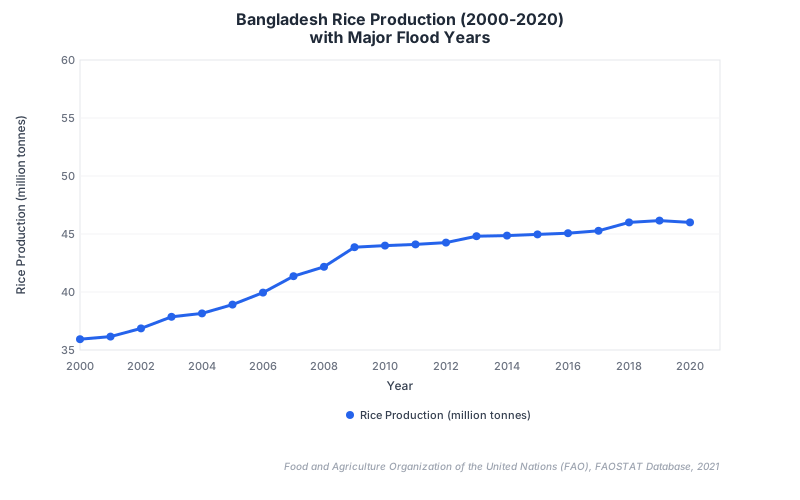
Key Takeaways
- Smallholder rice farmers in Bangladesh face increasing uncertainty due to climate change, with traditional weather patterns becoming unreliable
- Daily life revolves around water management — too much or too little can destroy entire crops and livelihoods
- Economic vulnerability forces difficult choices, such as children leaving school to work in fields or factories
- Community networks provide crucial support systems for sharing information, resources, and mutual aid during crises
- Adaptation strategies exist but require capital that many farmers lack, creating barriers to climate resilience
- Despite enormous challenges, farmers maintain hope and determination, viewing their work as both survival and service to their families and communities
References
- Islam, Nazrul, et al. "Flooding and Wetland Systems in Bangladesh." Environmental Management, 2010.
- World Bank. "Bangladesh Development Update: Moving Forward with Resilience." World Bank Group, 2023.
- Huq, Saleemul, et al. "Climate Change and Bangladesh: Mapping Vulnerabilities and Building Capacities to Address Loss and Damage." International Centre for Climate Change and Development, 2015.
- Rahman, Atiq, et al. "Climate Change Adaptation and Disaster Risk Reduction in Bangladesh." Action on Climate Today, 2012.
- Mirza, M. Monirul Qader. "Climate Change and Extreme Weather Events in Bangladesh." Natural Hazards, 2003.