Why does white-collar crime steal more money than all street crime combined but get a fraction of the punishment?

The numbers reveal a stunning paradox: while a convenience store robbery might net a few hundred dollars and result in years behind bars, corporate executives who steal millions often receive lighter sentences than street-level drug dealers. This disparity represents one of the most glaring inequities in American criminal justice, where the scale of financial harm seems inversely related to punishment severity. Understanding why white-collar crime extracts vastly more wealth from society while receiving comparatively lenient treatment requires examining the complex web of law, economics, politics, and social perception that shapes how we punish different types of criminal behavior.
The Scale of Financial Impact
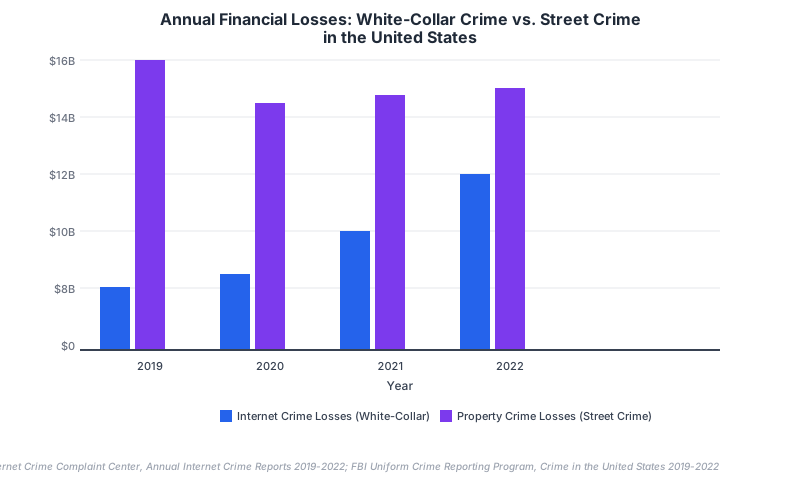
The financial gap between white-collar and street crime is staggering. According to FBI estimates, property crimes—including burglary, larceny-theft, and motor vehicle theft—cost Americans approximately $15.3 billion annually[1]. White-collar crimes, by contrast, extract hundreds of billions of dollars from the economy each year. The Association of Certified Fraud Examiners estimates that organizations lose about 5% of their revenues to fraud annually, representing hundreds of billions in losses globally[2].
Individual cases illustrate this disparity dramatically. Bernie Madoff's Ponzi scheme alone caused losses estimated at $65 billion[3]. The 2008 financial crisis cost the U.S. economy an estimated $22 trillion in lost wealth, though this includes both criminal fraud and legal but reckless financial practices[4]. Meanwhile, bank robberies typically net far smaller amounts, according to FBI statistics[5].
Corporate fraud cases routinely involve sums that dwarf entire categories of street crime. The Enron scandal cost investors and employees over $74 billion, while Wells Fargo's fake accounts scandal affected millions of customers and resulted in $3 billion in fines[6]. These aren't abstract numbers—they represent devastated pension funds, wiped-out retirement savings, and shattered financial security for ordinary Americans.
Sentencing Disparities in Practice
Despite white-collar crime's massive financial impact, sentencing patterns reveal stark punishment disparities. Research consistently shows that white-collar offenders receive lighter sentences relative to the harm they cause. A 1992 study of Medicaid provider fraud found that white-collar offenders were significantly less likely to receive prison sentences, and when they did, sentences were substantially shorter than for comparable street crimes[7].
The contrast is jarring in practice. Someone convicted of robbing a bank of $5,000 might receive 5-10 years in prison, while a corporate executive who embezzles $5 million might get 2-3 years. Federal Sentencing Guidelines do account for loss amounts in white-collar cases, but critics argue the increases are insufficient given the scale of harm.
Federal sentencing data confirms significant disparities, with fraud offenses generally receiving shorter sentences than robbery offenses[8]. This gap persists even when controlling for factors like criminal history and specific offense circumstances.
Historical Development of White-Collar Crime Law
White-collar crime is a relatively recent legal concept. Sociologist Edwin Sutherland first coined the term in 1939, defining it as "crime committed by a person of respectability and high social status in the course of his occupation"[9]. Before this, many behaviors we now classify as white-collar crimes were treated as civil matters, not criminal ones.
The legal framework for prosecuting white-collar crime developed gradually throughout the 20th century. Major legislation like the Securities Exchange Act of 1934 and the Foreign Corrupt Practices Act of 1977 created new criminal categories, but enforcement remained inconsistent. The Sarbanes-Oxley Act of 2002, passed after Enron and WorldCom, significantly strengthened penalties for certain corporate fraud[10].
However, this evolution occurred alongside increasingly harsh penalties for street crimes during the "tough on crime" era of the 1980s and 1990s. Mandatory minimum sentencing, three-strikes laws, and the war on drugs created a system imposing severe penalties for relatively minor offenses while white-collar crime penalties remained comparatively modest.
Enforcement Challenges and Resource Allocation
Resource allocation contributes significantly to the punishment disparity. Street crimes are typically investigated by local police with substantial manpower and established procedures. White-collar crimes require specialized expertise and extensive resources that many jurisdictions lack.
The FBI's white-collar crime program, while sophisticated, operates with limited resources compared to the scope of potential violations. Complex financial fraud cases can take years to investigate and require teams of forensic accountants, computer specialists, and attorneys. A single major corporate fraud case might consume resources equivalent to investigating hundreds of street crimes.
Regulatory agencies like the SEC and CFTC handle many white-collar cases through civil enforcement rather than criminal prosecution. This approach allows faster resolution and monetary penalties but doesn't result in prison sentences. The choice between civil and criminal enforcement often depends on resource constraints and evidence strength rather than harm severity.
Social Perceptions and Cultural Factors
Public perception crucially shapes criminal justice priorities and sentencing practices. Street crimes, particularly violent ones, generate immediate fear and outrage that translates into political pressure for harsh penalties. White-collar crimes, despite their greater economic impact, often seem abstract and remote to the public.
Social psychology research suggests people view white-collar offenders more sympathetically than street criminals. White-collar defendants are often seen as having "fallen from grace" rather than being inherently criminal. Their higher social status, education, and community ties work in their favor during sentencing, as judges may view them as less likely to reoffend and more capable of rehabilitation.
White-collar crime complexity also affects public perception. A bank robbery is easily understood and clearly wrong, while securities fraud or tax evasion may seem like technical violations requiring expertise to comprehend. This complexity can reduce moral outrage and, consequently, lead to more lenient treatment.
Political and Economic Influences
The political economy of criminal justice helps explain white-collar crime's comparatively lenient treatment. Wealthy individuals and corporations wield significant political influence through campaign contributions, lobbying, and revolving-door relationships with government officials. This influence affects both law creation and enforcement.
"Regulatory capture" suggests industries often influence the very agencies meant to oversee them. Former regulators frequently move to high-paying industry jobs, creating incentives for lenient enforcement. Similarly, prosecutors handling white-collar cases often move to lucrative positions defending corporate clients, potentially affecting their enforcement approach while in government.
Economic considerations also matter. Harsh penalties for corporate executives might harm business confidence and economic growth, according to some policymakers. This economic argument is rarely made for street crimes, where focus remains on punishment and deterrence rather than broader economic effects.
The Deterrence Question
Criminal punishment's key justification is deterrence—discouraging potential offenders through severe consequences. However, deterrent effects may work differently for white-collar and street criminals due to their different circumstances and decision-making processes.
White-collar offenders typically have more to lose from prosecution, including professional licenses, reputation, and social standing. Some researchers argue that even modest prison sentences can effectively deter this population because social and professional consequences are severe regardless of sentence length.
Many street criminals face limited legitimate economic opportunities and may view imprisonment risk as an acceptable cost of doing business. This suggests longer sentences may be necessary for deterrent effects in street crimes, though empirical deterrence research remains mixed for both crime types.
Systemic Reform Challenges
Addressing white-collar and street crime punishment disparities faces several structural obstacles. The American criminal justice system's decentralized nature means reform must occur at federal, state, and local levels. Different jurisdictions have varying capacities and priorities, making coordinated reform difficult.
Legal reforms face resistance from powerful interests benefiting from the current system. Defense attorneys specializing in white-collar cases, the corporations employing them, and their political networks all have incentives to maintain the status quo. Meanwhile, white-collar crime victims are often diffuse and unorganized compared to victims' rights groups advocating harsh penalties for violent crime.
Technical challenges also complicate reform efforts. White-collar crimes often involve complex financial instruments and international transactions making prosecution difficult. Increasing penalties without addressing underlying enforcement challenges may have limited effectiveness.
The punishment disparity might reflect rational criminal justice resource allocation rather than systemic bias. White-collar offenders often face devastating collateral consequences—career destruction, professional license revocation, and massive civil liability—that effectively serve as additional punishment beyond formal sentencing. Meanwhile, street crimes requiring immediate intervention for public safety may justify different enforcement priorities, even if raw financial damages appear smaller.
Critics argue that comparing total financial losses between white-collar and street crime categories creates misleading equivalency that ignores fundamental harm differences. A $10,000 armed robbery traumatizing victims and threatening community safety may warrant harsher punishment than $100,000 accounting fraud diffusing losses across thousands of shareholders, each experiencing minimal individual impact. This perspective suggests monetary damage alone shouldn't determine punishment severity—physical danger, psychological trauma, and immediate public safety threats may justify current sentencing disparities.
Key Takeaways
- White-collar crime causes hundreds of billions in annual losses compared to roughly $15 billion from all property crimes combined, yet receives significantly lighter punishment
- Federal sentencing data shows fraud offenses generally receive shorter sentences than robbery offenses, despite often involving much larger sums
- Historical legal development treated many white-collar offenses as civil matters while street crimes faced increasingly harsh penalties
- Resource constraints and complexity make white-collar crimes more difficult and expensive to investigate and prosecute
- Social perceptions favor white-collar defendants, who are often viewed more sympathetically than street criminals
- Political and economic influence allows wealthy defendants and corporations to shape both laws and enforcement practices
- Reform faces structural challenges including decentralized jurisdiction, powerful opposing interests, and technical complexity of financial crimes
References
- Federal Bureau of Investigation. "Crime in the United States, 2019." FBI Uniform Crime Reporting Program, 2020.
- Association of Certified Fraud Examiners. "Report to the Nations: 2020 Global Study on Occupational Fraud and Abuse." ACFE, 2020.
- Henriques, Diana B. The Wizard of Lies: Bernie Madoff and the Death of Trust. Times Books, 2011.
- Luttrell, David, Tyler Atkinson, and Harvey Rosenblum. "Assessing the Costs and Consequences of the 2007–09 Financial Crisis and Its Aftermath." Economic Letter, Federal Reserve Bank of Dallas, 2013.
- Federal Bureau of Investigation. "Bank Crime Statistics." FBI Financial Crimes Report, 2019.
- McLean, Bethany, and Peter Elkind. The Smartest Guys in the Room: The Amazing Rise and Scandalous Fall of Enron. Portfolio, 2003.
- Tillman, Robert, and Henry Pontell. "Is Justice 'Collar-Blind'?: Punishing Medicaid Provider Fraud." American Sociological Review, vol. 57, no. 6, 1992.
- United States Sentencing Commission. "2019 Annual Report and Sourcebook of Federal Sentencing Statistics." USSC, 2019.
- Sutherland, Edwin H. "White-Collar Criminality." American Sociological Review, vol. 5, no. 1, 1940.
- Sarbanes-Oxley Act of 2002. Public Law 107-204, 116 Stat. 745.