Why does oil from one region still control global energy prices in 2024?

In an era of renewable energy expansion and electric vehicles, a striking paradox persists: oil from a handful of regions still dictates energy prices for billions worldwide. Despite decades of diversification efforts, geopolitical tensions in key producing areas can send shockwaves through global markets, affecting everything from gasoline prices in suburban America to heating costs in European homes.
Recent tensions involving Iran have demonstrated this vulnerability once again, with oil prices experiencing sharp volatility as markets react to potential supply disruptions. This raises fundamental questions about energy security and why geography continues to dominate global economics in the 21st century.
The Concentration of Global Oil Reserves
The answer begins with geology. Approximately 48% of the world's proven oil reserves are concentrated in the Middle East, with Saudi Arabia alone holding about 22% of global reserves[1]. This concentration creates what economists call "geographic monopoly power," where a small number of producers can significantly influence global supply and pricing.
The Persian Gulf region sits atop some of the world's largest and most accessible oil fields. These reserves are not only vast but also cheap to extract, with production costs often below $10 per barrel compared to $40-60 per barrel for shale oil or tar sands. This cost advantage means Gulf producers can maintain profitability even during price downturns that force higher-cost producers to shut down.
Iran controls approximately 11% of global oil reserves and supplies major economies, particularly in Asia[2]. When tensions threaten Iranian exports, markets must account for the potential loss of roughly 2-3 million barrels per day—about 3% of global daily consumption.
The Mechanics of Oil Price Formation
Oil prices are determined in global commodity markets where even small supply changes trigger significant price movements. This sensitivity exists because oil demand is relatively inelastic in the short term—consumers and businesses cannot quickly reduce consumption in response to price increases, and alternative energy sources cannot immediately compensate for supply shortfalls.
The benchmark pricing system amplifies regional influence. Brent crude and West Texas Intermediate serve as global price benchmarks, but their prices are heavily influenced by supply conditions in major producing regions. When geopolitical tensions threaten Middle Eastern supplies, traders bid up futures contracts, affecting oil prices worldwide regardless of whether actual disruption occurs.
Market psychology plays a crucial role. The mere threat of supply disruption can trigger a "fear premium"—price increases based on perceived risk rather than actual shortages. During the September 2019 attacks on Saudi Aramco facilities, oil prices spiked 15% in initial trading despite Saudi assurances of quick restoration[3].
Strategic Petroleum Reserves and Market Intervention
Governments have attempted to mitigate this vulnerability through Strategic Petroleum Reserves, with the United States maintaining the world's largest emergency stockpile at approximately 350-400 million barrels. However, these reserves represent only about 40 days of U.S. consumption and are designed for short-term disruptions rather than sustained price management.
The effectiveness of strategic reserves in stabilizing prices has proven limited. During major supply crises, the psychological impact of potential shortages often outweighs the reassurance provided by emergency stockpiles. Additionally, reserve release decisions are often politically charged and may be delayed until prices have already risen substantially.
International coordination has improved since the 1970s oil crises, with the International Energy Agency coordinating member responses. However, growing oil consumption in non-IEA countries, particularly China and India, has reduced the relative impact of coordinated Western responses.
The Limits of Energy Diversification
Despite significant investments in renewables, oil remains irreplaceable for many critical applications, particularly transportation and petrochemicals. While renewable energy accounts for approximately 30% of global electricity production, it cannot directly substitute for oil in most primary uses[4].
The transportation sector, consuming about 60% of global oil production, has proven particularly resistant to rapid substitution. Although electric vehicle adoption is accelerating, EVs represented approximately 14% of global new car sales in 2023. The existing fleet of internal combustion vehicles will require decades to replace. Commercial aviation, shipping, and heavy trucking remain almost entirely dependent on petroleum-based fuels.
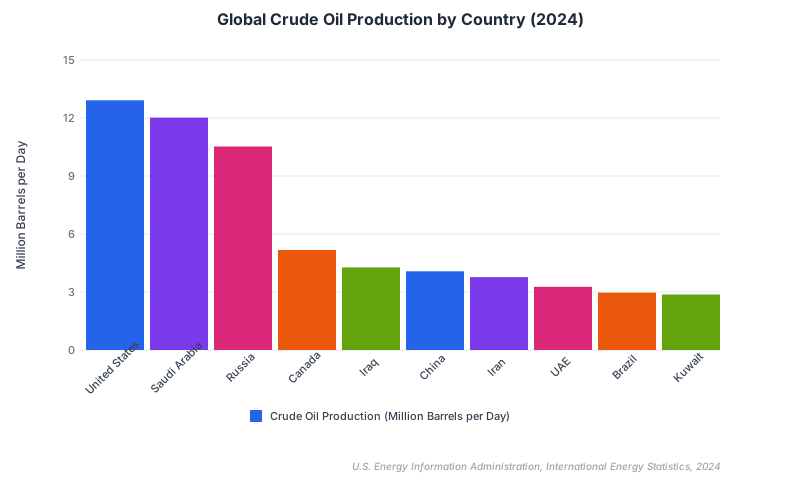
U.S. shale oil production has provided some diversification, making America the world's largest oil producer since 2018. However, shale production is more expensive and environmentally controversial than conventional oil. Its rapid decline rates require sustained high investment to maintain production, and during price downturns, shale can quickly become uneconomical.
Geopolitical Leverage and Energy Weaponization
Oil-producing nations have learned to use energy supplies as geopolitical leverage—a phenomenon known as "energy weaponization." This strategy is particularly effective because oil markets are global and interconnected, so disrupting supplies in one region affects prices worldwide, giving producers influence over countries that may not even import their oil directly.
Iran's position is particularly significant due to its control of the Strait of Hormuz, through which approximately 20% of global oil supplies transit daily[5]. Threats to close this waterway can trigger immediate price increases as markets price in supply disruption risk. This geographic chokepoint gives Iran influence over global oil prices that extends far beyond its own production capacity.
The effectiveness of energy weaponization has been demonstrated repeatedly, from the 1973 Arab oil embargo to Russia's use of natural gas to pressure European nations. These precedents reinforce market sensitivity to geopolitical tensions, creating a feedback loop where the possibility of supply disruption becomes a source of actual price volatility.
Financial Markets and Speculation
The financialization of oil markets has amplified the price impact of geopolitical tensions. Oil futures and derivatives markets, while providing important hedging functions, also attract speculative investment that can exaggerate price movements. During geopolitical tension, financial speculators may amplify price increases by betting on further supply disruptions.
Exchange-traded funds have made oil markets accessible to broader investors, including those with no direct involvement in oil production or consumption. This increased participation can lead to price movements reflecting financial market sentiment rather than fundamental supply and demand. During the 2008 financial crisis, oil prices reached nearly $150 per barrel, driven partly by speculative investment, before collapsing as recession reduced demand.
Climate Policy and Transition Challenges
Paradoxically, climate policies aimed at reducing oil dependence may actually increase the influence of remaining oil-producing regions in the short to medium term. As Western nations and companies reduce investment in oil exploration, global spare capacity—the ability to quickly increase production during supply disruptions—has declined.
This "green transition paradox" means that while long-term oil demand may decline, short-term supply disruptions may have even more dramatic price effects as the spare capacity buffer shrinks. Environmental, social, and governance investment criteria have led many Western oil companies to reduce capital expenditure on new production, potentially making global supplies more dependent on state-controlled producers in regions like the Middle East.
The timeline mismatch between climate goals and energy transition realities creates ongoing vulnerability. While many countries have committed to net-zero emissions by 2050, the International Energy Agency projects oil demand will not peak until the late 2020s, leaving more than two decades during which geopolitical tensions in oil-producing regions will continue affecting global energy prices.
However, some energy economists argue that apparent Middle Eastern price control may actually reflect market efficiency rather than manipulation. The rapid price responses to regional tensions could indicate that global markets have become increasingly sophisticated at pricing geopolitical risk, with financial instruments and algorithmic trading creating more accurate—albeit volatile—price discovery mechanisms than the relatively stable but potentially mispriced oil markets of previous decades.
An alternative interpretation suggests that technological disruption is already undermining traditional regional influence in ways that aren't immediately visible in headline prices. The shale revolution's ability to rapidly increase production in response to price signals, combined with growing strategic petroleum reserves in consuming nations and emerging bilateral trading arrangements that bypass traditional benchmarks, may be creating a more distributed and resilient energy system than current price volatility suggests.
Key Takeaways
- Geographic concentration of oil reserves in the Middle East creates structural market power that persists despite diversification efforts
- Oil price formation mechanisms amplify the impact of supply threats through inelastic demand and speculative trading
- Strategic petroleum reserves provide limited protection against sustained price volatility
- Energy transition timelines mean oil dependence will persist for decades, maintaining regional influence over global prices
- Geopolitical leverage through energy supplies remains an effective tool for oil-producing nations
- Climate policies may paradoxically increase short-term dependence on traditional oil producers as Western investment in production declines
References
- U.S. Energy Information Administration. "International Energy Statistics." EIA.gov, 2024.
- BP Statistical Review of World Energy. BP plc, 2024.
- Blas, Javier and Grant Smith. "Oil Jumps Most Since Gulf War After Attack Halves Saudi Output." Bloomberg, September 16, 2019.
- International Renewable Energy Agency. "Global Energy Transformation: A Roadmap to 2050." IRENA, 2023.
- U.S. Energy Information Administration. "The Strait of Hormuz is the world's most important oil transit chokepoint." EIA.gov, 2019.