
Why does every Middle East conflict seem to pull in the whole world?

When tensions flare in the Middle East, the world holds its breath. From the Suez Crisis of 1956 to today's Iran nuclear standoff, regional conflicts routinely explode into global crises that reshape international alliances, crash oil markets, and draw in superpowers. Unlike disputes in other regions that often remain contained, Middle Eastern conflicts seem to possess an almost magnetic ability to pull in the entire world.
The answer lies in a perfect storm of factors that make the Middle East uniquely positioned to influence global affairs. Geographic chokepoints, vast energy reserves, nuclear proliferation risks, religious significance, and historical great power rivalries create multiple pressure points that activate simultaneously—making containment nearly impossible.
Geographic and Strategic Importance
The Middle East sits at the crossroads of three continents, controlling maritime chokepoints that are arteries of the global economy. The Strait of Hormuz handles 20% of daily global petroleum flows, while the Suez Canal carries 12% of world trade[1][2]. Any threat to these waterways sends shockwaves through international markets.
The 2019 attacks on Saudi Aramco facilities demonstrated this vulnerability perfectly—cutting global oil production by 5% and triggering worldwide price spikes that affected everything from gas stations to manufacturing costs[3]. When critical infrastructure in the Middle East comes under threat, the global economy immediately feels the impact.
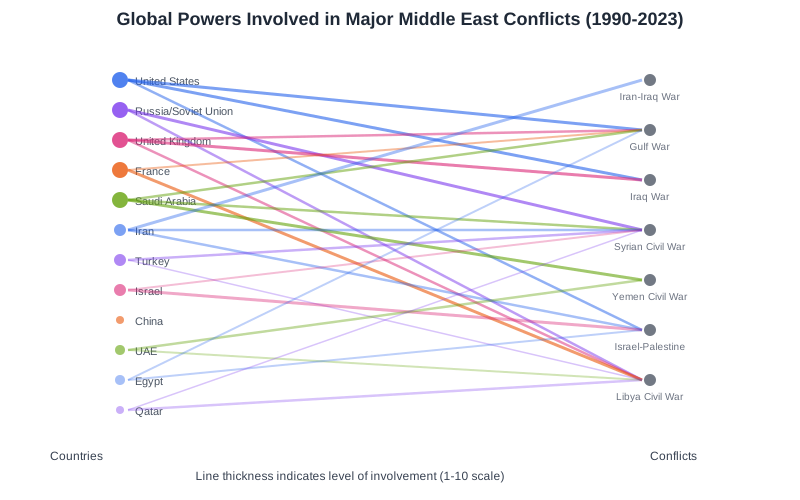
This strategic position also makes the region a natural arena for great power competition. Russia, China, and the United States all view Middle Eastern influence as essential to their broader objectives, turning local conflicts into proxy battles between global rivals.
Energy Security and Economic Vulnerability
No factor internationalizes Middle Eastern conflicts more than energy dependency. The region holds 48% of proven oil reserves and 40% of natural gas reserves[4]. Major economies have built their systems around reliable Middle Eastern energy—Japan imports 85% of its oil from the region, while Europe depends heavily on Middle Eastern gas supplies[5].
This creates a fundamental vulnerability. Even countries with domestic energy production remain sensitive to Middle Eastern disruptions due to integrated global markets. The Iran-Iraq War's "Tanker War" drew in multiple navies to protect shipping lanes, while Iran's repeated threats to close the Strait of Hormuz continue to prompt military buildups by Western powers.
The economic web extends beyond energy. Middle Eastern sovereign wealth funds have become major players in global finance, meaning regional instability can trigger capital flight and investment uncertainty worldwide.
Nuclear Proliferation Concerns
Nuclear weapons concerns add existential urgency to Middle Eastern conflicts. Iran's nuclear program has dominated international diplomacy for two decades, spawning sanctions, negotiations, and military threats[6]. The 2015 nuclear deal and its 2018 collapse by the United States show how nuclear issues can reshape global alliances overnight.
Israel's estimated 80-200 nuclear warheads add another layer of complexity[7]. The possibility of nuclear weapons use—by states or terrorists—represents a threat that transcends all borders. This drives extensive international involvement, from intelligence sharing to military cooperation aimed at preventing proliferation.
The specter of a regional arms race amplifies these concerns. Saudi Arabia has pledged to develop nuclear weapons if Iran does, while Turkey and Egypt have made similar statements[8]. Such proliferation would fundamentally alter global security dynamics.
Religious and Ideological Dimensions
As the birthplace of Judaism, Christianity, and Islam, the Middle East holds profound significance for billions worldwide. Conflicts involving Jerusalem, Mecca, or other holy sites become matters of global religious concern[9].
Transnational movements have further internationalized regional conflicts. ISIS and Al-Qaeda explicitly sought global reach, conducting attacks across continents and inspiring followers worldwide. This necessitated the 80-country coalition against ISIS—demonstrating how regional ideological conflicts demand international military response[10].
The Saudi-Iran rivalry exemplifies how sectarian divisions create proxy conflicts that draw in co-religionists globally, adding emotional intensity that makes political resolution more difficult.
Historical Legacy of Great Power Involvement
International involvement in Middle Eastern conflicts has deep roots. The 1916 Sykes-Picot Agreement, dividing Ottoman territories between British and French spheres, established the precedent for external powers shaping regional arrangements[11].
The Cold War transformed the Middle East into a primary US-Soviet battleground, with each superpower backing regional allies. This pattern persists today, with Russia and China challenging American influence. The legacy of colonial boundaries created artificial states prone to internal conflict, ensuring that resolution requires international involvement.
Refugee Crises and Humanitarian Imperatives
Middle Eastern conflicts generate massive refugee flows that become immediate international concerns. Syria's civil war created over 13 million people needing humanitarian assistance[12]. This crisis reshaped European politics, contributed to populist movements, and strained international institutions.
When millions flee across borders, distant societies feel direct impact. European struggles to accommodate Syrian refugees led to political backlash and government changes. International humanitarian law requires global response to such crises, ensuring Middle Eastern conflicts become worldwide concerns regardless of strategic importance.
Digital Connectivity and Information Warfare
The digital age has amplified global impact through real-time information sharing. Images from conflict zones instantly reach worldwide audiences, creating public pressure for international response. The Arab Spring showed how social media could rapidly internationalize local grievances[13].
Modern conflicts now include cyber warfare that transcends borders. Iran's cyber capabilities have targeted infrastructure in multiple countries, while groups like ISIS used sophisticated media operations for global recruitment. This connectivity means Middle Eastern conflicts now play out simultaneously across diplomatic, military, economic, and informational stages—making containment increasingly impossible.
The pattern of international involvement may be largely self-perpetuating—major powers intervene primarily because they expect rivals to do so, creating a strategic security dilemma. If historical precedent were different, the same conflicts might remain regional affairs, with global powers finding other arenas for competition.
The premise that "every" Middle Eastern conflict becomes global may reflect Western-centric media coverage rather than actual worldwide engagement. Many regional conflicts—from Lebanon's civil war phases to Horn of Africa tensions—remained relatively contained, suggesting specific political calculations, not geographic inevitability, determine international intervention.
Key Takeaways
- Strategic chokepoints controlling 20% of global oil flows and 12% of world trade make regional conflicts immediate threats to the global economy
- Concentration of 48% of world oil reserves creates economic vulnerabilities that force international involvement in local disputes
- Nuclear proliferation concerns, especially Iran's program, elevate regional tensions to global security matters requiring international response
- Religious significance for billions worldwide and transnational terrorist movements ensure conflicts resonate far beyond regional boundaries
- Historical great power competition has established the Middle East as a primary arena for international rivalry
- Massive refugee flows directly impact distant societies, creating humanitarian obligations that internationalize conflicts
- Digital connectivity and cyber warfare capabilities allow regional conflicts to instantly influence global politics and security
References
- Council on Foreign Relations. "The Middle East: Crossroads of Civilizations." CFR, 2024.
- U.S. Energy Information Administration. "The Strait of Hormuz is the world's most important oil transit chokepoint." EIA, 2019.
- Reuters Staff. "Saudi Aramco restores output after attacks, prices fall." Reuters, September 18, 2019.
- BP. "Statistical Review of World Energy 2023." BP, 2023.
- International Energy Agency. "Oil Market Report 2023." IEA, 2023.
- International Atomic Energy Agency. "Verification and monitoring in Iran." IAEA, 2024.
- Kristensen, Hans M. and Norris, Robert S. "Israeli nuclear weapons, 2014." Bulletin of the Atomic Scientists, Vol. 70, No. 6, 2014.
- Reuters Staff. "Saudi crown prince says kingdom will get nuclear bomb if Iran does." Reuters, March 16, 2023.
- Encyclopædia Britannica. "Jerusalem: Religious significance." Britannica, 2024.
- U.S. Department of State. "The Global Coalition to Defeat ISIS." State.gov, 2024.
- U.S. Department of State Office of the Historian. "The Sykes-Picot Agreement, 1916." History.state.gov, 2024.
- UNHCR. "Syria Regional Refugee Response." UNHCR, 2024.
- Howard, Philip N. and Hussain, Muzammil M. "Democracy's Fourth Wave?: Digital Media and the Arab Spring." Oxford University Press, 2013.